
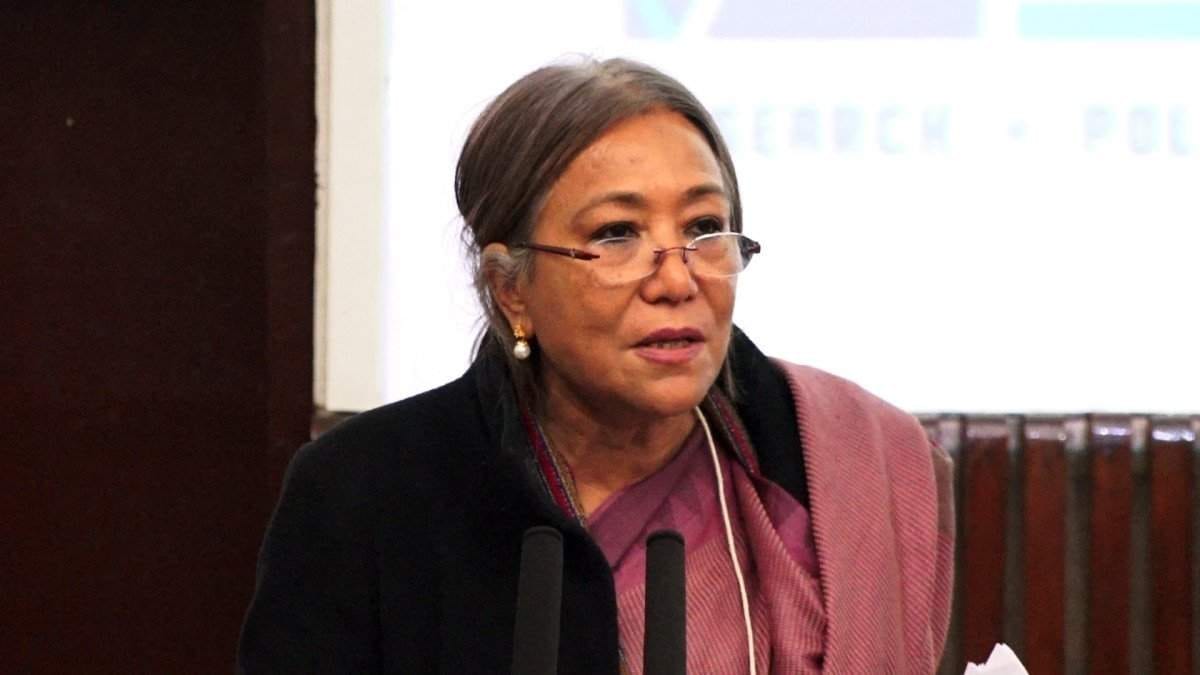
IMAGE VIA RATOPATI
ON MAY 7TH Nepal’s acting chief justice, Sapana Pradhan Malla, watched as the Constitutional Council recommended Justice Manoj Kumar Sharma for the country’s top judicial post. Ranked fourth in seniority, Sharma leapfrogged the acting chief and two senior colleagues. The recommendation, unprecedented in Nepal’s judicial history, broke a seven-decade convention of appointing the senior-most justice to lead the apex court.
The government insisted this was meritocracy. Do not believe it. The decision was made possible by an ordinance the Shah government had pushed through earlier, amending the Constitutional Council Act to allow the six-member council to proceed with just four members and reach decisions with only three, including the prime minister. Critics said it was designed to ensure favourable outcomes. Two council members—National Assembly Chair Narayan Dahal and Opposition Leader Bhishma Raj Angdembe—registered formal notes of dissent against the breach of seniority.
Malla, addressing the 74th National Law Day, did not hide her dismay. “It is an attempt to turn the judiciary into an institution that surrenders and compromises with the executive body,” she said. “It is not important who has been affected, but it is an attempt to control the judiciary through the discretionary power of the government”. Asked about the government’s claim that the nominee had delivered more verdicts, she shot back: “On what basis capability was tested, I do not know. The details about capability are not correct”.
The prime minister defended his choice, arguing that seniority should not be an untouchable rule and that merit, expertise and judicial capability must also be considered. A prime minister with a near-supermajority and an anti-establishment mandate has every right to challenge old conventions.
Yet the worry here is about the precedent: a determined executive able to reset the rules mid-game using a tailor-made ordinance can pick a chief justice who fits its vision. And the selection has raised eyebrows as the Supreme Court moves to curb some of the prime minister’s more controversial decisions, including the dismantling of student unions and the razing of riverbank settlements.
The harshest criticism came from former chief justice and former prime minister Sushila Karki. “Nobody is as capable as Sapana Pradhan Malla. Her qualifications are even stronger than mine. It is a slap in the face of 15m women,” she said. Then, after being addressed as “mother” by a journalist—a term the prime minister had earlier used for her—she snapped. “Don’t call me mother. Call Balen Shah’s wife, your mother”.
That outburst was raw, but it captured the depth of the rupture. Karki was not just angry: she was signalling that a consensus keeper had become a political adversary. When a former chief justice publicly mocks the prime minister in such terms, the judiciary’s internal confidence has cracked already.
The Supreme Court remains the last meaningful check on executive power in Nepal. Parliament has been tamed. The bureaucracy has been reshaped. Civil society shouts but cannot stop. Now the executive has demonstrated that it can circumvent the council and pick its own chief justice.
Malla’s loneliness is no more personal. As acting chief and first in seniority, she has become a symbol of a judiciary under siege. Her dissent will not stop the appointment. But institutions rarely collapse in one blow. They erode when a series of procedural shortcuts meet a public too tired or cynical to notice. The country still has time to notice. The question is will it? ■




