
IMAGE: KATMANDU JOURNAL
FOR A man who has never lost an election, Balendra Shah is oddly scared of being found. On May 13th opposition lawmakers demanded his presence in parliament to debate his own government’s policy programme, as well as his resignation. The man they were summoning sat fifty metres away in his office. He sent his finance minister instead. That is no substitute for showing up. A prime minister who never addresses parliament is scarcely acting like one.
The contempt was mutual. Harka Sampang, a mayor turned MP, accused the prime minister of “evading questions from the public”. Gyanendra Shahi of the Rastriya Prajatantra Party put it more crisply: the prime minister’s first duty is to the people’s representatives. Mr Sampang stormed out, chanting “Nepal has no prime minister.” Hyperbole? Perhaps. But a month and a half into his premiership, Mr Shah has still not addressed parliament once. In a parliamentary system, that is a refusal of accountability.
The crisis began earlier. On May 11th Mr Shah walked out of a joint sitting of parliament while the president was presenting the government’s own policies for the coming fiscal year. Leaders across the spectrum—including the Nepali Congress and the CPN-UML—called the act undignified. One Congress leader asked whether the prime minister was aiming for a Guinness record; no previous premier has walked out on his own government’s policy presentation.
The executive’s disdain for the legislature goes beyond walkouts. On May 3rd the president issued three ordinances, one of which terminated 1,594 politically appointed office-holders across state enterprises, universities and regulatory bodies. The government’s justification—clearing out appointees made before the leadership change—has a surface logic. But the scale is extraordinary, and beyond a few press releases, the government has yet to explain how the new appointments will actually work.
Meanwhile the prime minister’s office has tried to ban student unions and civil-service trade unions through ordinances, only for the Supreme Court to issue interim orders halting both moves. When a government rules through decrees and courts are left trying to hold it back, the separation of powers starts to look meaningless.
The anti-corruption crusade began to rot early. On April 22nd Home Minister Sudan Gurung—a handpicked aide whom Mr Shah had personally chosen—resigned after news reports linked him to business partnerships with a man under investigation for money laundering. Mr Gurung insisted he was stepping down to allow an impartial probe. But his wealth disclosures included shares in two micro-insurance firms alongside figures tied to the same businessman. His departure was the second ministerial setback within weeks; on April 9th the prime minister sacked a labour minister after a disciplinary panel found he had misused his position to keep his wife on a state board. The anti-corruption party is losing its lieutenants to the very vices it promised to eradicate.
Behind the palace drama is an underlying problem. The RSP holds 182 seats in the 275-member House—the largest majority any party has won in more than six decades. That is a mandate for reform. Yet the party is not a coherent political organisation. It is a movement built around a single personality, propelled by generational disillusionment and held together by a brand rather than an ideology. Its parliamentary party is packed with first-time legislators. And its founding mythology—a crusade against corruption—has already been stained by the Gurung affair and by the unresolved legal shadow hanging over Rabi Lamichhane, the RSP’s party president, who faces embezzlement accusations. The party that promised to end special protections for politicians finds itself navigating a legal minefield of its own making.
The business community, which initially gave Mr Shah the benefit of the doubt, watches with unease. His mayoral record in Kathmandu—potholes filled, footpaths cleared—suggested a man who could get things done. His pitch to foreign ambassadors in early April, promising stability and openness to investment, was well received.
Yet a two-thirds majority is not a licence for autocracy. Investors see a prime minister who will not answer questions about his own policy programme; a government that resorts to ordinances even though it has a big mandate; and an inner circle whose institutional memory is measured in weeks. An ordinance can be torn up by the next ordinance. A contract signed under an executive that bypasses the legislature is only as durable as the next election.
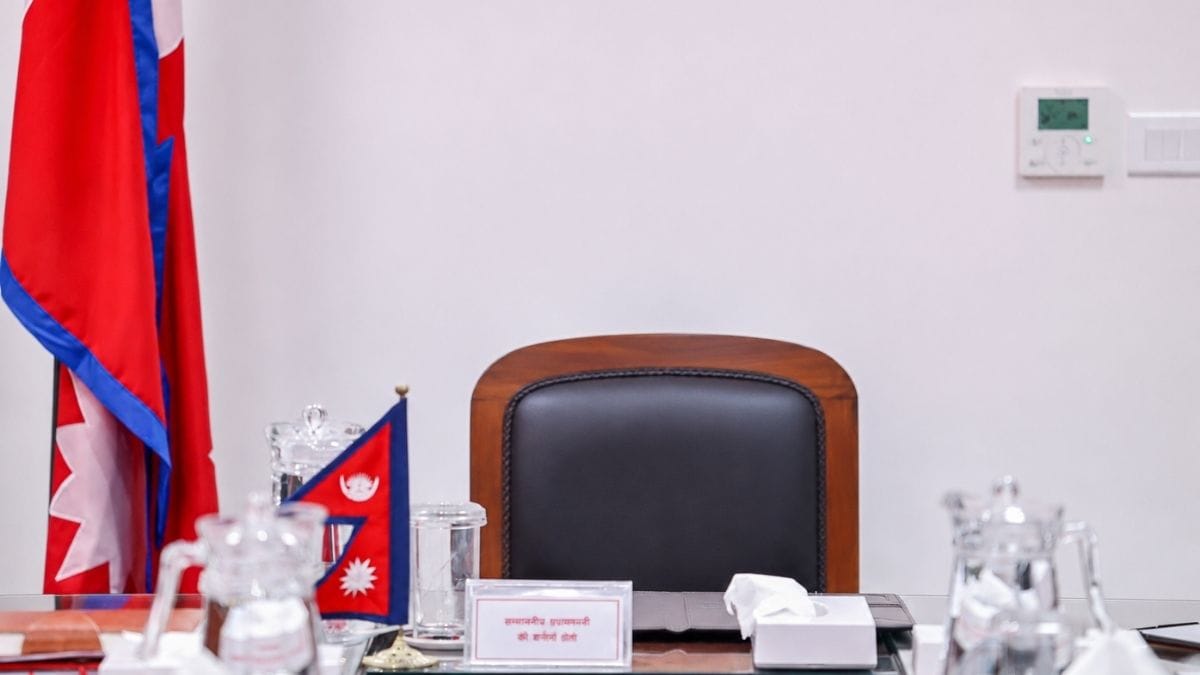
The most troublesome image of the past week is not the walkout or the ordinance or the resignation. It is the photograph of the prime minister’s empty seat in the House of Representatives during the debate on his own government’s plans. The chair is vacant. Nepal’s constitution is clear: the prime minister is the chief executive responsible to parliament. A prime minister who refuses to sit in that chair, who sends a finance minister in his stead, who walks out on the president’s address, is refusing to be prime minister in any meaningful sense.
Balendra Shah is 36. He has time to become the transformative leader his voters believed they were electing. He could still walk the fifty metres, sit in the chair and take the questions. He could still prove that his mandate was for reform, not for rule by decree. The question that now hangs over Nepal’s parliament and its young democracy is the simplest one: does he believe he is accountable to anyone at all? For the moment the empty chair offers no answer. ■




