IMAGE INDIA’S FOREIGN MINISTRY
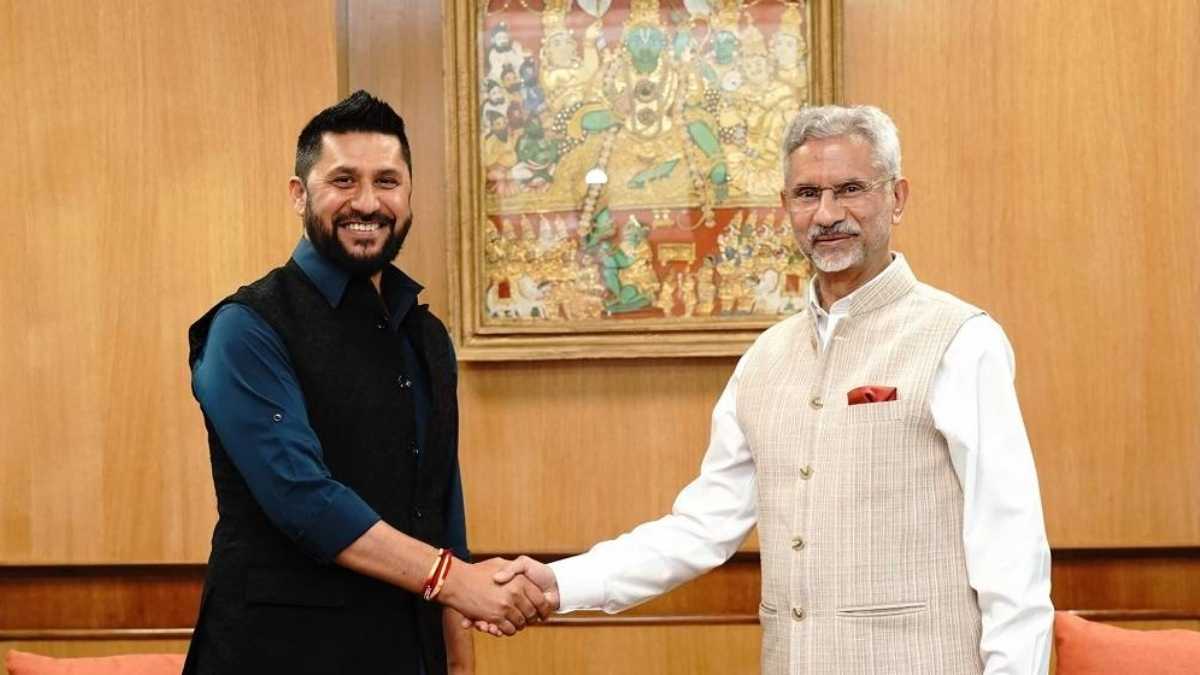
WHEN RABI Lamichhane landed in New Delhi this week, accompanied by his wife, two RSP lawmakers and his personal secretary, the visit had not been announced by either side. Nepal’s foreign ministry had not coordinated it through normal diplomatic channels; a ministry official told the Kathmandu Post that there was “no official communication from the RSP to the Ministry of Foreign Affairs to manage the visit”. Education minister Shailendra Kumar Pokharel, asked about it, said Lamichhane was “travelling in his personal capacity” and that it “has nothing to do with the prime minister”.
This is a remarkable pair of sentences to be said about the five-day visit of the ruling party’s president to Nepal’s most important bilateral partner, in the middle of the worst stretch of Nepal-India relations in several years, at a moment when the Indian Ministry of External Affairs had issued a formal invitation and the meetings on the schedule included India’s external affairs minister, its foreign secretary, its national security adviser, its road transport minister, the president of India’s ruling party, and, on June 3rd, prime minister Narendra Modi himself.
The official characterisation that this visit was a personal trip by a private citizen does not survive contact with any of those meeting formats. What it shows, instead, is the awkward constitutional fiction that surrounds the most consequential diplomatic engagement Nepal has had with India since the March election: a government that cannot officially acknowledge what its own party chairman is doing in New Delhi on its behalf.
The sequence that produced this moment began immediately after the RSP’s landslide victory in March. India extended invitations to both prime minister Balendra (“Balen”) Shah and RSP party president Rabi Lamichhane. Shah, who has imposed a self-imposed moratorium on overseas travel for the foreseeable future—prioritising domestic affairs, as his office has put it—has not gone. India’s foreign secretary Vikram Misri planned a visit to Kathmandu in May; Shah declined to meet him and the trip was postponed. Nepal’s foreign minister Shishir Khanal had planned to visit India in late May; that visit was also put off.
By late Ma, not a single formal interaction had occurred between Nepal’s new government and India’s leadership. Three months after the election of the most commanding Nepali government in a generation, the most important bilateral relationship in the country’s foreign policy remained formally unengaged.
India, faced with this deadlock, adapted. It had a party-to-party relationship to pursue alongside the state-to-state one. The BJP had invited Lamichhane because party-to-party diplomacy with Nepal is an established Indian practice: former Nepali Congress president Sher Bahadur Deuba and former Maoist Centre chairman Pushpa Kamal Dahal had both made similar visits to New Delhi, met BJP leaders and toured the party headquarters on Pandit Deen Dayal Upadhyay Marg. Lamichhane’s visit followed the same template. What it could not follow was the same diplomatic weight: several Indian officials in New Delhi noted, carefully, that a party president’s visit “is not a substitute for the Nepali prime minister’s visit”.
And yet the meetings that materialised by June 2nd were anything but symbolic. External affairs minister S. Jaishankar confirmed the meeting on his own social media account, writing that discussions had focused on “development partnership and people-to-people ties”—the language of substantive bilateral engagement rather than courtesy calls. The meeting with Modi on June 3rd, confirmed by KathmanduPati citing sources at the Nepali Embassy in New Delhi, is the highest-level contact India has had with Nepal’s ruling establishment since the election.
Whether it produces anything concrete—on energy, on the Lipulekh dispute—will take weeks to assess. That it happened at the party-chief level rather than the prime ministerial level is itself the political event.
Two things make this arrangement difficult to sustain. The first is constitutional. Nepal’s prime minister is the head of government and the designated custodian of foreign policy. A party president who meets a foreign prime minister, foreign minister and national security adviser and discusses “bilateral issues” is operating in a space that formally belongs to someone else. The RSP government’s own minister acknowledged that Lamichhane was not there officially. Yet a meeting with Modi, coordinated through India’s Ministry of External Affairs, with Nepali Embassy officials present in all substantive discussions, is official in every meaningful sense. The legal fiction of “personal capacity” puts Nepal’s foreign ministry in the position of managing a diplomatic relationship it was not asked to manage and cannot officially acknowledge.
The second ugly element is what the visit reveals about the RSP’s internal power structure—and what India has concluded from watching it. As established throughout the past two months, Lamichhane controls the RSP’s party organisation, its candidate selection, its disciplinary apparatus and the right-to-recall provision that makes every RSP lawmaker accountable to the party president rather than the prime minister. Shah runs the government; Lamichhane runs the machine that keeps Shah in government. India, which has been reading Nepali politics carefully since the September 2025 revolution, has drawn the obvious conclusion: engaging Lamichhane is not a second-best substitute for engaging Shah. It is a first-best engagement with the person who controls the RSP’s medium-term political decisions, regardless of who holds the prime ministerial title.
That reading may be correct or premature. Shah has shown, in two months of governing, that he makes decisions independently and does not defer publicly to Lamichhane on policy. The ordinances that bypassed parliament were the government’s initiative. The diplomatic stand-offs with India, the US and China over protocol and sovereign issues reflect Shah’s instincts rather than Lamichhane’s. The self-imposed moratorium on foreign travel is Shah’s own decision, not one that a party president can override.
But India is not wrong to notice that a government which has a party president conducting high-level diplomatic meetings while the prime minister declines to travel is a government with a complicated internal architecture. Nihar Nayak, an associate professor at the University of Delhi who was quoted by the Kathmandu Post before the visit, observed that “the visit will enable Rabi to challenge the media’s narrative that bilateral relations are strained”. That is a diplomatic service to the government—shoring up the relationship that Shah’s moratorium has left unattended—performed by someone who holds no government portfolio and answers, formally, to no minister.
Nepal has always found unusual ways to manage its relationship with India. The party-to-party channel, the undeclared visit, the meeting that is simultaneously official and personal: these are familiar instruments in a bilateral relationship too important to be left entirely to formal diplomacy. What is new is that the party president performing this function is operating in a governing context where his own institutional position relative to the prime minister is genuinely ambiguous, and where the visit to New Delhi—whatever it produces—will be read, in Kathmandu as much as in New Delhi, as evidence of where real authority in Nepal’s new government actually lies. That reading may be wrong. But Lamichhane is the one who went. ■