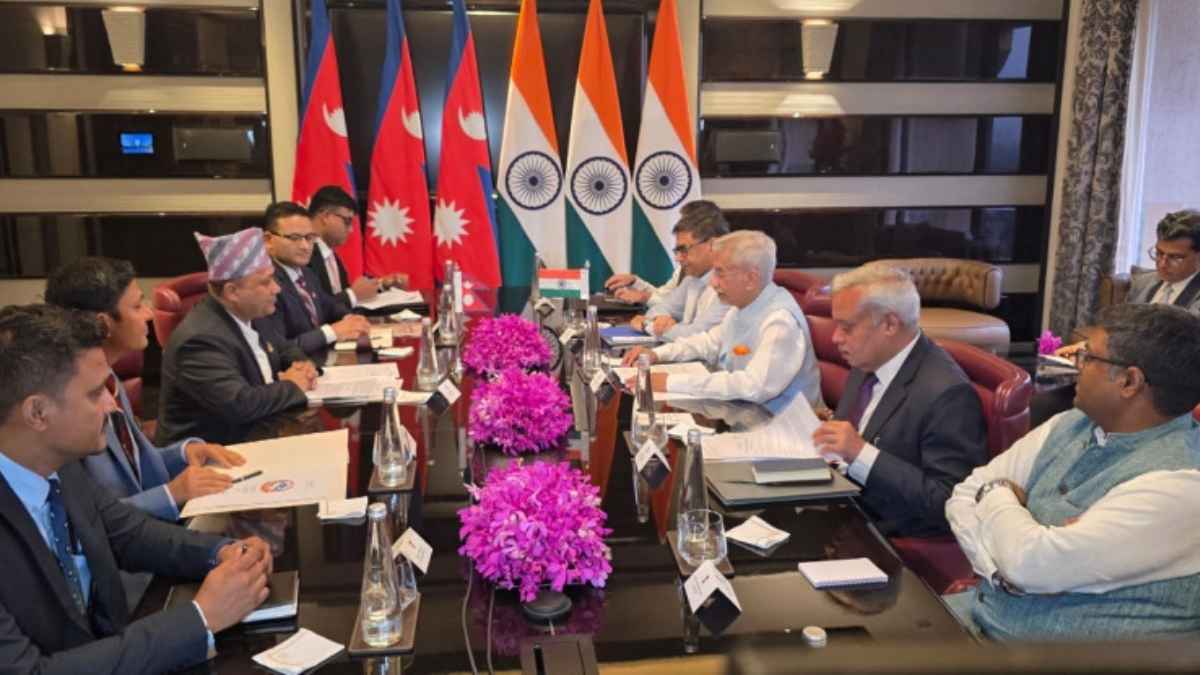
IMAGE: S. JAISHANKAR/X
SHISIR KHANAL’S visit to India from June 5th to 7th was the first official trip by any minister of the Shah government to the country that matters most to Nepal. That fact alone should have made it significant. In practice the visit arrived days after Rabi Lamichhane, the Rastriya Swatantra Party’s president who holds no government portfolio, had already met prime minister Narendra Modi as well as external affairs minister S. Jaishankar.
The sequencing is not Khanal’s fault. It is the product of decisions made by his own government: prime minister Balendra Shah’s self-imposed moratorium on foreign travel, the decision to let Lamichhane’s party-level visit proceed without formal foreign ministry coordination, and, most immediately, Shah’s own words.
Last month the prime minister told parliament that Nepal was “in touch with China and the UK” over the Lipulekh border dispute. India responded days before Khanal arrived, rejecting any third-country involvement and affirming bilateral mechanisms as the only acceptable forum. Khanal flew to New Delhi carrying two jobs at once: the normal work of bilateral diplomacy and the cleanup from his own prime minister’s parliamentary remarks.
The official readout from the Khanal-Jaishankar talks was impeccably bland: development cooperation, connectivity, trade and transit, energy, people-to-people ties. Both sides “expressed happiness over the satisfactory progress on bilateral cooperation”. A new initiative on innovation, startups and digital services was announced. The language was warm. The outcomes were not.
Khanal is, by any reasonable measure, a credible foreign minister for what the job currently requires. He is 47, holds degrees from the University of Wisconsin-Madison, has been a member of parliament since 2022 and speaks fluent English. He has none of the ideological baggage of his predecessors. He is the right person for a relationship-normalisation task. The problem is that by the time he arrived, normalisation had already been attempted at a higher level by someone who holds no government role, and partially complicated by the prime minister himself.
The oddity of Nepal’s current diplomatic situation is evident in the calendar. Lamichhane met Modi on June 3rd. Shah spoke about third-party involvement in the border dispute on May 31st. Khanal met Jaishankar on June 6th to manage the consequences of both. A foreign ministry is supposed to manage state-to-state relations; party-to-party contacts are supposed to supplement that channel, not substitute for it. Nepal’s current arrangement has inverted the relationship, and Khanal’s visit—coming after rather than before the party chairman’s—locked that inversion into the official record.
Modi’s message, delivered through Lamichhane to Shah, was that he had already sent an invitation and was ready to welcome the prime minister in Delhi. That invitation is sitting unanswered while the foreign minister tends the relationship in the capital where the prime minister has been asked to come. The chasm between the formal invitation and the absence of a date is the most precise description of Nepal’s India policy at this moment: engaged enough to send the foreign minister, not yet ready to send the man who matters.
Khanal returned to Kathmandu this week. The relationship had been tended. Nothing had been fixed. That is, in fairness, exactly what a foreign minister can be expected to accomplish when the decision about what to actually fix sits with someone else. ■