IMAGE VIA GOOGLE
SOMEWHERE in Nepal’s Tourism Board offices in Kathmandu, two documents sit in uneasy coexistence. The first outlines the “16th Plan” tourism target: 2.5m international arrivals annually by 2029, roughly double the 1.16m who came in 2025. The second describes the NTB’s new five-year strategy, which explicitly commits to “focusing on high-value tourism” and attracting visitors who spend more per day rather than simply more visitors. The problem with holding both documents at once is that they pull in opposite directions. A country committed to high-value tourism does not need 2.5m arrivals. A country committed to 2.5m arrivals is not going to be selective about who comes. Nepal has not yet decided which it is trying to be.
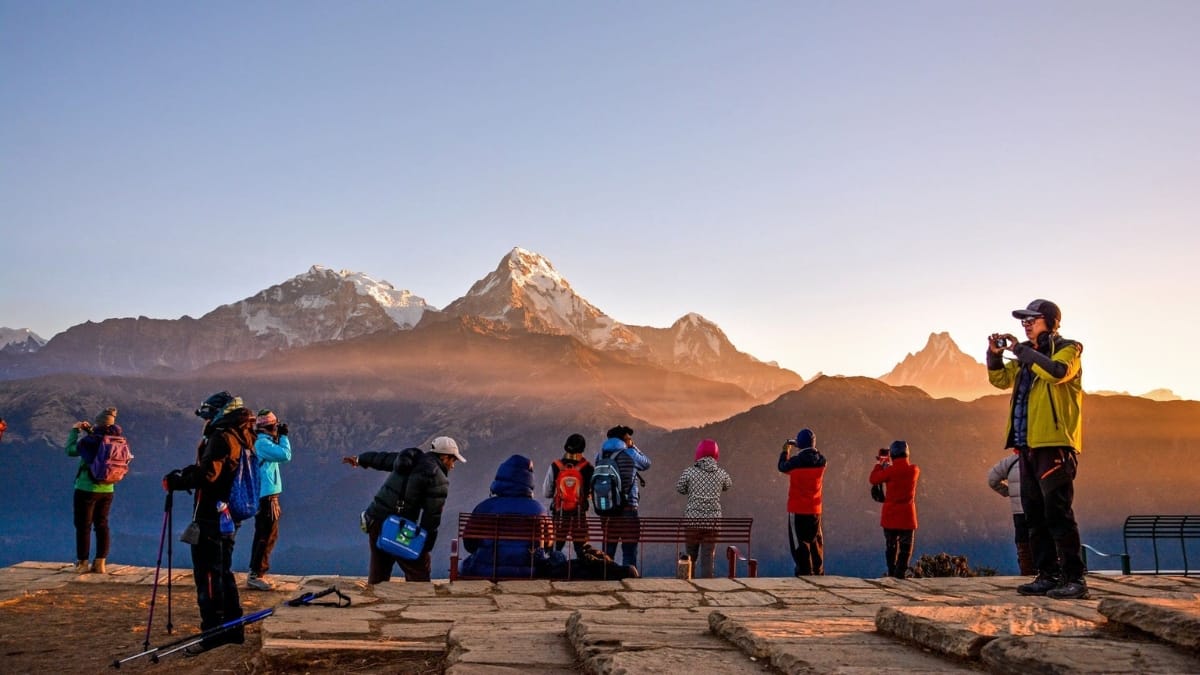
The case for luxury tourism is obvious enough and the country’s assets are breathtaking. Nepal has eight of the world’s fourteen peaks above 8,000 metres, including Everest, which remains the single most aspirational destination in global adventure travel. It has Chitwan, one of South Asia’s finest national parks, with a healthy Bengal tiger population. It has Lumbini, the birthplace of the Buddha, a site of big spiritual significance for hundreds of millions of people who are, by and large, not currently visiting it in numbers proportionate to that significance. It has Kathmandu, one of the densest concentrations of UNESCO-listed heritage sites in the world. These are not budget-destination assets. They are the raw material of a premium tourism offer.
The chasm between what Nepal has and what it extracts from it is evident in one comparison. Bhutan, Nepal’s eastern Himalayan neighbour, imposes a Sustainable Development Fee of $100 a night on most international visitors, ensuring a minimum daily expenditure that forces the market towards higher-spending travellers. Bhutan attracted roughly 145,000 international visitors in 2024, a fraction of Nepal’s numbers, but each of those visitors is spending multiples of what the average Nepal visitor spends. Nepal has no minimum daily expenditure requirement. Its average tourist spending in 2024 was some $44 per day, one of the lowest ratios in Asia for a major destination. The upshot is a tourism economy that generates modest revenue from enormous natural and cultural capital.
The luxury segment is growing, and the industry knows it. Private operators report that helicopter-supported trekking, luxury lodge circuits and high-end spiritual retreat packages are expanding at 20 to 30% a year, with average spending in this segment running three to four times higher than standard trekking itineraries. The NTB itself, at its 27th anniversary event in 2025, announced that the 2026-2035 strategic plan would focus on “highly personalised experiences over standardised formats” and “off-grid destinations over tested ones”. Deepak Raj Joshi, former NTB’s chief executive, put the ambition plainly: the board intends to develop Kanchenjunga, Manaslu and Api-Saipal trekking routes—remote, technically challenging circuits that attract exactly the kind of independent, high-spending traveller Nepal wants—into viable luxury destinations.
Yet the infrastructure is the trouble. Tribhuvan International Airport in Kathmandu, the entry point for most international visitors, operates from a single runway and was designed for a fraction of its current traffic. Pokhara International Airport, built with a $215.96m Chinese loan and opened in 2023, was intended to open Nepal’s second city to direct international flights; as of mid-2026, it handles almost none. Gautam Buddha International Airport in Bhairahawa, the gateway to Lumbini, is similarly underutilised. A high-spending visitor who cannot reach Lumbini from Singapore without transiting Kathmandu twice is not going to return. The spiritual tourism market that the NTB correctly identifies as a major untapped opportunity is, in truth, blocked by the absence of direct international connectivity to the sites of greatest significance.
There is also the question of accommodation. Five-star hotel capacity in Nepal outside Kathmandu is thin. Chitwan has luxury lodges (Tiger Tops, the Barahi Jungle Lodge) but supply is small relative to the potential market. Pokhara has lakeside hotels of charm but not of international luxury standard. A visitor accustomed to Aman resorts or Six Senses properties, the chains that serve the demographic Nepal says it wants, does not have a Nepal itinerary available to them that matches their expectations throughout.
The mountain is there. The assets are extraordinary. What Nepal is still building is the experience around them that turns an extraordinary place into an extraordinary trip. Until it does, the world’s highest peaks will keep attracting backpackers with ten days and a budget, alongside the small number of wealthy climbers who arrive anyway because nothing else on earth offers what Everest does. Ambition and infrastructure need to travel together. ■