
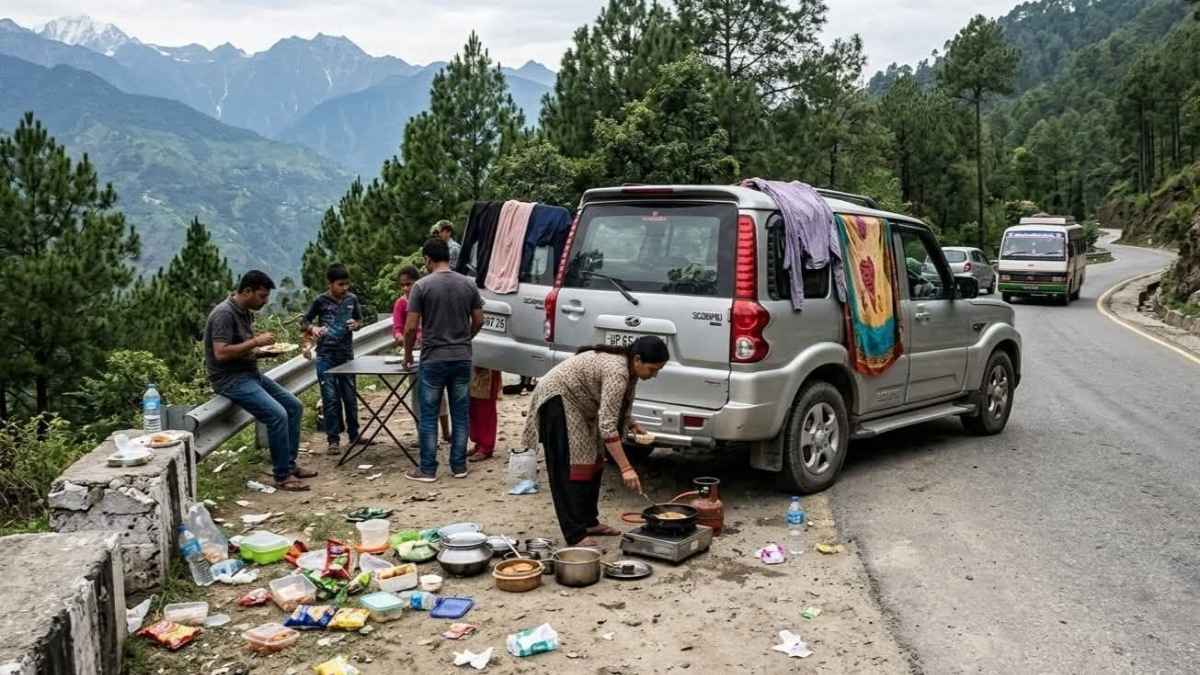
IMAGE: MUGLAAN/FACEBOOK
THE CLIP is a few seconds long. A group of Indian tourists, parked near the entrance to a religious site, are rolling dough, cutting vegetables and heating a pan on a portable stove. They are doing what millions of budget travellers in South Asia commonly do: making their own food, keeping costs down, sustaining themselves through a long journey. In India, this kind of roadside self-sufficiency barely registers. In Nepal, the clip went viral. The comment sections filled with fury. Other videos followed: a tourist drying underwear on the window of a moving car, someone spitting in a public space, litter left in a parking area. By now the hashtags have turned into a national conversation about civic sense, as well as sovereignty and the economics of hospitality.
Nepal’s relationship with Indian tourists is the most important and most complicated in its tourism economy. More than 3m Indian visitors arrived in 2024, roughly four times the number from any other country. Many are pilgrims making their way to Muktinath, Pashupatinath and Lumbini, sites of deep religious significance. They are not luxury travellers. They arrive in private cars and overland buses, often carrying their own food, using their own cooking gas, sleeping in vehicles or in cheap guesthouses when they use any at all. The towns they pass through provide roads, parking, waste collection and sanitation. The money they leave behind, in many cases, does not cover the cost of providing those things.
This is the economic complaint underneath the viral anger. A high-altitude pilgrim town that receives a thousand self-catering bus tourists in a day generates noise, waste, road wear and crowd management costs without generating the hotel revenue, restaurant bills and guided tour fees that would offset them. Municipal budgets in Nepal’s tourist hubs are not built to absorb this. The frustration that erupts on social media every summer is partly about litter and spitting. It is also, more fundamentally, about the feeling that one neighbour’s religious tourism is being subsidised by another’s infrastructure.
The government’s response has been cautious and mostly sensible. The Tourism Ministry issued formal “Do’s and Don’ts” for visitors. The vehicle registration monitoring system (which tracks foreign-registered cars and buses at the border) was misreported by several Indian news outlets, including Zee News, as a ban on Indian tourists. It is not. It is a digital tracking system that has existed in various forms for years and was updated to be more systematic. The corrections were issued. The anger continued anyway, because corrections do not travel as fast as viral clips.
Nepal’s Gen-Z, the generation that was last year protesting in the streets against its own government’s corruption and media ban, has turned part of its civic energy outward. Young Nepalis filming tourists for misbehaving in public spaces are doing something similar to what they were doing in September 2025: demanding accountability from people in public positions. The target has changed. The instinct is the same. The camera is a tool of civic enforcement now, applied to foreign visitors the way it was applied to politicians.
The bilateral risk is real and most Nepali commentators are aware of it. Roughly 3.5m Nepalis live and work in India, many of them in conditions of precariousness and dependence on Indian goodwill. A social media war over tourist behaviour, if it tips from civic complaint into generalised hostility, creates risk for those workers that the people filming the videos will never personally face. The internet does not make these distinctions. Zee News certainly did not.
What the moment reveals, more than anything, is that Nepal’s tourism model has not kept pace with its tourism numbers. A country that welcomed more than a million visitors from its northern neighbour in 2024 and several times that from the south has still not built the pricing, the infrastructure or the social compact that would make large-scale mass tourism manageable. The viral videos are the symptom. The question they are really asking is what kind of tourism Nepal wants—and what it is prepared to invest in to get it. ■




