
IMAGE VIA NEPAL VIEWS/FACEBOOK/KATMANDU JOURNAL
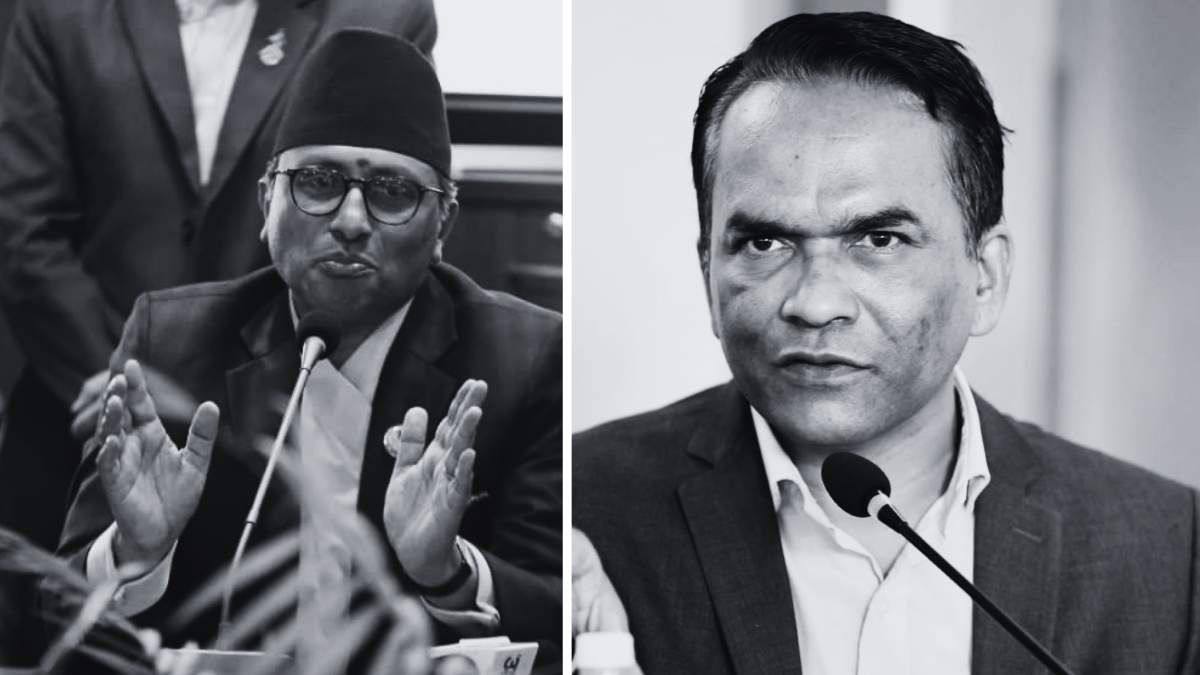
HERE IS A scene from February that, in a more transparent country, might have made headlines. An IMF team led by Sarwat Jahan visited Kathmandu for two weeks and met Finance Minister Swarnim Wagle; National Planning Commission Vice-Chair Prakash Kumar Shrestha; and Nepal Rastra Bank (NRB) Governor Biswo Nath Poudel. The IMF described the talks, in its typically diplomatic language, as “open and constructive”. The actual result was a list of things Nepal still hadn’t done. Chief among them: the government had still not submitted amendments to the Nepal Rastra Bank Act to parliament, a reform the IMF had flagged as critical under Nepal’s Extended Credit Facility programme—a condition that has been outstanding since at least the 2021 Safeguards Assessment. Five months later, as of July 1st, those amendments still haven’t been submitted. The finance ministry controls the legislation. The central bank needs it. The two institutions are waiting on each other to act first.
That small standoff is a microcosm of a bigger problem. Nepal’s central bank and its finance ministry are not running two sides of the same economic strategy. They are running adjacent strategies that share a few numbers but diverge sharply in their underlying logic—and that mismatch is now, in a slow-motion way, costing the economy.
Start with what each institution actually thinks it’s doing. The NRB’s monetary policy for the current fiscal year was described, on launch, as “cautiously accommodative”. By most measures the NRB has genuinely loosened: it cut its policy rate to 4.25% in the first half of the year, adjusted the interest rate corridor and introduced targeted relief for sectors still bruised by the September 2025 unrest. Inflation, which had been above 5% two years ago, fell to a low of 1.7% in the first half of the fiscal year before recovering slightly on higher fuel prices. Foreign exchange reserves sit at some $24bn. By the central bank’s own mandate (price stability, financial stability, external sector management) things look essentially fine.
Drive 12 minutes from Baluwatar to Singha Durbar, however, and the reading changes completely. Wagle’s budget, presented on May 29th, targets 7% growth and involves net domestic borrowing of around Rs164bn on top of Rs247bn in external loans. It projects revenue collection of Rs1.4trn, an increase of roughly 25% on what the government actually collected this year. It promises AI computing centres, a Sovereign wealth fund seeded from foreign exchange reserves and a transformation of the Nepali economy within a single fiscal year. The two institutions are technically working in the same country. They are not working towards the same outcome within the same timeframe.
The problem isn’t mainly that the NRB and the finance ministry disagree in theory. It’s that the one lever the NRB controls—the price of money—has stopped transmitting into the economy in the way the textbook says it should. The credit-to-deposit ratio across commercial banks sits at below 75% against a regulatory ceiling of 90%. Banks are swimming in deposits. Lending rates have crashed. And yet, as the World Bank put it in its April update, private credit expansion “remained subdued, reflecting weak domestic demand”. Businesses aren’t borrowing because they don’t trust the environment, not because they can’t afford the rate. That’s a confidence problem, not an interest rate problem—and it’s one monetary policy has limited tools to fix.
Meanwhile the government’s own large domestic borrowing programme competes, at the margin, with private credit for the same pool of bank funds. A government issuing Rs410bn in domestic debt gives banks a safe, liquid, government-backed place to park money rather than extending it to riskier private borrowers. The NRB, which manages this borrowing schedule, can see the crowding-out risk clearly. The finance ministry, which set the borrowing target to fill a Rs657bn budget gap, had limited alternatives.
There is also a political dimension laying behind the institutional one. Governor Poudel was appointed only after a 44-day standoff in which the then-ruling Nepali Congress and CPN-UML spent six weeks arguing over whose candidate should get the job: a delay that exceeded the legal appointment timeline. Poudel is a Nepali Congress nominee. The RSP government that Wagle serves came to power explicitly rejecting the political culture that produced that appointment process. Neither man has publicly acknowledged any tension. Tensions between elected governments and central bankers are a universal feature of economic governance. What makes Nepal’s version unusual is that the governor’s position itself was filled through the kind of coalition horse-trading the current government was elected to end.
The IMF, characteristically, sees both sides and wants both to move simultaneously: “Further efforts to mobilize domestic revenues would support development spending, while efforts to boost public investment and improve spending efficiency would enhance medium-term growth.” In practice its own forecast puts growth at 4.6% for fiscal year 2026-27, barely two-thirds of Wagle’s 7 % target. Nobody at the IMF expects the finance ministry and the central bank to converge on that difference this year. The question is whether the difference widens before it closes.
The NRB Act amendments would be a start. They’re not glamorous—they cover governance safeguards, board composition rules and the bank resolution framework—but submitting them would signal that the government and the central bank are actually coordinating, not just occupying adjacent offices in the same capital city. Right now, the most reliable evidence of that coordination is an IMF communiqué saying it still hasn’t happened. ■





