IMAGE VIA GOOGLE
HERE IS ONE way to read Nepal’s new draft traffic law, currently working its way through the Ministry of Law before heading to Cabinet and parliament: it is an earnest attempt to reduce the country’s catastrophic road death rate, which at 28.2 fatalities per 100,000 people is among the worst in the region, by making violation expensive enough to hurt. Here is another: a government that cannot pave its roads, fix its traffic lights or issue driving licences on time has decided to charge citizens up to Rs100,000—nearly six months’ wages for the average Nepali worker—for driving on them improperly.
The numbers proposed in the bill are extraordinary in context. Running a red light would cost between Rs3,000 and Rs5,000. Tinted glass beyond the permitted standard draws a fine of up to Rs100,000. Drink-driving ranges from Rs25,000 for a motorcyclist to Rs50,000 for a truck driver. Speeding triggers fines between Rs25,000 and Rs50,000. Driving significantly too slowly earns a fine of Rs3,000 to Rs5,000. These figures are being proposed for a country where a typical monthly salary runs between Rs20,000 and Rs30,000, and where a big share of Nepali motorcyclists are riding second-hand bikes worth Rs30,000 to Rs50,000, bought on credit. A single drunk-driving fine for a motorcyclist would consume an entire month’s salary. A tinted-glass fine, for what is in some countries a minor infraction, could wipe out six.
The government’s case for the draft is not entirely without merit. Nepal’s existing traffic fines, set by a law from 1993, have not kept pace with inflation or with the scale of the problem. Road accidents killed 2,649 people in the last financial year. Drink-driving and overloaded trucks are real killers, and the draft rightly treats them as such. The Good Samaritan provision—giving full legal protection to bystanders who help accident victims without fear of police trouble—is progressive, the sort of reform that saves lives at no cost and that should have been law years ago.
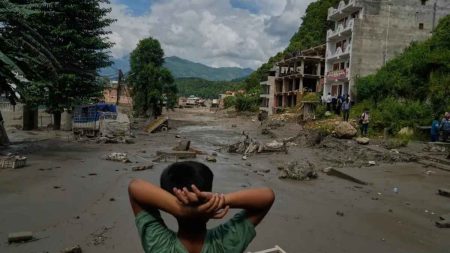
But the bill’s critics are asking a question the government has not answered: what, exactly, is the citizen being fined for violating? In Kathmandu, traffic lights malfunction commonly and nobody fixes them. Footpaths that exist on a city plan exist only on that plan in many neighbourhoods, pushing pedestrians into the road. Potholes are so endemic that the Nepali Supreme Court has ordered roads to be repaired within 24 hours of a complaint, an order that has been largely ignored. Driving licences take so long to process that applicants tend to give up and drive without them.
Former Deputy Inspector General Keshab Adhikari put the problem this way: “First build the infrastructure, provide the facilities, spread awareness, and install proper traffic furniture. Otherwise, a Rs 50,000 fine provision will only create severe hassles for the traffic police.” Even with the current Rs1,000 fines, he noted, drivers regularly argue with officers or flee checkpoints. Multiply the stakes fifteenfold and you multiply that problem, rather than solve it.
Lawmaker Gyan Bahadur Shahi made the sharpest point in parliament. If citizens face Rs100,000 for violations, he asked, should the state face Rs100,000 for a pothole unrepaired after 24 hours? Should a broken traffic light cost the relevant authority a fine? Should a delayed licence attract a penalty against the office responsible?
“Laws must apply equally to both the state and the people,” Shahi said, “otherwise they risk becoming tools that punish citizens while ignoring institutional failure.” He is right. A law that punishes the citizen for navigating a broken system while leaving that system unaccountable is not a road safety law. It is a revenue mechanism with safety branding.
Singapore’s fines are higher than what Nepal is proposing, and Singapore’s roads are impeccable. India has comparable fines at the top end, introduced in 2019 after years of investment in road marking, signage and enforcement technology. The comparison that actually fits Nepal’s current infrastructure level is not Singapore. It is roughly where India was in 2015: high ambition, poor roads, enforcement capacity that varies between districts and individual officers, and a penalty structure that, in truth, mainly creates negotiating leverage for traffic police.
That last sentence is the real concern. A spot fine of Rs50,000, payable digitally through the Nagarik App in theory, but collectible in cash by an Assistant Sub-Inspector on a dusty roadside in practice, is not obviously a corruption-reduction measure. It is a dramatically improved price list for exactly the kind of encounter Balendra Shah, the prime minister, says he wants to eliminate. Fine the infrastructure first. ■