
IMAGE: AP
THE ARITHMETIC is rarely presented like this, so it is worth doing once. Nepal spends approximately twelve years educating a child through primary and secondary school; subsidizes healthcare through childhood and adolescence; and maintains the roads, markets and social infrastructure that keeps rural families alive long enough to produce a working-age adult. At roughly 18 to 25 years old, that person boards a flight to Doha, Dubai or Kuala Lumpur. For the next decade, their most productive working years flow into a foreign economy. Qatar gets a construction worker who helps build a highway. The UAE gets a security guard who stands outside a shopping mall. Malaysia gets a factory operative. Nepal gets a remittance cheque, which goes to the family, not to the treasury that paid for the education and healthcare that made the worker exportable in the first place.
This is what economists who study migration call the human capital subsidy: the transfer of development costs from the receiving country to the sending country, mediated by individual workers who never asked to bear it. Nepal’s case is among the most extreme versions of this dynamic anywhere in the world. Remittances account for 28.2% of GDP, one of the highest ratios the world over. The foreign exchange reserves built on those inflows now stand at some $24bn. These numbers are cited regularly as evidence of how successfully Nepal’s migration economy works. They are also evidence of how thoroughly Nepal has been integrated into a model in which it bears the developmental costs and wealthy destination states collect the productive output.
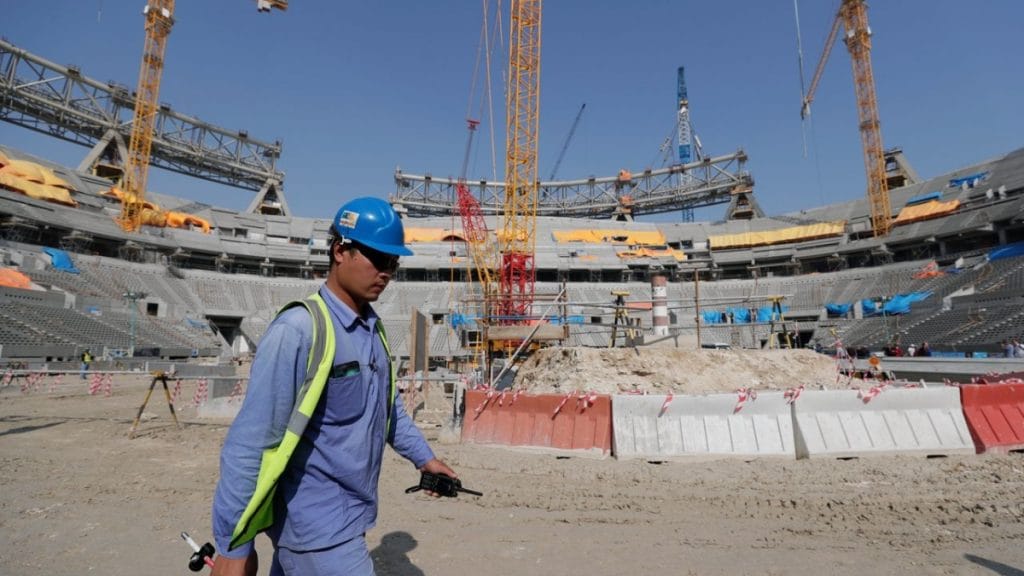
The Gulf version of this is the most documented. When Qatar built the stadiums, highways and metro lines for the 2022 World Cup, it did so with labour drawn overwhelmingly from Nepal, India, Sri Lanka and Bangladesh. The Guardian’s count of migrant worker deaths in Qatar in the decade preceding the tournament reached 6,750. Many of those workers were Nepali. Nepal educated them, their families raised them and their bodies now lie in foreign soil or were returned in coffins. Qatar paid FIFA hosting fees. It did not pay Nepal a shekel towards the human development costs of the workforce whose health and literacy made them available to hire. The sponsorship agreements and infrastructure contracts that made Qatar famous are built, in part, on a subsidy that flows from some of the world’s poorest families to one of its wealthiest states.
The mechanism works at every skill level. Nepali nurses trained in government colleges, whose education was partially publicly funded, leave for Australia and the United Kingdom under healthcare worker visa schemes that those countries introduced specifically because they had underinvested in their own domestic health workforces.
The UK’s National Health Service employs thousands of South Asian healthcare workers. The British taxpayer did not pay to train most of them. The Nepali taxpayer, in a partial and inefficient way, did. Australia’s construction sector employs Nepali engineers whose degrees came from Kathmandu colleges that subsidise tuition. The ADB’s own research on human capital mobility in South Asia has documented this dynamic without being able to do much about it: bilateral labour agreements commonly address wage floors and recruitment standards but say nothing about compensating origin countries for pre-departure developmental investment.
Nepal’s recruitment industry piles up another extraction before the worker even boards the plane. Manpower agencies charge between Rs100,000 and Rs300,000 in fees before a worker can access a foreign job.
Many workers borrow from informal lenders at usurious rates to pay these fees. They then arrive in the destination country pre-indebted, which depresses the wages they are willing to accept because a worker who needs to repay a loan at 24% annual interest cannot afford to hold out for better terms. The destination country gets discounted labour twice over: once because the origin country pre-financed the human capital, and again because the recruitment industry’s debt structure means the workers arrive desperate enough to take whatever is on offer.
None of this is addressed by Nepal’s current policy framework. The Social Security Fund requires employers to contribute 20% of salary for workers employed in Nepal, a much-needed protection for domestic workers. For the 3.5 m or soNepalis working abroad, there is no equivalent way of requiring foreign employers to contribute to Nepali social security. There is no bilateral agreement with Qatar, the UAE, Malaysia or Saudi Arabia that requires even a token payment towards the educational infrastructure that produced the workers those countries import. Nepal has asked. The receiving countries have not agreed. The 450,000 young people who entered Nepal’s labour market this year, most of whom will not find work here, will carry the subsidy forward into the next decade. The receiving countries are already preparing visa categories to receive them. ■





