
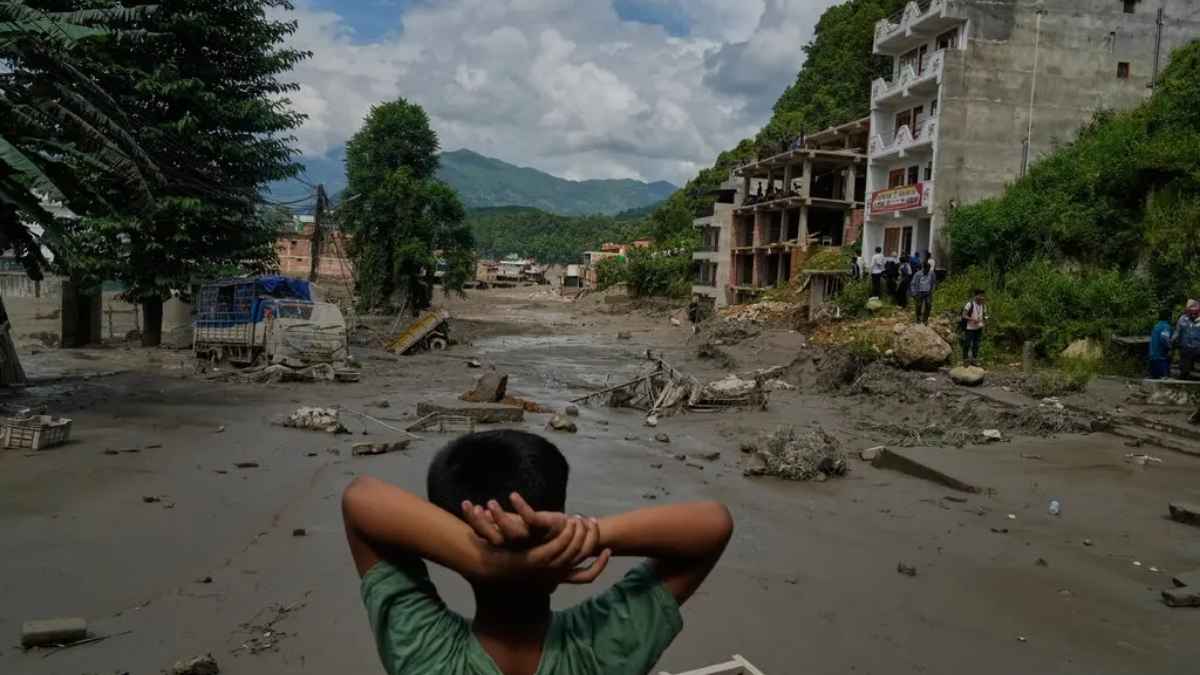
IMAGE ASSOCIATED PRESS
ON AUGUST 26TH a cascade of rock, ice and water tore through Nepal’s Bhote Koshi and Trisuli river valleys. Homes vanished. Roads and bridges got smashed to rubble. Hydropower plants were wrecked. By October 3rd, 1,455 bodies had been recovered and more than 5,200 people remained missing. The government reckons recovery and reconstruction will cost at least $4.7bn.
On October 22nd the United Nations’ Fund for Responding to Loss and Damage provisionally set aside $21.6m for Nepal’s recovery. Of that sum, $20m is earmarked for potential support with $1.6m covering oversight costs. Nepal must still submit a funding request for approval before the money gets released. The headline figure sounds substantial until it meets the bill. The $20m allocation amounts to roughly 0.4% of estimated recovery needs. That is a sick joke dressed up as solidarity.
This is the ugly maths of climate finance. Rich countries have spent decades acknowledging that poorer countries face severe consequences from a warming planet they contributed relatively little to heating. They have promised assistance, negotiated new funds and celebrated diplomatic breakthroughs. When a catastrophe arrives, the money available is measured in millions while the damage is counted in billions.
Nepal’s case makes the chasm especially difficult to excuse. The government estimates the disaster caused $2.69bn in economic losses and physical damage, before the full cost of recovery and reconstruction. Roads must be rebuilt, electricity infrastructure repaired and communities given the means to return to work. Every month of delay adds hardship for families and can hold back economic activity across entire districts.
The fund’s decision is still a milestone. Created after years of pressure from vulnerable countries, the loss-and-damage fund was meant to help pay for climate-related harm that adaptation and disaster preparation can never prevent. Nepal’s allocation is its first funding decision. The board has also agreed to explore a faster route for urgent requests, an admission that conventional funding procedures crawl at a glacial pace when people need help at once.
Yet the fund itself is painfully small. Countries have pledged more than $820m, while developing nations have submitted requests totalling about $2.8bn. Demand already tops the money pledged by more than three times. Nepal’s disaster is therefore a test of a system whose resources were inadequate before the next emergency arrived.
The political problem is bigger than one cheque. Climate finance has long been tangled in arguments over responsibility, liability and the public finances of wealthy countries. Governments fear that accepting legal liability for historic emissions could expose them to claims far beyond their current commitments. Vulnerable countries argue that voluntary contributions can never match the scale of the damage. The upshot is a system in which the moral case for assistance is widely acknowledged while the financial response remains discretionary and limited.
There is a further injustice in the form of the money. Loans can finance reconstruction, but they leave disaster-hit countries with another bill. Nepal needs grants for losses that have destroyed homes, livelihoods and public infrastructure. Borrowing to rebuild can make sense for productive projects: yet loading fresh debt onto a country after a catastrophe risks forcing its citizens to pay for damage they had little power to prevent.
Nepal also has work to do at home. Reconstruction must reach affected households fast. procurement must be transparent. And new infrastructure must be designed for the risks ahead. Better early-warning systems as well as hazard monitoring and coordination across borders can reduce future losses. International finance can never substitute for a competent government. Equally, good government can never conjure billions of dollars from a budget already stretched by competing needs.
The wider lesson is grim. Nepal’s recovery will depend on domestic spending, international donors, development banks and neighbouring countries, rather than the loss-and-damage fund alone. The government has reported receiving around $102m in domestic and international assistance by the end of September, still a small sum beside the reconstruction bill. The country will have to find the rest while protecting ordinary public services and supporting people whose homes and livelihoods have disappeared.
Rich countries have every reason to help vulnerable nations recover: humanitarian duty, diplomatic credibility and a shared interest in limiting the damage of a warming world. The loss-and-damage fund was supposed to turn those arguments into practical support. Its first decision has opened a door, but the amount behind it is a fraction of what Nepal needs.
A $20m promise can help people in urgent need. It can never rebuild a country’s damaged infrastructure. If climate finance is to mean anything beyond conference speeches, wealthy governments must put far more money into the funds they have created and favour grants over fresh debt. Nepal’s disaster has exposed the price of delay. The world’s response has exposed the price of its own cowardice. ■




