
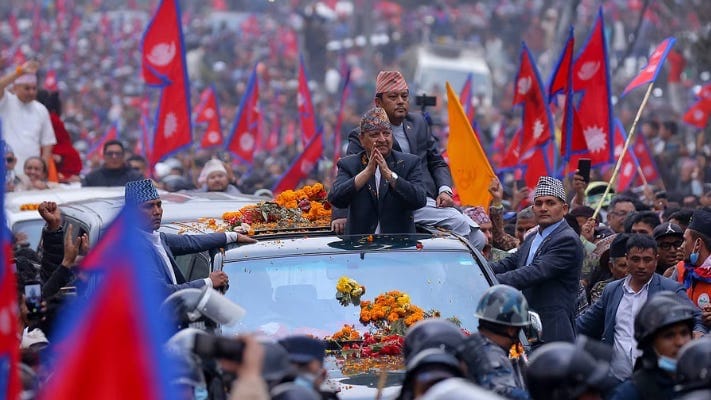
Nostalgia is no longer just a mood in Nepal. It is becoming a movement. On May 29th the Rastriya Prajatantra Party (RPP), a royalist party that blends saffron and scepticism, staged protests in Kathmandu calling for the restoration of the Hindu monarchy. Its leaders, invoking the spirit of Gandhi’s Satyagraha, profess peaceful intentions. But their political ambition is far from quaint: to upend the country’s secular republic and revive a dynasty thought dead and buried.
That this is no fringe spectacle should give democrats pause. In 2008 after ten years of Maoist rebellion and the ignominious fall of a monarchy tarnished by massacre and malaise, Nepal became a federal secular republic. It was a remarkable, if chaotic, leap into modernity. Now less than two decades later, some Nepalis are questioning whether the leap was worth it. As public disillusionment with democratic politics deepens, the old crown begins to gleam again: less from the shine of legitimacy than the dimming of alternatives.
Support for the monarchy is not driven by reverence for kingship so much as resentment toward politicians. With slow economic growth and political parties caught in an endless game of musical chairs, many voters are seeking stability—even of the ornamental kind. For some Sanatan Dharma, the traditional order of Hindu life, provides both moral certainties and an institutional anchor. Monarchists have seized upon this mood, arguing kings may have been flawed but they were at least not for sale.
Among those leading the charge is Kamal Thapa, a veteran royalist who served in Nepal’s post-2006 governments. He has floated the idea of reinstating the monarchy under Hridayendra Shah, the teenage heir to the deposed Gyanendra. It is not clear whether the prince himself has any political appetite—or indeed political thought—but for his supporters, symbolism suffices. Ideology, Mr Thapa argues, matters more than inheritance. Yet in practice it is precisely the lure of dynastic continuity that makes monarchy such a potent cipher: it allows citizens to project order without demanding delivery.
This royal revival is not confined to the margins. Within the Nepali Congress (NC), the country’s oldest and largest democratic party, a fierce debate is under way. Some leaders, like Minendra Rijal and Prakash Sharan Mahat, argue secularism was imposed under Maoist pressure and has no roots in Nepal’s civilisational history. Others such as Shekhar Koirala and Shashank Koirala have gone further: openly flirting with the idea of a Hindu state. Even the party’s internal think-tanks have advised “strategic flexibility” on the matter. The leadership, embodied by the ageing Sher Bahadur Deuba, remains characteristically indecisive.
Nor are the communists entirely immune. Pradeep Gyawali, a senior figure in the CPN-UML, admits secularism is misunderstood as state-sanctioned atheism or encouragement of Christian conversion: issues that foreign-funded missionaries have unwittingly inflamed. KP Sharma Oli, the party’s prime minister, is no stranger to temple theatrics. His claim Lord Ram was born in Nepal, not India, was as much a jab at Delhi as a genuflection to domestic sentiment. Even so, the party has not made religion part of its formal agenda, and Gyawali insists there is no plan to amend the constitution.
The Maoists, for their part, are adamant. Secularism, they say, is a red line. To them the return of a Hindu state—or worse, monarchy—is not only a reversal but a betrayal. Yet their own relevance has waned, and few voters still see them as revolutionary.
Public opinion is harder to pin down. In a country where religion suffuses daily life but institutional trust is eroding, the lines between faith, frustration and political identity are increasingly blurred. D.P. Aryal of the Rastriya Swatantra Party, a rising force of self-styled reformers, argues the state’s failure lies in its inability to govern competently. “God is not the problem,” says one observer, “but governance is.”
The mood is not unique to Nepal. Across the border in India, the rise of the Bharatiya Janata Party has turned secularism into a dirty word and majoritarianism into a winning strategy. In both countries, democracy has delivered not utopia but underperformance (corruption, inefficiency, ideological drift). Into this vacuum, religious nationalism has crept, wearing the guise of cultural authenticity and moral restoration. Nepal’s royalists have taken note.
Still, it would be premature to proclaim the king’s return. The monarchy may be gaining followers, but it has no roadmap. Nor does it provide a convincing answer to domestic pressing problems: youth unemployment, geopolitical balancing between China and India or the looming debt burdens of infrastructure dreams. At best, it offers a hazy idea of moral order. At worst, it is a form of escapism, a backward glance masquerading as a political programme.
The irony is sharp. Nepal’s 21st-century republic was born in blood; negotiated through civil war; and designed to modernise a feudal society. That it now faces calls for divine kingship says less about the appeal of monarchy than the failures of those who replaced it. If Hridayendra ever dons a crown, it will not be a sign of renewal but of resignation.
The gods, as ever in Nepal, are watching. But it is mortal politicians who must decide whether the republic’s future lies forward—or in retreat. ■




