Image: Getty Images
In Nepal the path to political stardom has ceased to wind through party headquarters or newspaper columns. It cuts straight through a ring light. The fastest route to national relevance is not to write a white paper but to lip-sync one’s indignation to trending audio. The new mantra of civic engagement is less Cogito ergo sum than I trend, therefore I am.
Like many young democracies, Nepal’s public sphere has always been fragile, shaped by turbulent politics, a fragmented media and people more focused on daily survival than on politics. Yet it had, at times, functioned. From the referendum of 1980 to the people’s movement of 2006 and the federal debates that followed, Nepalis once argued with vigour about monarchy, Maoism, constitutionalism. What passes for debate today is a one-minute clip, optimised for rage, scrollable on a smartphone and sponsored by the algorithm.
The rise of TikTok as Nepal’s primary civic arena is less a disruption than a dethroning. It has displaced not only platforms but principles: reason with reaction; argument with affect; and truth with traction.
Scroll and fury
TikTok’s growth in Nepal is stunning. With more than 2.2m active users in a population of 30m, its reach dwarfs that of any newspaper or television channel. Among urban youth—who constitute more than half of the app’s user base—it is plausible that many rely on it as their primary source of political information. In this new ecosystem, virality functions as validation. If it resonates, it must be right.
That would be harmless if TikTok confined itself to dance routines and recipes. But in Nepal it has become the primary platform for politics. From federalism to foreign aid, caste violence to constitutional tweaks, every issue is now subject to algorithmic arbitration. The more performative the opinion, the more persuasive it seems.
Gone is the era when serious thinkers shaped public discourse. The likes of Devendra Raj Panday, Krishna Khanal or Kanak Mani Dixit commanded respect through slow, deliberative engagement like columns, lectures, roundtables. Today’s intellectual heavyweights are often shirtless, occasionally misinformed—and almost always trending.
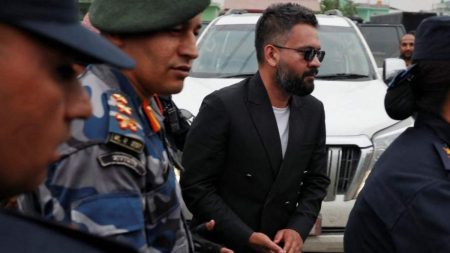
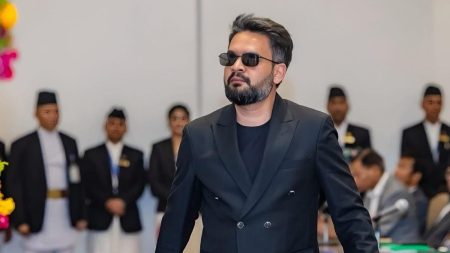
Rabi Lamichhane may be the purest avatar of this transformation. His metamorphosis from media personality to parliamentarian was less a campaign than a content strategy. His political ascent—emotive, dramatic, televisual—was born not of manifestos but of moments. TikTok did not merely amplify his message: it authored it.
Lamichhane’s success has spawned imitators: self-styled “analysts” with ring lights and ring tones, preaching geopolitics one minute, gender theory the next. Their credentials are irrelevant; their cadence, everything. Credibility, once earned over years of study and public service, is now issued by the algorithm and revoked just as quickly.
The incentives are clear: complexity confuses, outrage attracts. A poorly sourced rant on American imperialism garners more traction than a constitutional explainer from the Supreme Court Bar Association. In this attention economy, misinformation isn’t a bug, it’s a feature.
The country is no stranger to shallow institutions. But the digitisation of discourse has deepened the problem. A democracy cannot thrive if its deliberative spaces are captured by spectacles. TikTok encourages reaction not reflection. It prizes immediacy over insight. And it privileges aesthetics over accuracy.
The shift is visible in policy debates—or the lack thereof. The 2024 election cycle featured more clips than commitments. Parties scrambled to adapt, turning manifestos into montages. Some candidates hired social media “strategists” whose job was to manufacture moments of virality. One party’s education policy was distilled into a 15-second video featuring a dancing goat.
The consequences are not merely cosmetic. When public opinion is shaped by the most watchable, not the most reliable, populism thrives. Fringe ideologies gain traction. Conspiracies—about foreign takeovers, caste conspiracies or UN plots—spread unchecked. By the time fact-checkers catch up, the damage is done.
Algorithmic populism
TikTok is not the cause of the country’s democratic dysfunction, but it is its most effective enabler. The platform thrives on division, accelerates polarisation and turns politics into personalised arena. It invites users to become performers and partisans.
Some argue this is democratising. After all, marginalised voices—Dalits, women, queer activists—have found platforms they were long denied. That is true. But amplification without accountability is a double-edged sword. Many of these voices are drowned out by influencers who mistake conviction for comprehension.
A worrying by-product is the rise of the “pop-intellectual”: charismatic, unvetted and unburdened by evidence. These figures do not only fill the vacuum left by retreating journalists and academics, they profit from it. Some have parlayed online clout into lucrative speaking gigs, political appointments, even ambassadorships. In such a climate, truth becomes a casualty.
Perhaps the most damning indictment of TikTok politics is not what it says but what it silences. Serious thinking, doubt, humility, these do not trend. The slow, necessary work of democratic deliberation is crowded out by digital mobs. Hashtags replace ideas. Dissenters are not debated but doxxed.
This has bled into offline life. Students increasingly cite TikTok videos in university assignments. Teachers complain of declining attention spans. Politicians tailor their rhetoric to social media virality, discarding coherence in the process. Even local elections are influenced by candidates’ TikTok presence—an aptitude for editing now more valuable than a history of service.
Yet it would be facile to dismiss TikTok as the villain. The platform is only as good—or as dangerous—as the incentives we design around it. What is needed is not nostalgia for a more “serious” past, but a strategy for a more responsible future.
The country needs a civic literacy reboot. Media studies must enter school curricula, not as electives but as core subjects. Fact-checking institutions must be better funded—and better publicised. And platforms like TikTok must be pressured, through policy or public pressure, to elevate credible voices, not only clickable ones.
Some signs are encouraging. University groups are experimenting with fact-based TikTok explainers. NGOs are translating legal and economic ideas into bite-sized, accurate content. A few politicians now preface their speeches with references to source material, an act of resistance in an age of spectacle.
TikTok will not kill Nepal’s democracy. But if left unchallenged, it may mutate it beyond recognition. The task ahead is not to log off but to log on more wisely. Democracy has always required more than elections. It needs debate, discernment and doubt. The algorithm may be indifferent to these virtues. But a public that values its own future need not be. ■