Born to be wild Image: Getty Images
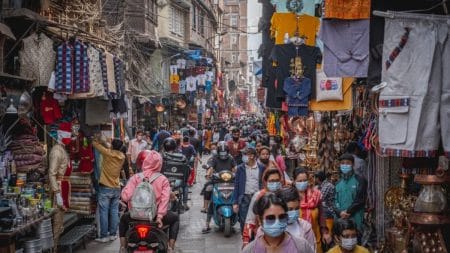
If Dante had visited Kathmandu, he might have added a tenth circle of hell just for motorbikes.
Kathmandu has become one of Asia’s most two-wheeled cities. In 2000, Nepal had just under 120,000 registered motorbikes. Today there are north of 3.8m—more than one for every ten Nepalis, and three-quarters of urban households own at least one. Cars, with their sticker prices and luxury taxes, are unaffordable for most. Public transport is sparse and sclerotic. The fallout is a metropolis that runs not on rails or buses but on a humming, honking swarm of two-stroke pragmatism.
This motorbike supremacy is rooted in economics. A basic model like the Honda Shine or Bajaj Pulsar retails for under NPR 300,000 ($2,184), whereas a new car can cost ten times as much. Fuel, though expensive relative to income, rarely outsrips NPR 5,000 a month for a biker. Loans are widely available, if steep—interest rates top 15%. And parking is generally free, if flagrantly illegal. For a city where time is money and money is short, the case for two wheels is almost unassailable.
Almost. Motorbikes are both Kathmandu’s solution and its scourge. They account for more than 50% of traffic fatalities nationwide. In the valley alone well over 100 riders perish a year. Average vehicle speeds have slowed to 12km/h, hardly the swift urban mobility promised by private ownership. A big chunk of road space is lost to erratic parking, dominated by two-wheelers. Their poorly maintained engines belch pollutants into an already toxic atmosphere: Kathmandu regularly ranks amongst the world’s most polluted cities. And two-wheelers consume 40% of the country’s petrol, adding to the import bill and the smog.
The capital is not alone in its two-wheeled dependency. Hanoi, Jakarta and Delhi share the same addiction like smoking. But many peer cities are at least trying to mitigate the downsides. Hanoi has pedestrianised large swathes of its historic core. Jakarta has experimented with emissions standards and dedicated motorbike lanes. Kathmandu, by contrast, builds flyovers: concrete monuments that merely transfer gridlock from one intersection to the next. The city’s urban planning appears governed less by policy than by fatalism. Its traffic management ethos might be summed up as: “see what happens”.
Still the motorbike’s dominance cannot be blamed on infrastructure alone. Culture rides pillion. Bikes are symbols of masculinity, mobility and middle-class arrival. And sometimes—if you are lucky—romantic viability. A Royal Enfield is not only a vehicle. It is an identity. Among rural migrants, owning a motorbike signifies entry into the urban economy. For women it signals something more radical: independence. In 2023 women made up 20% of new bike buyers, up from 5% a decade earlier. In a patriarchal society, the scooter may be a more potent instrument of female autonomy than any legislative reform.
Attempts at regulation stall on every corner. Fuel is lightly subsidised, a populist salve made possible by dependency on Indian imports. Enforcement is haphazard, undermined by public apathy and an overstretched police force. One-way systems are routinely flouted; fines, when issued, are usually negotiable. Meanwhile motorbike dealerships—many tied to politically connected business groups—resist reforms that would dent sales. The political economy of Kathmandu runs on petrol and pragmatism.
Yet banning bikes would be like banning ladders in a city of high shelves. Two-wheelers are Kathmandu’s circulatory system. They enable its gig economy, from ride-hailing apps and food delivery to courier services and errand-runners. In tight alleyways where trucks cannot go, bikes deliver goods. Credit agencies depend on the high turnover of two-wheeler loans, defaults and repossessions. Repair shops and parts dealers dot the city’s lanes. In effect, the motorbike is Kathmandu’s most efficient public service, privately funded, self-managed and only incidentally governed.
What, then, can be done? Colombo has restricted bikes from its core; doing the same in Kathmandu would throttle access for the working poor. Some urbanists call for accommodation, not opposition: dedicated lanes, rationalised parking, stricter emissions rules. The most hopeful path may be electrification. Nepal’s surplus of hydropower gives it a rare opportunity to green its transport sector without costly fuel imports. Sales of Chinese-made electric two-wheelers are rising, albeit from a low base. But with charging infrastructure rudimentary and policy coherence elusive, progress will be slow.
In 2040 the valley could resemble a model of green urbanism: e-bikes gliding silently through pedestrianised zones, a functioning metro soaking up commuters and traffic rules that mean what they say. Equally likely, however, is a continuation of the current chaos: thousands of motorbikes weaving, honking and idling their way through the haze.
Highway to hell
That latter vision, sadly, is more in tune with Kathmandu’s rhythm. Progress here does not glide in on rails or wait at red lights. It zigzags, sputters and improvises—much like the riders who keep the city moving. As one inDrive rider remarked between trips: “In Kathmandu, the only traffic rule is: don’t stop”.
Here development does not drive. It rides pillion.