
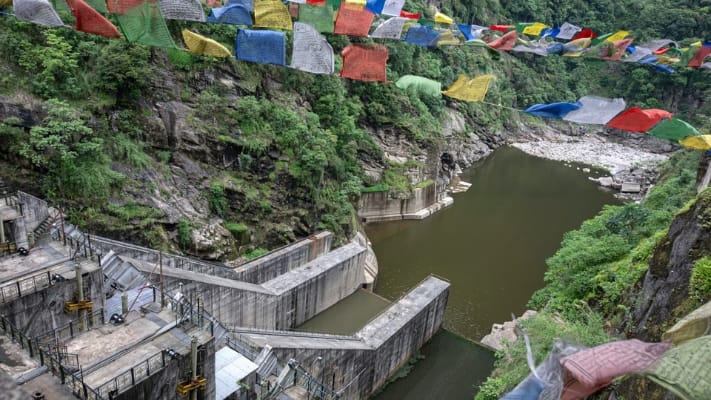
Photograph: Saumya Khandelwal/WSJ
The rivers of the Himalayas offer Nepal a bounty that most countries would envy: clean, renewable electricity flowing downhill, seasonally in excess. Yet much of this energy, especially during the monsoon, goes unused, lost in transmission bottlenecks, weak grid demand or dumped at throwaway rates to India. Meanwhile across the border in Bhutan, those same kinds of rivers have been transformed into a digital goldmine.
Since 2020 Bhutan has been mining bitcoin using surplus hydropower, converting electrons into encrypted assets. By mid-2025 its government-controlled reserves had hit $1.3 billion, equal to nearly 40% of its GDP. When revenues from tourism and electricity exports dipped after the pandemic, the government sold $100 million worth of bitcoin to fund civil servant salaries. The cryptocurrency once derided as speculative folly is now underwriting Bhutan’s bureaucracy.
Nepal by contrast has remained inert. Its policymakers have responded to crypto with bans. The Nepal Rastra Bank treats digital assets with the same enthusiasm it once reserved for psychedelic music or chewing gum imports. Even as countries like Singapore, the United Kingdom and India experiment with regulated crypto sandboxes, Nepal remains frozen in regulatory denial.
The missed opportunity is not theoretical. Nepal has more hydropower potential than Bhutan—over 43,000 megawatts, of which 3,500mw is already operational. Current peak demand is less than 2,400mw. Each monsoon leaves gigawatts of energy stranded or wasted. Bhutan solved this with bitcoin mining: using the network as a battery, soaking up surplus electricity and converting it into a storable, portable asset.
Nepal spills it into rivers, and then complains of a balance-of-payments crisis.
The arithmetic is not difficult. Dedicating even 100mw of hydro capacity during surplus months to mining could generate $200–300 million a year, assuming bitcoin at $60,000. That would equal nearly one-fifth of the remittances the country receives from Qatar alone. No passports, no visa quotas, no diplomatic indignities required. Only wires and software.
Critics will point to volatility. Bitcoin has crashed before and will crash again. But so do other commodities—oil, copper, even rice. Bhutan’s model is not reckless speculation. It mines, stores and holds. Coins are sold selectively to manage budget gaps. The strategy resembles the behaviour of central banks holding gold or sovereign funds banking oil. The volatility is absorbed by fiscal discipline.
Others worry about energy consumption. But here, too, the Bhutanese example provides clarity. The real environmental harm from crypto arises when powered by fossil fuels. In hydro-rich economies like Bhutan, and possibly Nepal, mining does not burn coal. It captures wasted green energy; stabilises grid load; and monetises surplus without emissions. It is not a drain: it is a plug.
The serious issue is institutional rather than technical. Bhutan’s sovereign wealth fund led the project, backed by a coordinated state apparatus. Its mines are run by a government-owned company, their locations kept secret for cybersecurity reasons. International firms such as Bitdeer pay Bhutan in dollars for electricity and keep the mined coins, creating foreign-currency inflows without exposing the state to speculative risk. A dual system of public and private mining now underwrites both fiscal and monetary stability.
Nepal has no such architecture. The Nepal Electricity Authority, the Finance Ministry, the central bank and the investment board operate in silos—united only in their shared suspicion of innovation. Policy is fragmented; regulatory guidance is non-existent; and bureaucrats remain more fearful of scandal than enthusiastic about structural transformation. Even minor experiments—such as regulated, state-controlled mining pilots—are considered too risky.
Yet the risk of inaction is not neutral. Every monsoon without a plan means lost energy and lost value. Transmission lines remain underutilised; border sales remain limited; and hydropower developers grow restive. Nepal exports electricity to India at nominal rates, with few guarantees and little return. Mining could provide a higher-value alternative, if not as a replacement, then as a strategic complement.
There is no shortage of comparative advantage. Nepal’s cooler highland regions are ideal for mining equipment, which performs better in low temperatures. Transmission lines already reach many remote areas. Containerised mining rigs, powered seasonally and monitored remotely, could be deployed with limited capital. The only element missing is regulatory clarity and political will.
Bhutan’s experience offers another lesson: public perception matters. Most Bhutanese were unaware of the mining programme until it began delivering visible benefits: pay raises, fiscal stability, national pride. Transparency, though belated, built trust. Nepali political class, hypersensitive to populist backlash, might learn to pre-empt scandal by pairing innovation with communication. Better to explain bitcoin as a sovereign hedge than face a parliamentary inquiry into why India owns Nepal’s electrons.
A small, state-led pilot could start the process. A joint venture between the NEA, the Finance Ministry and a reformed investment board could designate 50–100mw of surplus energy for seasonal mining. Foreign partners could provide hardware and technical support under strict rules: no token trading, no altcoins, no private ownership of coins. Coins mined could be stored in state-controlled wallets and reported publicly. Mining could be framed not as speculation but as digital asset accumulation, akin to buying gold.
If successful, such a pilot could be extended to provincial governments. Localised crypto zones—much like Bhutan’s planned Gelephu Mindfulness City—could emerge, where green mining supports digital payments and tourism. Nepali entrepreneurs are already active in tech services. Giving them a sandbox in which to innovate could bring investment, generate jobs and build technical capacity.
Nepal has rivers. It has electricity. It has youth. It even has a Ministry of Education, Science and Technology. What it lacks is ambition. Bhutan, with a GDP smaller than Kathmandu’s real estate market, has leapt ahead by asking a simple question: what if we treat electricity as capital and not as a commodity? Nepali planners, stuck in the logic of kilowatt-hour pricing and budget deficit firefighting, have yet to imagine the same.
Every year the monsoon arrives. Every year it delivers abundance. And every year the country lets it flow away. Perhaps it is time to bottle the river. Or at least, to hash it. ■





