PHOTO: ACT ALLIANCE/PAUL JEFFREY
ECONOMIC DEVELOPMENT is a ladder but Nepal treated it as a ramp. Despite abundant hydropower, a prime location between two industrial giants and a large supply of cheap labour, the country has jumped into services without first building an industrial base. That is a problem.
Output has risen, but jobs have not. Services are growing but productivity is weak. The current account holds only because millions of Nepalis work overseas. What Nepal has achieved is premature deindustrialisation—without the income levels that usually make it bearable.

The path Nepal avoided is well understood. In 1954 Arthur Lewis set out a simple idea: surplus labour moves from farms to factories; industry creates jobs, savings and productivity; services grow later, on the back of rising incomes. It is a sequence, not a shortcut.
East Asia followed it. The Four Tigers built export industries. Europe rebuilt through manufacturing after the war. China’s rise was driven by factories that pulled millions out of subsistence farming. Nepal skipped this stage—and is paying the price.
Nepal’s divergence is not unique, but it is severe. From 1996 to 2023, services drove most growth, adding 2.3 percentage points a year to real GDP. Industry managed just 0.8. Agriculture, still employing most workers, contributed even less. The economy has changed on paper more than in practice.
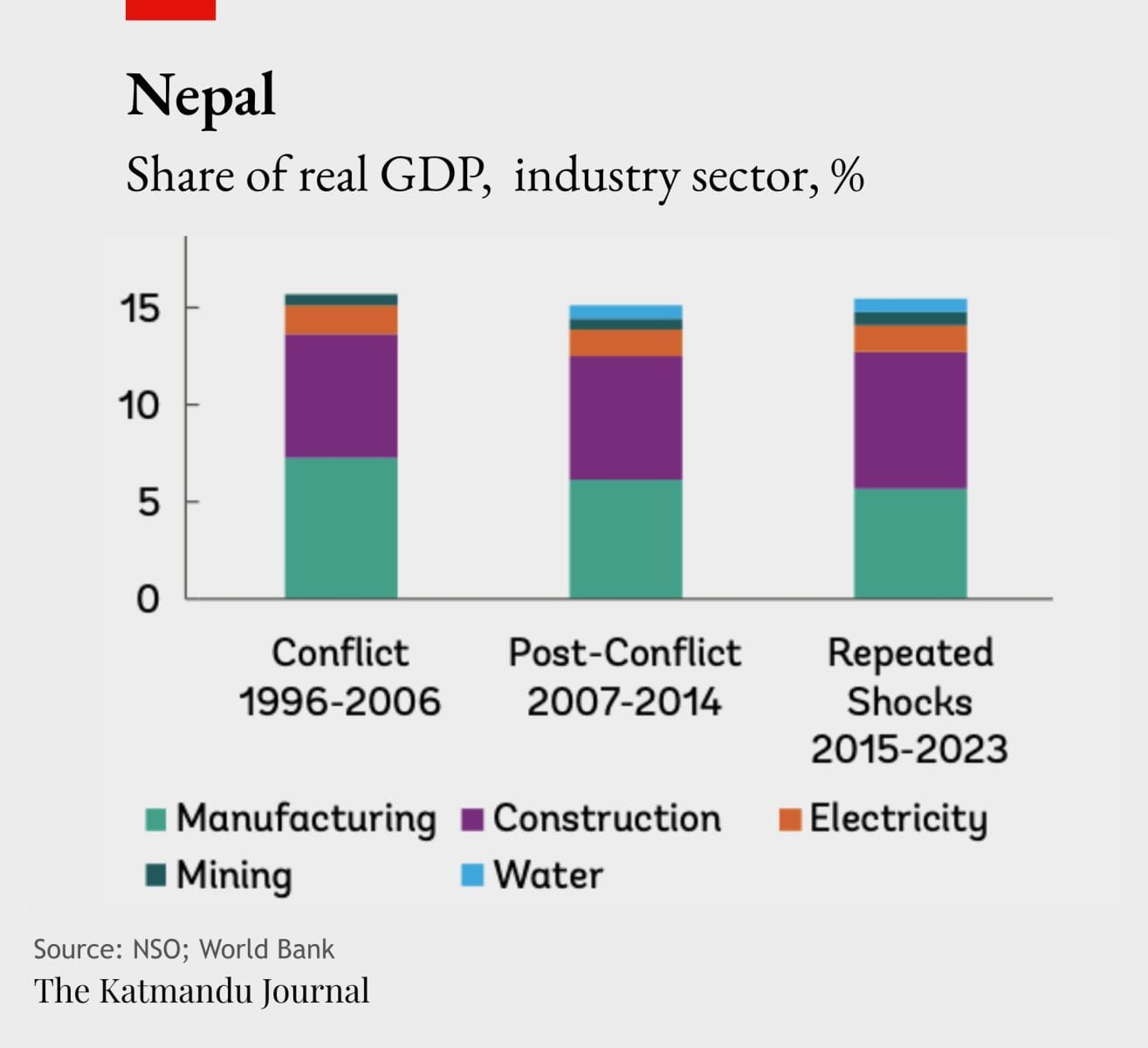
Manufacturing now makes up only 5.7% of GDP after the pandemic, far below the 12–15% seen as a minimum for emerging economies. What passes for industry is largely construction, fuelled by remittances and post-disaster rebuilding. A short-lived building boom masked a weak core. When import controls were imposed in 2022, the fragility was exposed.
Other poor countries have done better. Ethiopia, despite war and economic strain, built a manufacturing base through industrial parks and heavy investment in infrastructure. Bangladesh, starting poorer in the 1980s, turned garments into a $45bn export industry with little in the way of minerals or energy. Vietnam used WTO entry and trade deals with Europe and America to pull in high-tech manufacturing. Each case shared clear policy, an export focus and disciplined institutions. In Nepal, none of these lined up.
To its credit, Nepal has expanded hydropower fast. Installed capacity has risen from under 800 megawatts in 2016 to more than 3,150 today. With stronger grids and firm export deals with India and Bangladesh, this could cut energy costs, curb fuel imports and support industry. But power alone does not transform an economy. Transmission lines carry electricity, not skills or supply chains. Without firms, workers and institutions to use that power productively, dams become assets in search of an economy.
Others have made the same mistake. Ghana found that oil and gas brought revenue, instead of transformation; links to the wider economy stayed poor. Laos built dams and exported power yet domestic industry barely followed. In both infrastructure raced ahead of capacity. Without industrial policy, labour reform as well as an export plan, big projects turn into fiscal disasters. They absorb money and attention, but do not pull an economy forward.
Digital services provide another spark. ICT now makes up about 10% of service exports. Kathmandu hosts a growing army of freelance coders, designers and remote support workers. By 2023 digitally delivered services accounted for half of all service exports. That is an achievement few neighbours can match.
But the model is fragile. Digital exports bring in money rather than mass jobs. The Philippines built its BPO industry over decades, with education reform and state-backed skills programmes. Nepal’s version is scattered and exposed, to exchange-rate swings and the whims of global platforms.
Beneath these sectoral stories is a more troubling diagnosis: stalled productivity. Between 1996 and 2023 most growth came from capital—around three percentage points a year. Labour added just 0.5 while total factor productivity, a measure of efficiency, contributed barely 0.25—and has been negative since 2014. Shocks like the 2015 earthquake, India’s blockade and Covid-19 hurt, but the root is structural: firms are small, informality is high and linkages are weak. In Nepal growth rarely builds lasting capacity or global competitiveness.
Employment offers little comfort. Jobs in agriculture fell by around one percentage point a year, yet industry and services barely picked up the slack, each growing just 0.25 points a year. The fallout is that overall employment, especially among men, has dropped sharply. Non-agricultural jobs now lag those in comparable Asian and African economies.
The gender gap is severe. Women participate in the labour force at relatively high rates, but mostly in unpaid family work or informal roles. Non-agricultural employment for women is 20 points below the national average.
Few countries have grown without harnessing female labour. East Asia’s boom relied on women filling factories, offices and shops in large numbers. In Nepal cultural and institutional barriers—such as poor access to credit and rigid social norms—keep women on the margins of the formal economy. Education levels have risen but jobs have not followed. Programmes to back female entrepreneurship exist on policy documents, but are underfunded and badly run.
Migration keeps the economy afloat but weakens its future. Remittances fuel real estate, consumption and even government revenue. Yet sending workers abroad is no replacement for domestic jobs. A slowdown in Gulf construction or visa restrictions could cut inflows sharply. Permanent outmigration is even more worrying: if one in five migrant households never returns, the World Bank estimates GDP could be more than 10% below projected levels by 2050.
Policy optimism runs high. The 16th National Development Plan aims for 7.1% growth through 2029, while the Finance Ministry projects 6.7% for 2025–27. But these numbers hover above reality. Macro-fiscal models, including those used by international institutions, point to growth settling at 4.5% before falling to 3.3% by 2050—far too low to create enough jobs or fix infrastructure deficits.
Three levers could change the trajectory. Raising total factor productivity to the 75th percentile of lower-middle-income peers could lift output by 20% by 2050. Bringing capital investment up to regional norms could add another 10%. Small gains in labour participation, especially among women and returning migrants, would push GDP up further. Exports—particularly in hydropower, light manufacturing and digital services—could provide extra growth if trade logistics and tariffs are improved.
Yet all three depend on institutional overhaul. The bureaucracy is fragmented and ineffective. Ministries duplicate functions. Budgets are poorly executed. Federalism, introduced in 2015, added layers of government without strengthening local capacity. Industrial policy exists on paper but coordination is missing. Competitors like Vietnam, Rwanda and Morocco invested heavily in state capacity. Without the same, reforms remain empty slogans.
Other countries have learned this the hard way. Tunisia, despite early post-revolution promise, faltered because weak bureaucracy and drifting policy stifled execution. Sri Lanka’s fragile institutions caused instability even before its latest crisis. By contrast, Vietnam’s technocratic state managed a smooth shift from agriculture to industry to services, handling foreign investment and macro stability with skill. Bureaucracy is not a barrier—it is the engine of delivery.
Nepal’s problem is not a lack of ambition, but trying to do too much without the ability to follow through. Plans are made, targets set, committees formed—but the state cannot make them happen. Projects stall, policies drift and data are out of date. South Korea built big companies; Bangladesh built a garment industry; Ethiopia built factories and parks. Nepal builds plans. Doing nothing becomes the norm.
Rising numbers do not equal real progress. Skipping industrialisation has left Nepal dependent on migrant labour, vulnerable to shocks and short of formal jobs. Hydropower and digital services offer promise, but they are not a development strategy. Without major reforms—such as in policy as well as productivity and institutions—Nepal risks becoming a lesson in wasted potential.
In the end reality catches up. An economy cannot float forever on remittances and hope. Sooner or later it must produce something that lasts. ■