
NEPAL’S MOST valuable asset is shrinking before it has fully formed. Its children are growing up with only half the productivity they could achieve as adults. The World Bank’s Human Capital Index (HCI) gives Nepal a score of 0.50: an unflattering admission that a child born today will, on current trends, realise barely half of her economic potential. It is a diagnosis as much as a forecast: a future of curtailed ambitions and lower incomes, preordained by the failings of the present
The index distils three essentials of future productivity—survival beyond early childhood, quality education and good health—into a single measure. In each Nepal stumbles. School enrolment has expanded; child survival has improved; and life expectancy has reached 70. Yet a child completing 12.3 years of schooling emerges with skills equivalent to only 7.2 years of effective learning. A quarter of under-fives are stunted. No tier of the health system meets the government’s own minimum standards. Such failings are not evenly spread: in Karnali province the HCI is 0.46; in Bagmati, 0.58. Geography maps neatly onto inequality.
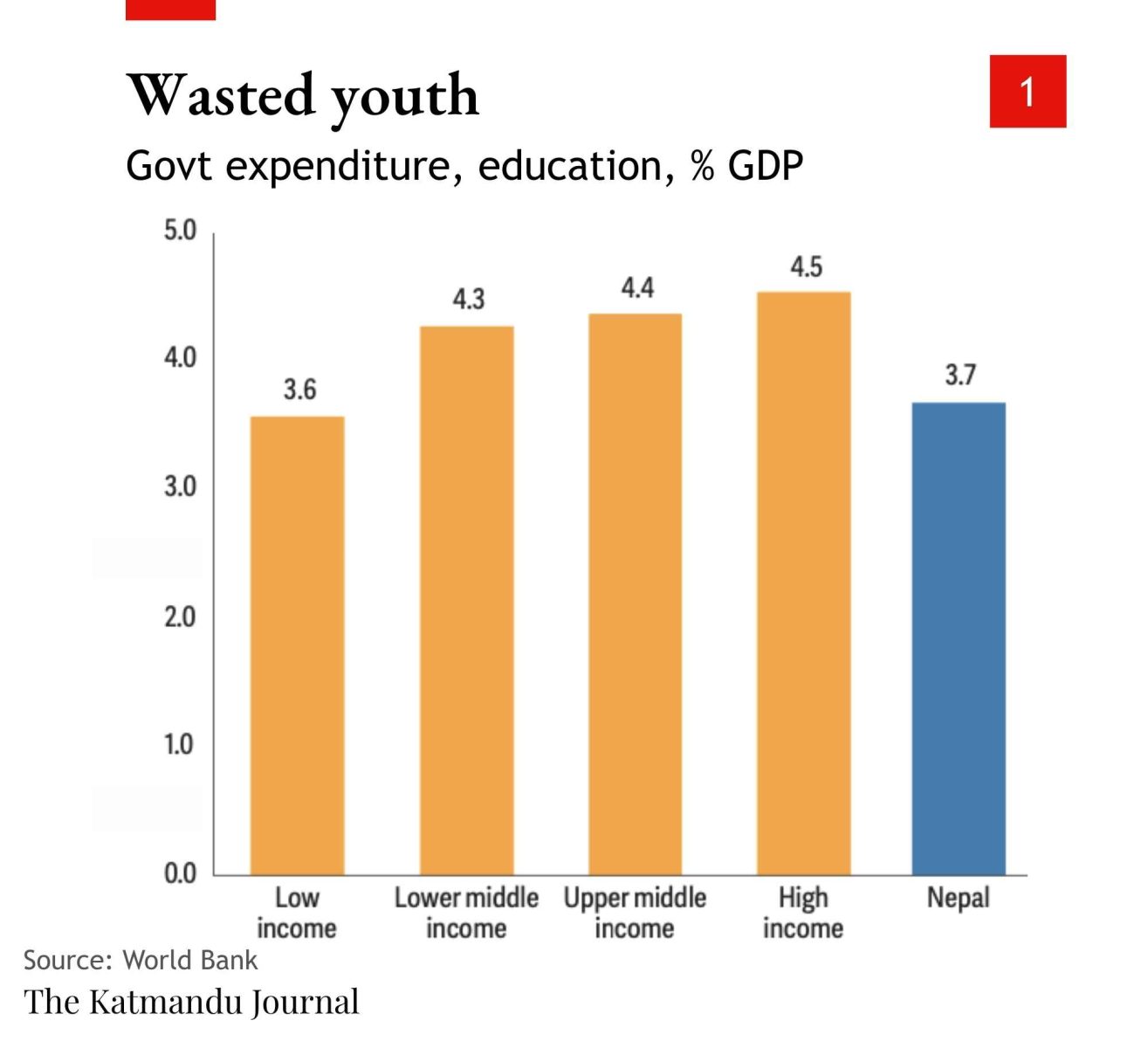
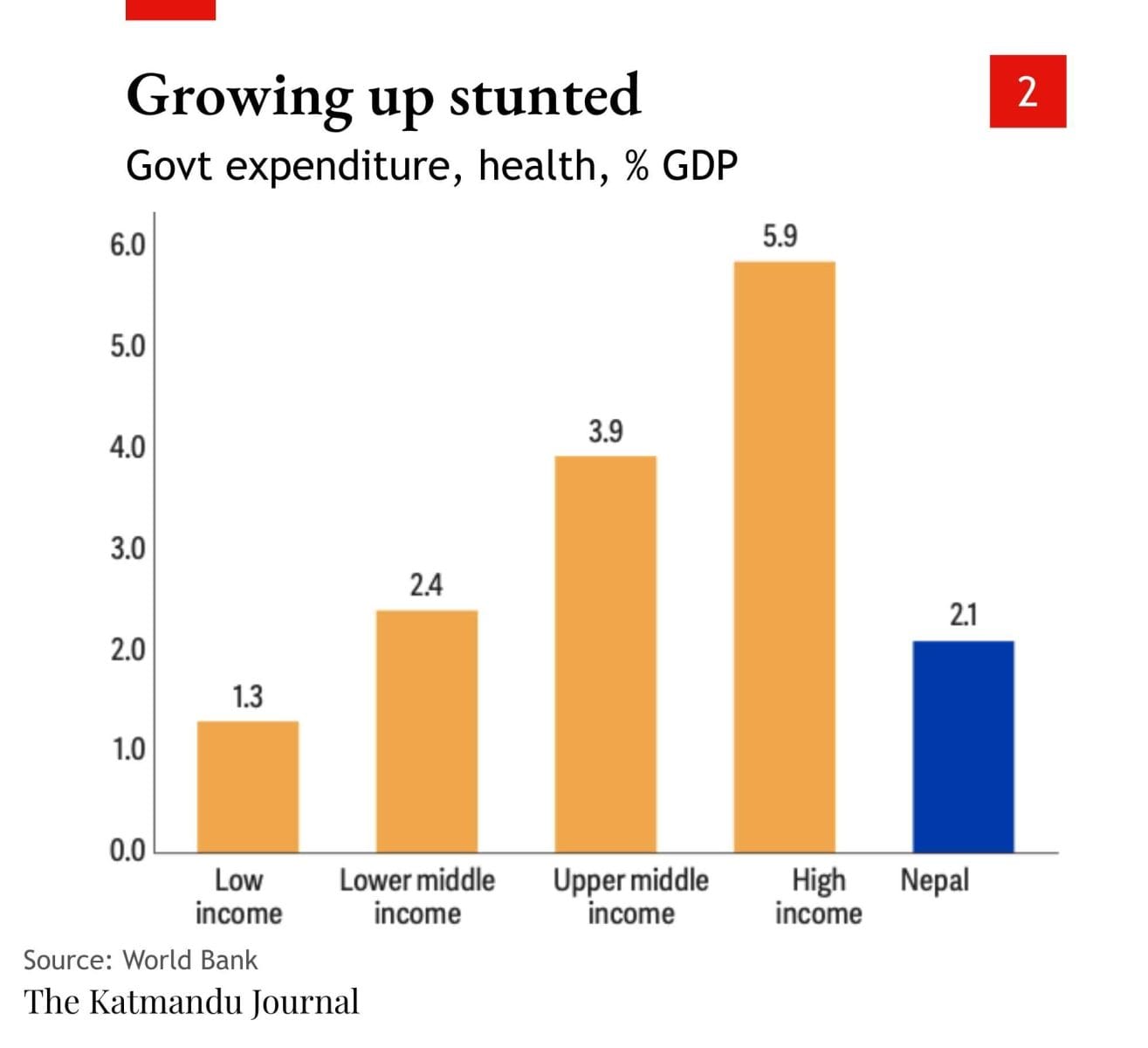
The malaise is not rooted in absence of progress but in its mediocrity. Public investment in education stands at 3.7% of GDP (see chart 1), below both the average for comparable economies and UNESCO’s benchmark of 6%. Health receives 2.1% of GDP (see chart 2), when the WHO recommends 5%. Other countries with similar outlays have achieved better outcomes, suggesting inefficiency, not scarcity, is the greater affliction. Nepal’s National Health Insurance scheme, launched in 2016, covers only a quarter of the population and suffers from patchy execution. Out-of-pocket medical expenses force households into wrenching choices between treatment and schooling.
Structural neglect is compounded by environmental hazard. Nepal ranks among the most polluted countries in the world; particulate levels exceed WHO recommendations by a factor of ten. The costs are vast: 10.2% of GDP in lost output; years of life shaved off the average lifespan; cognitive and developmental harm to the next generation. Pollution joins climate change, natural disasters and epidemics as chronic threats to health and learning. Yet the country’s disaster-response and social-protection systems are threadbare.
The economic stakes are unambiguous. Human capital is the biggest single component of national wealth worldwide. Nepal’s share has tanked since the 1990s, even as peer economies have strengthened theirs. Matching the health and education standards of high-income countries could nearly double GDP per head. That prize is not beyond reach: the basic policy menu—greater, better-targeted spending; higher-quality instruction; effective health coverage; cleaner air—is well known and technically feasible. What is missing is execution.
The real danger is less that children will be left behind by the global economy, and more that they will never be allowed to catch up. The cost of inaction compounds invisibly, year by year, as each cohort enters the workforce with compromised potential. Human capital, unlike mineral wealth, cannot be extracted late. A nation that neglects to develop it at the right time discovers, too late, that it has been squandering the only resource that matters more than gold. ■





