
This article has been rewritten
Few fiscal devices appear so innocuous, or raise so little protest, as Nepal’s tariffs. Rates are moderate, customs posts orderly and no trade rows dominate the headlines. Investors seem unbothered. Yet these charges supply over a fifth of government revenue—the highest share in South Asia. The customs gate is not merely a checkpoint. It is the government’s cash register.
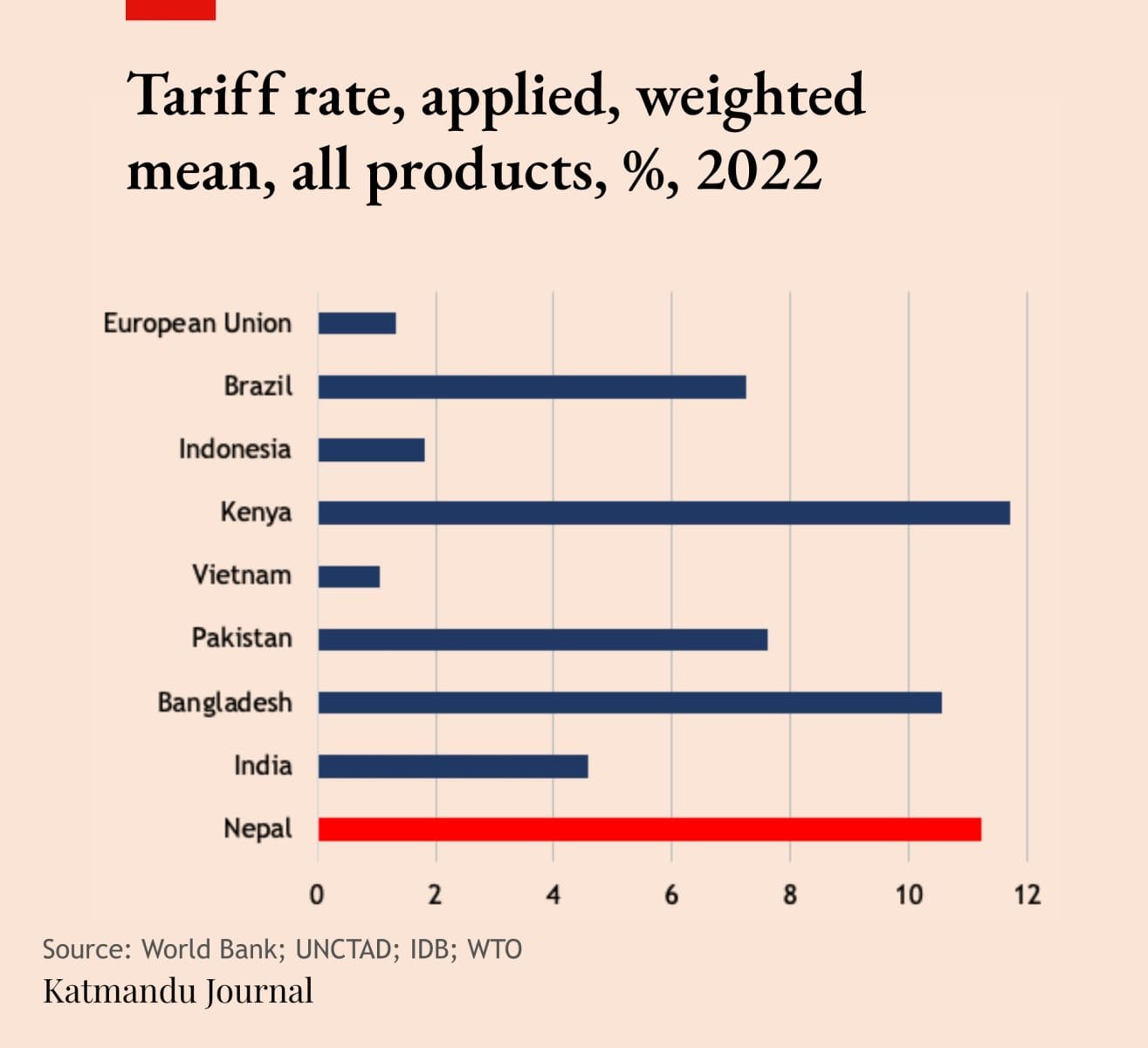
Such dependence is not accidental. It stems from reform in the 1990s, when Nepal’s tariff code was transformed from a jumble of arbitrary bands and discretionary valuations into something resembling order. With nudges from multilateral lenders and the discipline of WTO accession in 2004, tariffs became streamlined and legally bound at high ceilings. Weighted average rates sit below 15% (see chart), neither stifling nor trivial.
That stability explains why tariffs have become the government’s preferred fiscal instrument. Inland taxation is hampered by narrow compliance, weak record-keeping and political squeamishness about enforcement. Customs duties, by contrast, are easy to administer and impossible to avoid. For a state that struggles to collect income tax or VAT, the border delivers reliability.
Politics reinforces this reliance. Tariff schedules are tuned to multiple constituencies: raw materials and staples are lightly taxed, whereas cars and consumer durables face higher rates. Producers enjoy protection, consumers see affordable essentials and the exchequer fills its coffers. Regional trade arrangements, such as the South Asian Free Trade Area, have added predictability alongside preserving shelter for sensitive items. The outcome is cautious liberalisation: openness abroad, insulation at home.
The approach has worked—for stability. But stability is not a strategy. By taxing inputs and delaying rebates, Nepal penalises exporters. Special Economic Zones, meant to offer duty exemptions, have languished thanks to poor electricity, land shortages and clogged logistics, for example. Input neutrality exists in theory but is thwarted by red tape. Exporters complain of paying “at both ends”. As supply chains fragment globally, such frictions grow ever more costly.
Over-reliance on tariffs also entrenches administrative inertia. When border revenue suffices, reforms inland can wait. Remittance inflows compound the complacency: dollars earned abroad fuel imports at home, sustaining customs receipts without demanding broader tax discipline. Yet fiscal habits built on easy inflows are fragile.
Nepal’s peers offer warnings. India’s tariffs remain lower despite creeping protectionism. Bangladesh relies on opaque para-tariffs. Pakistan oscillates between liberalisation and retrenchment. By comparison Nepal’s regime is more transparent, which investors value. But transparency is no substitute for a growth strategy. Tariffs can raise revenue; they cannot build competitiveness.
What, then, should Nepal do? Five steps stand out. First, define tariffs explicitly as revenue instruments and transitional protection, not as permanent subsidies. Second, overhaul customs administration through digitalisation, streamlined valuation and reduced discretion. Third, enforce timely export rebates with penalties for bureaucratic delay. Fourth, publish tariff schedules two years in advance, with clear review cycles. Fifth, synchronise border taxes with inland reform so that customs reliance can gradually diminish without fiscal shocks.
Success would be visible in three numbers: faster clearance times, narrower rate dispersion across products and consistent schedules. These are not glamorous targets. But they signal competence and build investor confidence.
Trade is shifting. Firms increasingly prize certainty and speed over marginal cost advantages. Countries that deliver both gain a premium. Nepal’s tariff regime has delivered stability and revenue. What it has not delivered is transformation.
Tariffs balance the books today. They will not secure tomorrow. ■