IMAGE: RINA
The most revealing guide to an economy is not its GDP statistics, which arrive late and are endlessly revised, but the lending books of its banks. Credit is the bloodstream of commerce: when it is abundant, businesses expand, consumers spend and optimism abounds. When it tightens, firms retrench, households postpone and pessimism sets in. Nepal’s latest credit figures suggest neither euphoria nor collapse, but something more ambiguous: a system that is expanding in size, though narrowing in scope.
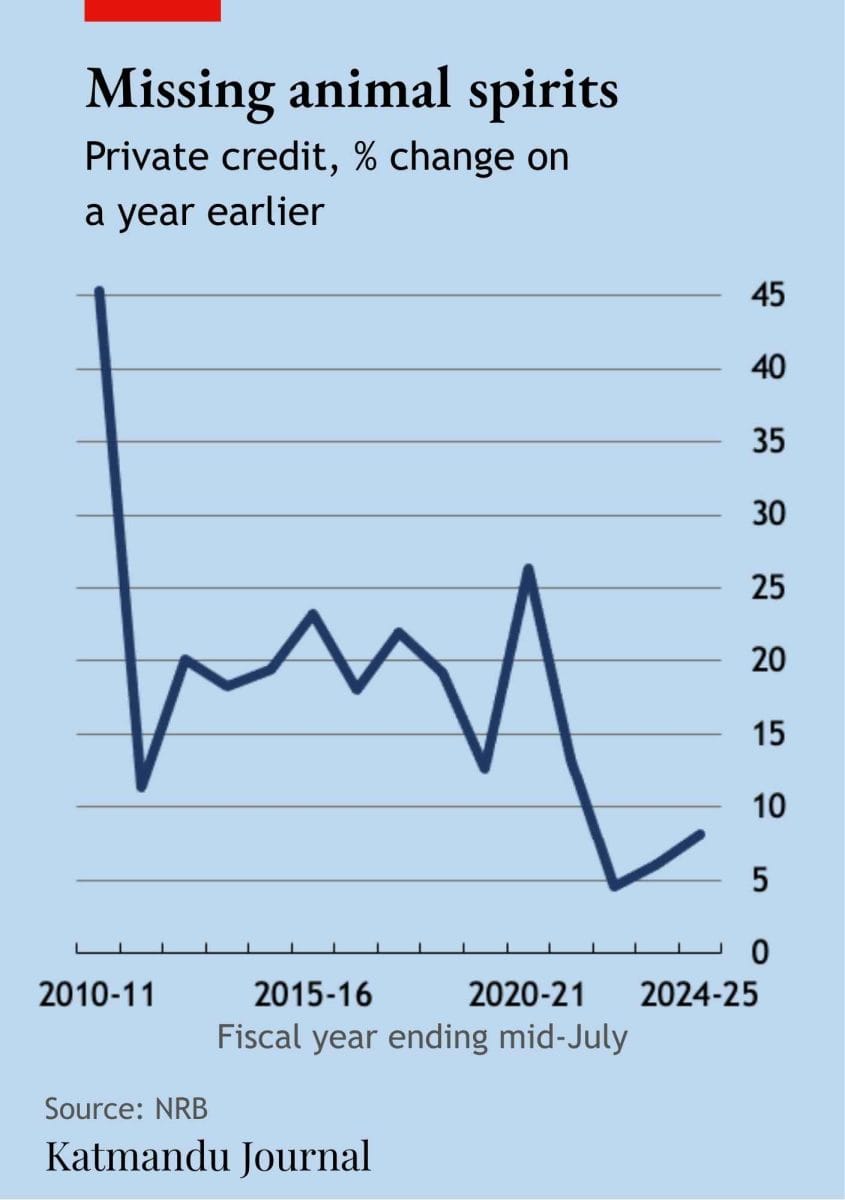
In the fiscal year ended mid-2025 banks and financial institutions had extended NPR 5.59trn (~$42bn) of outstanding credit, nearly 15% more than two years earlier. That growth is respectable for Nepal where GDP expansion has faltered amid hesitant investment. Yet the tempo has been uneven. Credit growth slowed sharply in 2024 before recovering this year.
The changing composition of lending is more telling. Term loans—longer-maturity debt for investment in factories, offices or services—stay dominant, soaring from NPR 1.58trn in 2023 to NPR 2.07trn in 2025. The bulk went to industrial and service firms, signalling an economy still willing to back productive activity. Yet the pace of increase has decelerated. In 2024 banks eagerly expanded such lending; in 2025 they tapped the brakes. Wholesalers and retailers, squeezed by weak demand, even trimmed their borrowing.
By contrast, short-term liquidity has drained away. Overdrafts, beloved by traders for working capital, have collapsed by more than half in two years. Regulators, wary of hidden risk, have nudged banks towards more formal structures. Cash-credit loans, a cousin of overdrafts, ballooned in 2024 before flatlining. Businesses are still borrowing, though with less vigour, perhaps reflecting weaker appetite.
Trade finance is surging. Trust receipt loans, which grease imports, grew by more than half in the past year, with industrial borrowers nearly doubling their usage. That points either to renewed production—factories importing raw materials and machinery—or to pre-emptive stockpiling as firms hedge against supply-chain hiccups. Given Nepal’s reliance on imported capital goods and intermediate inputs, the shift could be a cautious retooling of industry.
Housing and property tell a more subdued tale. Loans for middle-class homes continue to grow steadily, buoyed by salaried borrowers with predictable incomes. Yet higher-value residential real estate lending has shrunk, and credit for land plotting has slowed to a crawl. The speculative frenzy that once gripped Kathmandu’s property market has cooled under wary banks and subdued demand.
Meanwhile risk appetite is reappearing elsewhere. Margin loans, which allow investors to leverage bets on the stock market, rocketed by over 50% year on year, led by wealthier borrowers. That suggests a renewed taste for financial risk, even as consumer durables languish. Vehicle loans, funnelled through hire-purchase schemes, are depressed. Households are proving reluctant to finance cars or two-wheelers, notwithstanding small signs of recovery.
Other categories are changing, too. Education loans have leapt sharply, consistent with the exodus of students seeking degrees abroad and the rising costs of higher education at home. Bills purchased—tiny in absolute terms—have doubled, hinting at greater trade-linked financing. Lending to deprived sectors, once a political priority, has fallen. Financial inclusion, it seems, is fading from the banks’ agendas.
Three themes emerge. The first is caution: banks are lending more but in narrower bands, focusing on secured or long-term categories while retreating from short-term liquidity. The second is concentration: credit growth is clustered in industry, services and trade finance, rather than spread broadly across households or small businesses. The third is ambivalence: some signals—the rise in import loans, the jump in margin finance—suggest animal spirits returning; others, such as weak consumer borrowing, suggest restraint.
International comparisons sharpen the point. India’s credit boom is fuelled by consumer borrowing for, say, cars, homes and electronics. Bangladesh’s is tied to export-oriented industry, particularly garments. Nepal’s pattern sits uneasily between the two: consumption is tepid and industry is borrowing to import not to transform. The country’s banks are mirroring the structure of its economy, ie, service-heavy, import-reliant, consumption-lite—rather than reshaping it.
For policymakers this presents a dilemma. The system looks a bit healthier than a few years prior (though bad loans are high): speculative real estate lending has cooled; short-term overdrafts have shrunk; and banks appear more disciplined. Yet the narrow base of credit expansion signals limited momentum for broad-based growth. If banks lend mostly to big industrial firms and wealthy investors, the wider economy risks being starved of dynamism.
The Nepali state has long tried to steer credit through quotas and subsidies. Such programmes rarely outlast their slogans. Deprived-sector lending has slipped despite formal mandates. Infrastructure finance is still marginal. Students receive loans more reliably than farmers. A fiscally constrained government leans heavily on banks to carry the burden of development. Banks, predictably, prefer safer bets.
Credit data are not the stuff of cocktail conversation, but they offer a clear guide to mood. Domestic lenders are not in crisis. Nor are they exuberant. They are lending with caution: fuelling industry, imports and the occasional stockmarket punt, while keeping households and small businesses at arm’s length. Money is flowing. Conviction is not. ■