
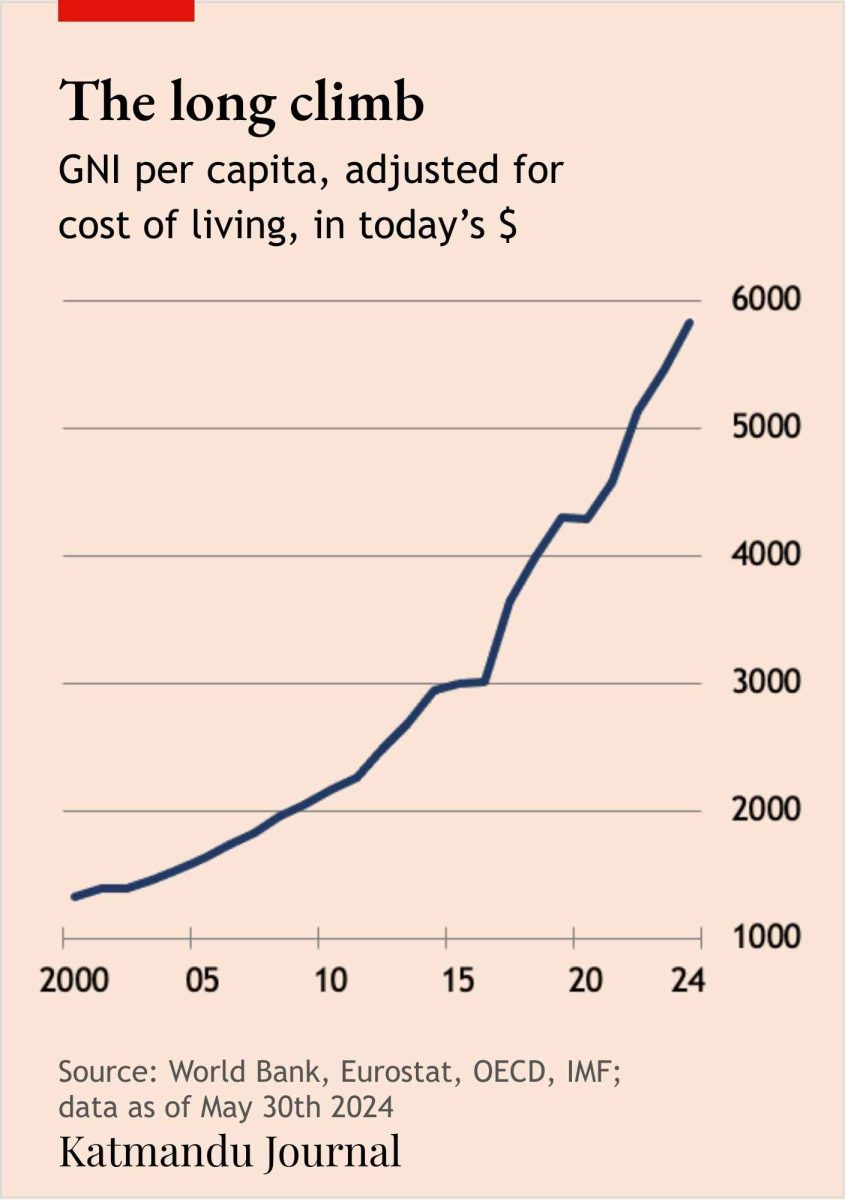
Nepal has come a long way. Its gross national income (GNI) per capita, adjusted for purchasing power parity (PPP)—it tells you how far your money goes in different countries—, has risen from $1,320 in 2000 to $5,830 in 2024, a near fourfold increase. That should be cause for celebration. Yet the country is among the poorest in South Asia, and its economic progress, though steady, has been slower and shallower than most of its neighbours.
Measured against the region’s average, Nepalese incomes look modest. South Asia as a whole reached a GNI per capita (PPP) of roughly $10,872 in 2024. Sri Lanka has surged ahead with a figure of $15,240. India ($11,000) and Bangladesh ($10,060) both surpass Nepal by a comfortable margin. Only Pakistan, with $6,140, sits comparably close.
Nepal’s relative underperformance is not for lack of external inflows. Remittances account for nearly a quarter of GDP,among the highest rates globally, thanks to a large migrant workforce, particularly in the Gulf. These earnings have helped support consumption and reduce poverty, but they have not spurred domestic productivity in the way foreign investment or industrial growth might. The country’s export base is narrow and dependent on low-value goods such as textiles and agricultural products, with India absorbing the lion’s share.
This reliance on a single market poses risks. Kathmandu has found itself vulnerable to shifts in Indian policy, whether deliberate or incidental. A blockade in 2015, unofficial but effectively enforced, brought severe fuel and goods shortages that highlighted the fragility of Nepal’s trade infrastructure. In a world of geopolitical hedging and supply chain recalibration, such dependence feels increasingly dangerous.
Structural constraints weigh heavily. Nepal’s terrain is famously unforgiving, complicating transport and logistics. Its hydropower potential, touted as a ticket to energy export wealth, remains underexploited. Political instability has not helped: since becoming a republic in 2008, Nepal has cycled through more than a dozen governments, each struggling to balance competing demands from entrenched parties and restive regions.
Still, there are signs of promise. Investments in infrastructure like roads, airports as well as transmission lines have accelerated in recent years, helped by concessional loans and Chinese-led projects under the Belt and Road Initiative, alongside MCC. Tourism, briefly battered by the pandemic, is recovering. And the digital economy, though negligible and nascent, is beginning to attract diaspora capital and young entrepreneurs.
But catching up with the region will mean more than passive growth. Nepal will need to cultivate a stronger manufacturing base, modernise agriculture as well as streamline its bureaucracy. A more diversified trade strategy, one that looks beyond India and leverages proximity to China, would offer strategic resilience. Equally the country’s education and labour policies must evolve to match the demands of a shifting global economy. Otherwise the exodus of its young workforce will continue to drain talent from an already stretched system.
Nepal is not standing still. Yet the region around it is moving faster. In South Asia’s economic ascent altitude alone is not enough. ■





