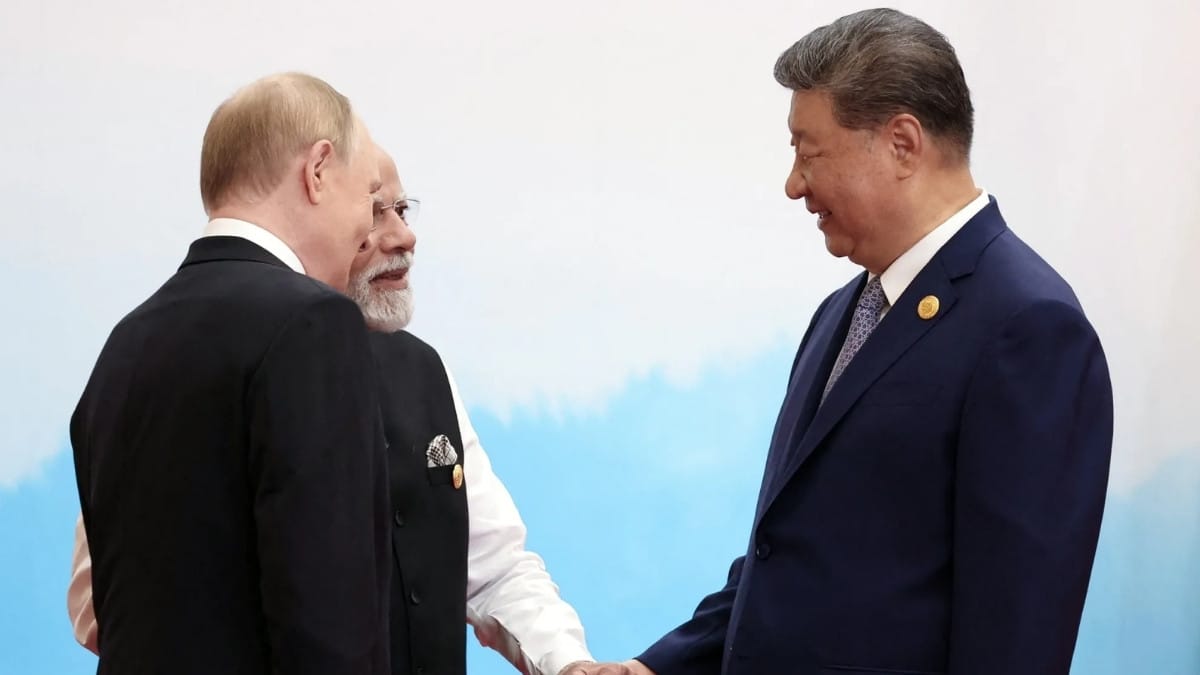
Photographer: Alexander Kazakov/AFP/Getty Images
In Tianjin this week, Xi Jinping played host to Vladimir Putin and Narendra Modi. The spectacle of motorcades, handshakes and broad smiles was crafted to impress: three nuclear powers, led by men with a taste for personalised rule, gathering on Chinese soil. The Shanghai Cooperation Organisation (SCO) summit delivered little beyond pageantry. Yet in geopolitics, pageantry matters. With America under Donald Trump retreating from alliances and waging tariff wars, the mere appearance of an alternative bloc carries significance.
Xi, Putin and Modi together command nearly 40% of humanity and a quarter of global GDP. Their systems differ, their interests diverge. But all bristle at American dominance. The question is whether shared grievance can be converted into real alignment.
The summit’s most tangible outcome was energy. Russia and China announced progress on Power of Siberia 2, a long-stalled pipeline. Beijing had long resisted, wary of dependence on Russian gas. That it is moving forward now reflects strategic urgency rather than commercial logic. India, for its part, pledged to keep buying Russian oil despite Washington’s ire. Since the invasion of Ukraine, Indian imports of discounted crude have surged. Mr Modi insists on “strategic autonomy”, not alignment. His brief visit to Tianjin, preceded by a stop in Tokyo, was meant to showcase flexibility.
These moves matter less for their immediate economics than for what they signal. China is willing to test Western sanctions. India is prepared to defy American tariffs. Russia, increasingly desperate, is willing to sell at a loss to keep customers. None of this amounts to an alliance. But all of it chips away at Western leverage.
Talk of a Moscow-Beijing-Delhi axis is not new. It underpinned BRICS, an unwieldy club of emerging economies better at slogans than policy. But fissures are deep. China and India fought border clashes in 2020 and are suspicious rivals. Russia is becoming China’s junior partner, forced to offer cut-price hydrocarbons. And India still depends on Western capital and markets to power its tech ambitions.
The photo ops of Tianjin hide asymmetry and mistrust. Xi will not share primacy. Modi will not accept subordination. Putin, weakened, has little to offer other than raw resources and rhetorical defiance.
What has changed is America. Mr Trump’s return to the White House has accelerated convergence among unlikely partners. His tariffs treat India much like China. His disdain for alliances unnerves South Korea, Japan and Europe. By behaving as if all countries must bend to American whim, he has encouraged even wary rivals to explore alternatives.
That exploration remains embryonic. Yet psychology matters. In Tianjin, the sight of three leaders—normally divided—standing shoulder to shoulder was a reminder that American dominance is not inevitable. Even the suggestion of a parallel order weakens the West’s hand.
Fragile fronts
This is no new Cold War. It is looser and far more volatile. Strongmen are decisive but their alliances are brittle. China’s energy strategy conflicts with its climate goals. India’s quest for autonomy collides with its reliance on Western investment. Russia resents its vassal status. Smiles cannot erase those contradictions.
Yet fragile fronts can still unsettle global order. Sanctions lose bite if big economies collude. The dollar’s primacy is corroded if alternative systems gain traction. And a West divided by Trump’s erratic diplomacy is less able to exploit the cracks between rivals.
The SCO summit did not produce a bloc. But it produced a spectacle: that Washington’s adversaries—and some of its supposed partners—can find common ground in resisting American dictates. Smiles are not a strategy. They are, however, a warning. ■