
IMAGE: REUTERS
The wreckage of Nepal’s biggest supermarket chain still smouldered when its founder walked through the debris. “We will rise again and make the future brighter,” declared Min Bahadur Gurung, who built Bhat-Bhateni into a retail empire. At least ten of his stores, plus a warehouse, had been gutted in the Gen-Z protests. Yet Mr Gurung was back on-site within hours, vowing to restart services almost immediately. His response captured the spirit coursing through Nepal’s business community: resilience in the face of ruin.
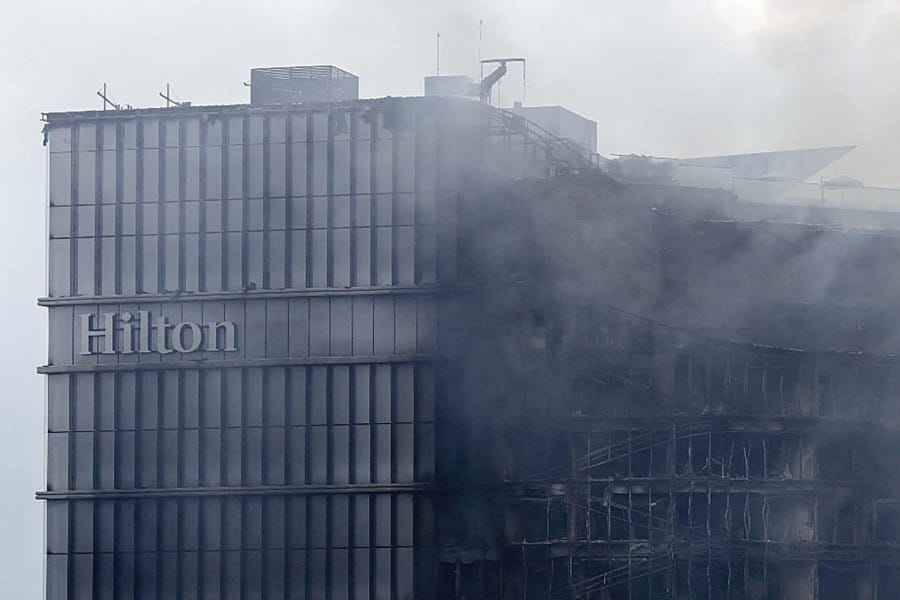
The violence of September 8th-9th marked one of the darkest episodes for Nepal’s private sector since the civil war. Protesters targeted symbols of wealth and influence. Showrooms belonging to the Chaudhary Group, Nepal’s only multinational, were looted and torched. Hotels in Kathmandu and Pokhara, including a newly built Hilton, were set ablaze. Cable cars at Chandragiri and Maulakali, emblems of modern tourism, were vandalised. Car dealerships, electronics stores and even the private residence of Shekhar Golchha, former president of the Federation of Nepalese Chambers of Commerce and Industry (FNCCI), were attacked. Analysts reckon the losses amount to hundreds of billions of rupees. Thousands of jobs vanished overnight. Economic growth, slowly recovering, is sure to take a blow.
Economic ruin on this scale could easily paralyse investment. Yet the reaction from leading entrepreneurs has been almost the opposite. Many have chosen defiance over despair, framing the crisis not only as a personal tragedy but also as a national test. “Yes, we are injured,” declared Nirvana Chaudhary, managing director of the CG Group, “but not broken. History will not remember the flames, but how we emerged united, proud and unbroken.” His words, widely circulated on social media, struck a tone of renaissance rather than retreat.
That defiance is not simply rhetorical. It reflects the peculiar role business plays in Nepal. The private sector accounts for some 80% of GDP and over 80% of employment. Without it, the country’s fragile prosperity would collapse. In a state plagued by political instability and weak institutions, entrepreneurs are frequently forced into roles that transcend commerce. They are seen as providers of jobs and sources of national pride, as well as sometimes even guarantors of social order.
Consider the response of Chandra Prasad Dhakal, the current president of the FNCCI and one of the country’s most prominent industrialists. Standing before a room of shaken entrepreneurs, he recalled how he had started with nothing. “There was no capital, but there was a dream,” he said. Four decades later, his companies employ tens of thousands of people directly and touch millions more indirectly. The fire had destroyed bricks and wood, he conceded, “but our minds, our labour values and our self-confidence will never burn.” His message was that this was not a moment for grief but for collective rebuilding.
Mr Dhakal’s words were also targeted at foreign investors. Nepal relies on external capital to sustain its infrastructure projects, telecoms networks and hydropower plants, among others. The sight of torched showrooms and luxury hotels risks scaring them away. By projecting calm determination, business leaders are attempting to shore up confidence. “We are committed to employment generation and investment—with wishes for a strong democracy,” said Mr Golchha, who despite seeing his home attacked, tied recovery explicitly to the survival of democratic institutions.
That symbolism matters. Business figures in Nepal are accustomed to being vilified as oligarchs and rent-seekers. Yet the aftermath of the protests has recast them in a different light: as national stewards. Their public messages are directed both at investors and citizens. “This is a moment of rebirth for Nepal,” declared Karan Chaudhary, president of the Nepal Automobile Dealers’ Association. He urged Nepalis to be “disciplined and patriotic”, pledging to devote himself to national progress.
None of this diminishes the severity of the blow. Analysts reckon insurance firms face claims far surpassing their reserves. Thousands of workers in hospitality, tourism as well as retail risk losing livelihoods. Consumer confidence may crumble further. Some argue that optimism from tycoons will not repair burnt assets or rehire laid-off staff. Nor can it substitute for sound policy. “The morale is shaken, but many have shown the confidence to rise again,” admitted Birendra Raj Pandey, president of the Confederation of Nepalese Industries, acknowledging both the scale of the trauma and the stubborn resilience of entrepreneurs.
Yet even sceptics recognise that the crisis has opened space for reform. The FNCCI, while condemning the violence, has acknowledged the legitimacy of youth grievances about corruption and unemployment. Business leaders now urge the government to treat those concerns with seriousness. They see reconstruction as a chance to reset Nepal’s economic order. “We must see this as an opportunity,” said Mr Dhakal, “to rebuild stronger; to reform our systems; and to ensure that the next generation will not need to migrate abroad for work.”
The long-term outcome will depend on more than morale. Nepal must bolster policing and create mechanisms to prevent political violence from spilling into economic life. Without such safeguards, repeated shocks could eventually erode even the most resilient private sector. For the moment, though, the rhetoric of defiance serves a purpose. It steadies nerves and encourages reinvestment. It also signals to the public that despair is not inevitable.
“They can loot our showroom,” said Mr Chaudhary, “but they can’t rob our purpose.” That distinction—between assets and aspiration—may determine whether Nepal’s battered economy rebuilds itself into something sturdier. Bricks can be replaced. Belief, once extinguished, is harder to restore. ■





