In 2019 Nepal looked like a country finally preparing to grow up. Its gross fixed capital formation (GFCF)—the share of national income reinvested into roads, power plants and factories—climbed to 34% of GDP, a ratio typical of economies on the cusp of industrialisation. Five years later the figure has slumped to 24%, the lowest in more than a decade and below the global average. In development terms Nepal has shifted from building capacity to consuming it.
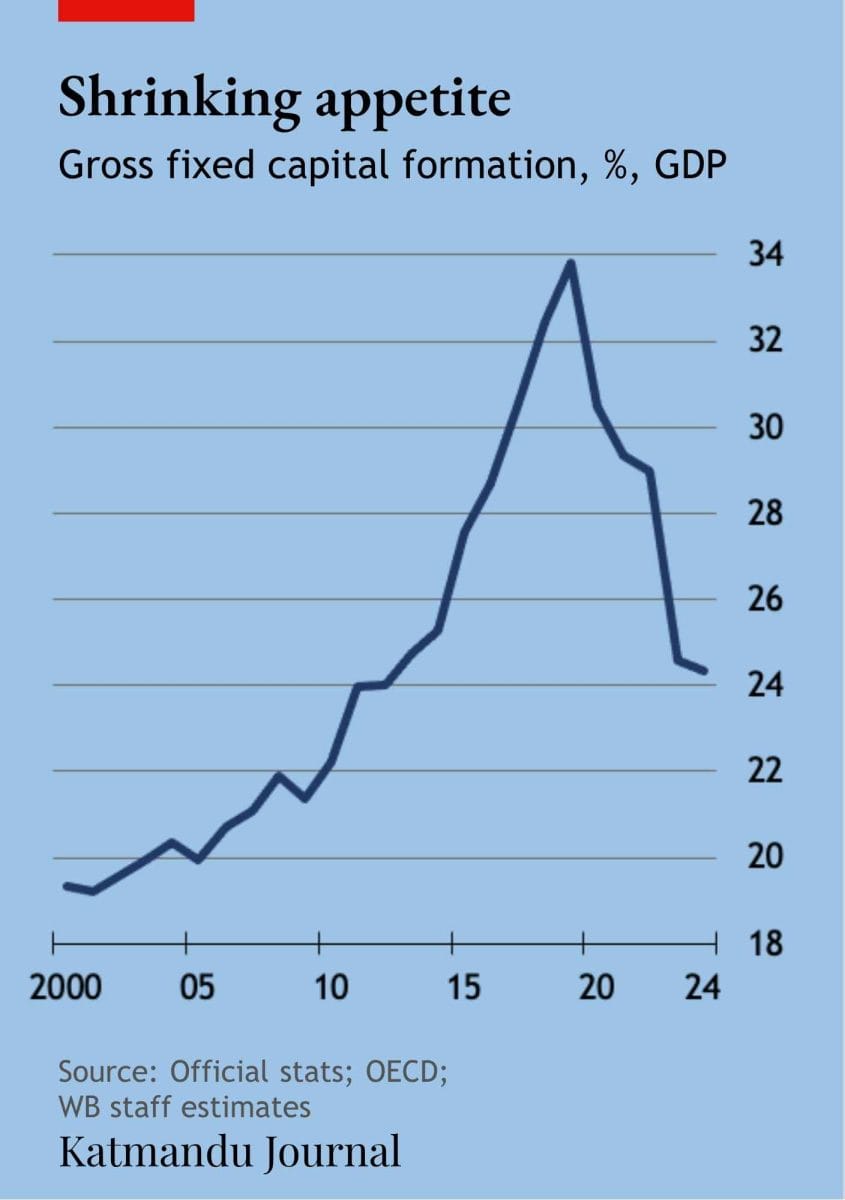
GFCF is a useful barometer because sustained growth in poor economies nearly always requires rising investment. South Korea, China and Vietnam each crossed the 30% threshold before their take-off. Nepal touched it briefly but failed to hold the line. The consequence is visible in job markets and trade accounts: consumption swells on the back of remittances but domestic production lags.
The climb before 2019 was real. Post-earthquake reconstruction funnelled money into roads, schools as well as housing. Multilateral banks backed hydroelectric dams. Kathmandu’s construction boom spurred demand for cement and steel. For a time, Nepal appeared to be turning remittance inflows into productive capital.
The retreat since 2020 reflects a combination of shocks and weaknesses. The pandemic paralysed public works and deterred private investors. Fiscal space narrowed as weak tax revenues met swelling consumption. Foreign investment—already trivial compared with neighbours—slowed further. Political churn, with three prime ministers in three years, undermined policy credibility. Budget execution stays chronically weak: projects stall on red tape or corruption, for example.
Comparisons sharpen the picture. Vietnam sustains investment around 33% of GDP, anchored by export-led industry. Bangladesh manages 31% despite its own turbulence. India hovers near 30% with infrastructure at the centre of strategy. Ethiopia has built furiously at 30–33%. Nepal, at 24%, now falls below the world average and far from the levels seen in successful catch-up stories. It sits closer to Pakistan, where investment languishes near 15% amid crisis.
The risks are clear. Nepal’s youthful labour force—its demographic dividend—finds few productive jobs at home, feeding mass migration to the Gulf and Malaysia. Capital per worker is low and productivity gains are meagre. GDP numbers are propped up by remittance-driven consumption, but with little addition to long-term assets, the growth base corrodes.
There are untapped levers. Pension and insurance funds sit on surpluses but keep them in low-yield deposits. Public capital budgets are underspent year after year. The private sector, deterred by erratic tax policies and weak contract enforcement, shies away from long-term commitments. Foreign direct investment could diversify capital sources, but Nepal has yet to create conditions to attract it.
A familiar objection is that high investment without efficiency produces white elephants. That is true in parts of Africa where donor-funded projects decay quickly. Nepal, however, is not drowning in excess investment, it is starving for basic infrastructure. Reliable hospitals, well-equipped schools, modern transport and industrial zones are still in short supply.
Investment ratios are not destiny, but they signal intent. In 2019 Nepal appeared intent on building a foundation for growth. Today it is living off remittances and imported goods. This way Nepal risks entrenching itself as a consumption economy with little to show at home for the sacrifices of its workers abroad. ■