PHOTOGRAPHER: ALEXANDER KAZAKOV/AFP/GETTY IMAGES
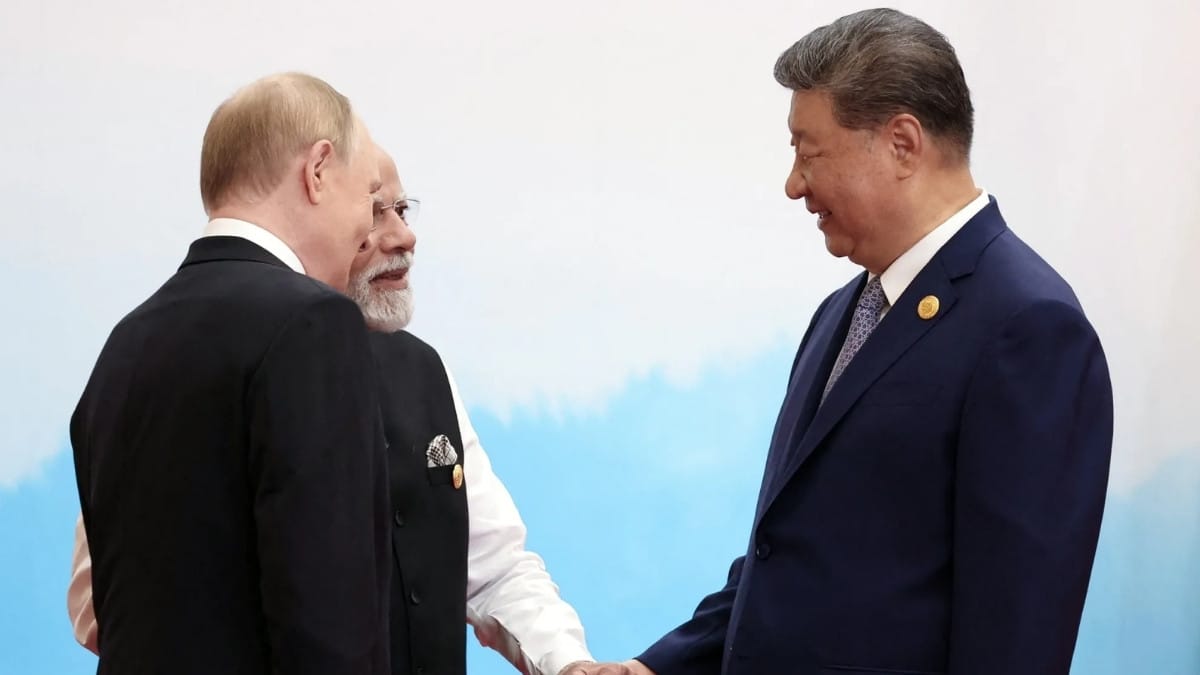
AMONG DIPLOMATS and strategists in New Delhi, a favourite phrase is “multi-alignment”. It captures India’s ambition to be a friend to all and a formal ally to none, navigating between great powers with a dexterity that in turn serves its own interests. The country’s external-affairs minister, Subrahmanyam Jaishankar, has written of exploiting “global contradictions”. In practice this means buying vast quantities of Russian oil after the invasion of Ukraine, while drawing closer to America to counter China. It is a high-stakes game. And it may not end well.
India’s desire for strategic autonomy is down to history and realpolitik. Jawaharlal Nehru, India’s first prime minister, vowed India would never be a ‘camp follower’, a stance forged under British colonial rule. The conviction today is that a rising power must never compromise the freedom of action it will enjoy once it has fully ascended. And Indian policymakers assume that other states act only in their self-interest. Why should India do otherwise?
The logical extension of this worldview is a drive for a “cooperative, multipolar world”, as one former prime minister put it. Unipolarity, with America as the sole hegemon, is seen as an unstable aberration. Bipolarity, as during the Cold War, offers some room to manoeuvre. But multipolarity, with several power centres, is the ideal—a system ripe for exploitation by a canny intermediary. Hence India’s eclectic partnerships, from the American-backed Quad (with Australia and Japan) to the anti-Western brio of the BRICS grouping and the Shanghai Cooperation Organisation, where China and Russia hold sway.
This chequerboard of affiliations produces curious outcomes. Even as India deepens defence ties with America, it lobbies alongside China and Russia in forums like the World Trade Organisation to dilute American influence on e-commerce and data rules. It pursues trade in local currencies to hedge against American sanctions, even as it relies on American naval power to keep Indian Ocean sea-lanes secure. It positions itself as a champion of the “global South”, while its economy, now the world’s fourth-largest, increasingly distances it from its poorer neighbours.
Worse, India’s multi-alignment rests on a precarious assumption: that America will indefinitely tolerate a partner that actively works to constrain American power, because it needs India as a counterweight to China.
So far, this has held. Successive American administrations, recognising India’s strategic value, have overlooked its dalliances with Moscow and Tehran. They see the relationship as a long-term investment. “A stronger India would make for a stronger United States,” is a common refrain in Washington think-tank circles. But patience is not infinite. A more transactional American administration like this one could ask why it should share sensitive technology or offer military support to a country that undercuts American interests at every turn. India’s attempt to conduct bilateral trade in rupees and dirhams to bypass the dollar, while pragmatic for New Delhi, looks to some in Washington as free-riding on a system America guarantees.
The larger flaw in India’s multipolar dream is that it may not come to pass—or may prove unpleasant. Genuine multipolarity requires several nations of roughly equal strength. By 2050, however, America and China are projected to be in a league of their own economically and militarily. The world is coalescing into two camps, rather than many. In a bipolar system, India’s room for manoeuvre shrinks. Its cherished autonomy could become isolation.
Indian strategists are not blind to these tensions. They talk of “issue-based alignments” and “strategic autonomy with Indian characteristics”. Yet the core contradiction remains: India wants American support to grow strong enough to help render American supremacy obsolete. It is betting that the geometry of power will always provide it with options. But in geopolitics, as in geometry, the angles of a triangle are not always what they seem. ■