Photograph: Getty Images
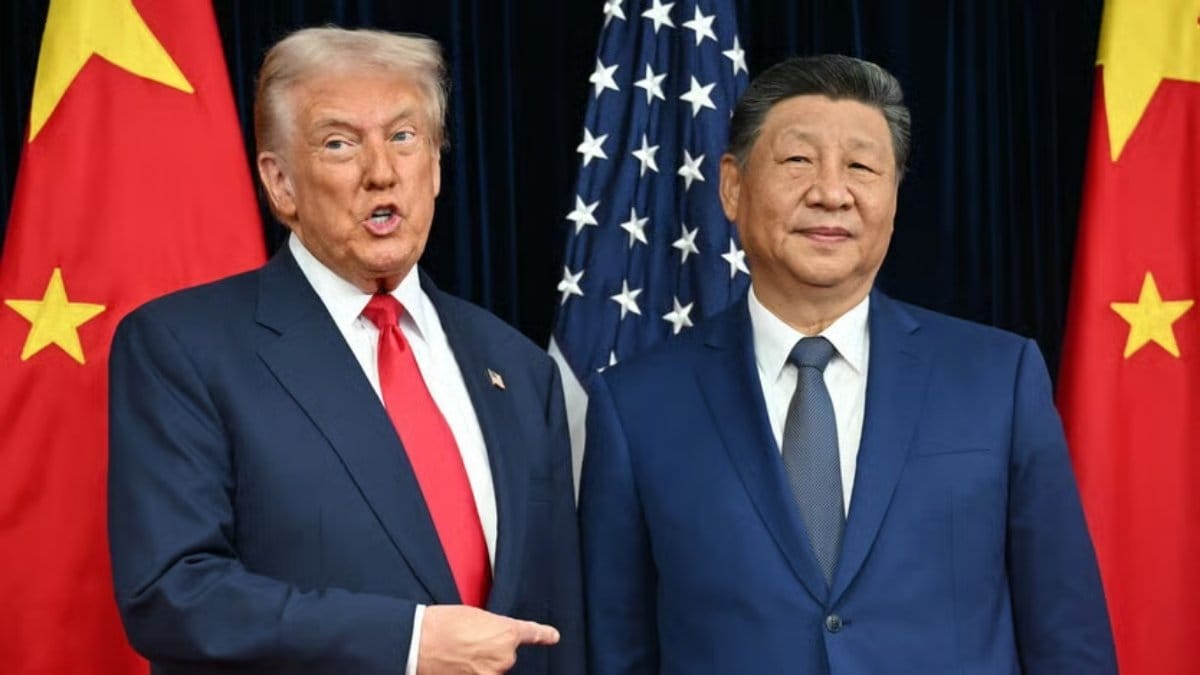
It was, by the standards of recent American–Chinese encounters, almost cordial. When Donald Trump met Xi Jinping in Busan this week, the two men clasped hands before a row of flags and declared “major progress”. The former television personality, now in his second term as America’s president, promised that relations were “back on track”. Mr Xi spoke of a “new chapter of cooperation”. Both had reason to smile. The United States agreed to cut tariffs on Chinese imports by ten percentage points, to 47%, while China suspended new restrictions on exports of rare earths. Each could return home claiming victory: Mr Trump as the master of the deal; Mr Xi as the steadfast guardian of national pride.
The détente, though real, is fragile. It was only months ago that Washington accused Beijing of flooding the market with subsidised electric cars and manipulating its currency, while China railed against American “containment” in technology and defence. The Busan meeting produced no lasting settlement, merely a one-year truce. China will resume buying American soyabeans and ease port fees on foreign ships; America will in return pause some sanctions and defer fresh technology bans. Both sides spoke of “reciprocal adjustments”.
At the heart of the accord stands the tariff cut, a symbolic concession from a president who has built his political persona on toughness. The reduction rewards Beijing for promises to stem the export of fentanyl, the synthetic opioid ravaging America, and to reopen agricultural channels frozen by retaliation. For China, the gesture buys time for a faltering economy weighed down by debt and deflation. For the United States, it may temper inflation and soothe discontent in the Midwest, where unsold crops have piled up since Chinese buyers withdrew. Yet even as farm states cheer, few expect the old trade order to return. The new normal is managed hostility: selective cooperation within a shadow of suspicion.
Nowhere is this more evident than in the murky world of rare earths, the minerals that power everything from smartphones and EVs to missiles. China dominates global supply, controlling nearly four-fifths of production. Earlier this month it had tightened export controls, rattling industries that depend on its metals. Its promise in Busan to lift those restrictions for a year—and to waive port fees on American ships—was thus a welcome reprieve for global manufacturers. Mr Trump hailed it as the removal of a “roadblock”. In truth, the obstruction remains; it has merely been moved aside. Beijing’s leverage endures, and will grow as demand for clean-energy technology expands.
Mr Trump arrived in South Korea after a whirlwind tour of Malaysia and Japan, where he was lavished with gold-plated gifts and flattery. Seoul awarded him its highest civilian honour. Such extravagance was not lost on Mr Xi, whose aides ensured that the Busan stage managed to flatter both men equally. For regional hosts, indulging Mr Trump’s vanity is a small price to pay for economic indulgence: Japan secured new minerals deals; South Korea won American approval to build a nuclear-powered submarine.
The most jarring note came from Mr Trump himself. Hours before meeting Mr Xi he announced that America would resume nuclear testing after a thirty-year moratorium, claiming that China and Russia had advanced their arsenals in secret. Beijing urged Washington to uphold its treaty obligations; Tokyo reaffirmed its faith in a world without nuclear weapons. The declaration undercut the very notion of détente. It reminded observers that while trade may be negotiable, security is not. Economic rapprochement now coexists uneasily with military rivalry—a pattern seen in the late cold war, and newly revived in this one.
Technology remains another fault line. The two sides hinted at a resolution over TikTok, the video app whose Chinese parent has been ordered to divest its American assets. Mr Trump said details were being “ironed out”, while Beijing promised to “properly address” the issue. Chip exports, too, are in limbo, with negotiations between Chinese officials and Nvidia proceeding under Washington’s watchful eye. The discussions suggest a grudging pragmatism: both countries wish to keep their industries alive even as they police the frontier between commerce and security.
For all the grand declarations, then, the Busan summit was less a breakthrough and more a breathing space. Each side secured domestic credit at minimal cost. Mr Trump can boast that he extracted concessions without new conflict; Mr Xi can claim that China stood firm and was treated as an equal. But neither altered the fundamentals of a rivalry that defines the age: America seeks to preserve its technological supremacy, China to reclaim its economic momentum. The handshake in Busan may slow the drift toward confrontation. It does not change its direction. ■