
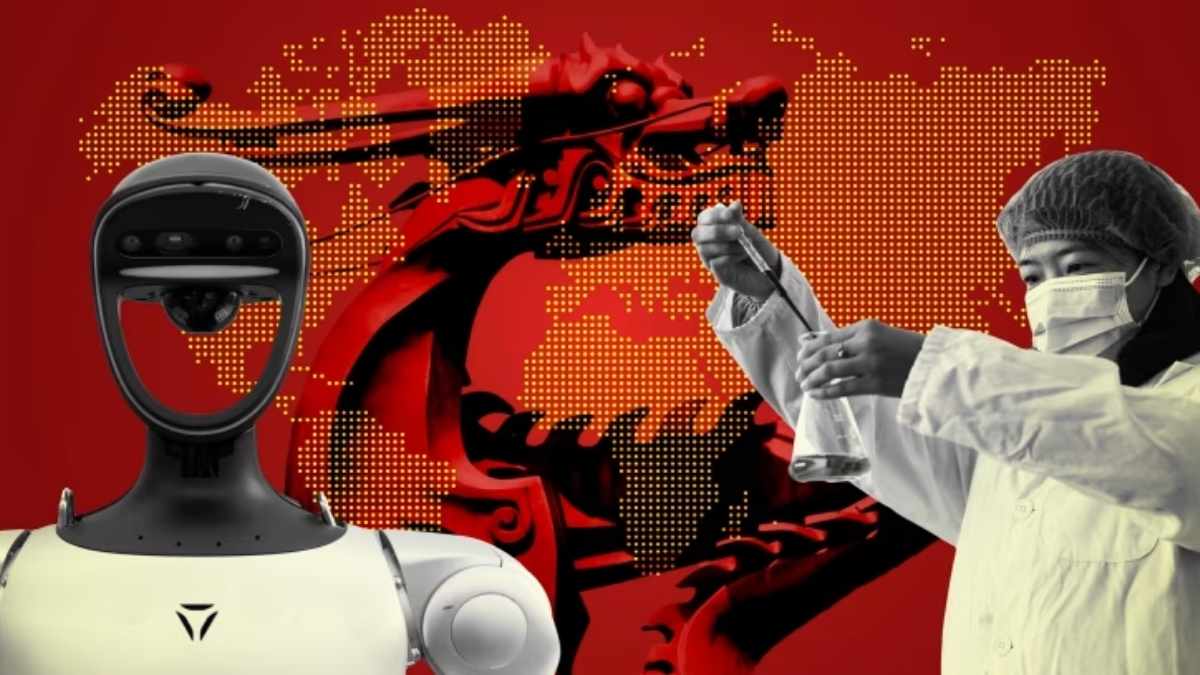
Image: FT montage/Getty Images
When a country dominates three successive global industries—solar panels, electric vehicles (EVs) and open-source artificial intelligence—in the space of a few years, the world should take note.
China’s formula for industrial supremacy has become obvious. It starts with massive manufacturing capacity. The state then pours in support through cheap credit, land and subsidies. Fierce domestic competition is encouraged, forcing firms to drive down costs and boost quality. Local regulators are permitted to experiment. Only then do the resulting corporate champions turn to global markets. Now observe two new industries where this playbook is being run again, almost point-for-point: autonomous vehicles (AVs) and new drug discovery.
Also read: How China engineered global solar dominance
Start with self-driving cars. China’s advantages in scale and cost are unmatched. Analysis by HSBC, a bank, finds that the average Chinese robotaxi costs around $40,000. That is between one-third and one-quarter of the price of a Waymo vehicle in America, which runs from $130,000 to $200,000. Baidu, a Chinese tech giant, has launched its RT6 model at $35,000. This price collapse is made possible by China’s existing EV manufacturing dominance, its control of key components such as lidar sensors and the depth of its supply chains. Huge production volumes rapidly lower unit costs.
China’s regulatory speed is another source of advantage. More than 50 Chinese cities allow AV testing on public roads; over ten permit commercial robotaxi operations. Local governments compete to attract AV firms with rapid pilot approvals, government-funded digital infrastructure such as smart traffic lights and swift rulemaking for liability and testing. America, by contrast, is slowing or blocking AV pilots in many states because of safety fears. China’s domestic market provides a perfect training ground. It has 139 cities with more than 1m people, compared with ten in America. Dense, chaotic traffic produces the world’s richest driving data, a critical advantage for training AI.
Brutal competition at home creates future export champions. Robotaxi operators must compete with each other, cheap human-driven taxis and sinking fares due to deflation. This pressure forces faster iteration, ultra-low-cost engineering and capital efficiency. Many firms will fail, but the survivors emerge as hypercompetitive global players, much as happened with EVs and solar panels. Global expansion is already under way. Chinese robotaxi firms have testing or commercial licences in Luxembourg, South Korea, Dubai, Hong Kong, Switzerland and Britain. They are blocked only in America on national-security grounds. The rest of the world is open.
A similar transformation is unfolding in pharmaceuticals. China is already the world’s second-biggest drug innovator, after America. It ran 33% of the world’s clinical trials last year, up from 5% a decade ago. In 2024 China approved 93 new drugs, 42% of them made domestically. A regulatory overhaul between 2015 and 2018 removed the biggest bottleneck. China’s drug regulator quadrupled its workforce, cleared a backlog of some 20,000 applications and cut clinical-trial approval times from over 500 days to under 90. The result is the fastest clinical-trial pipeline in the world.
China’s “sea turtles”—scientists returning from abroad—have brought Silicon-Valley-style biotech culture home. Returnees with experience of America’s Food and Drug Administration rebuilt China’s biotech industry from scratch. They brought venture-financing know-how, clinical-trial management skills, global regulatory literacy and partnerships with global pharma firms. China is now innovating and not just copying. It has moved from generics to fast followers to first-in-class drugs. Some 40% of its drug pipeline is now first-in-class. In a landmark moment, a lung-cancer drug from Akeso Bio, a Chinese firm, outperformed Merck’s, an American company, Keytruda in trials.
China is becoming the world’s discount research-and-development lab for big pharma. Western drugmakers face a $300bn patent cliff by 2030, as old drugs lose patent protection. Global firms are rushing to China to refill their pipelines. Pfizer paid $1.25bn to license a Chinese cancer drug. GSK signed a deal worth $500m, with up to $12bn in milestone payments. One-third of global licensing deals in 2025 are with Chinese biotechs. China’s immense patient pool accelerates trial speed. Large populations enable fast enrolment; strong hospital networks allow rapid data gathering. This is particularly advantageous for oncology, antibody-drug conjugates, obesity drugs and gene therapies.
The true prize is global markets. China’s drug market is worth $125bn, one-sixth the size of America’s. It is also highly price-controlled under state insurance, producing slim margins. The big profits lie in America, Europe and Japan. Chinese firms are creating new companies in America to bypass political barriers and list drugs locally.
Both AVs and biotech are “general purpose technologies” that reshape entire sectors from mobility and logistics to health care and longevity. Both depend on massive datasets, AI training, fast iteration, large populations, regulatory flexibility and industrial scale: areas where China has structural advantages. Both also create long-term global lock-in, as AV software ecosystems bind cities and transport systems, and pharma pipelines bind health systems, insurers and hospitals. Supply-chain control gives China geopolitical leverage.
The West is falling behind. Regulatory conservatism restricts AV pilots in many American and European cities. The FDA is wary of China-based trials; Europe is losing ground in biotech. Political hostility to immigration repels talented scientists that China attracts. Decreasing public investment in science hampers basic research in America; Europe lacks integration to fund big bets. Regulatory fragmentation is also a problem: America’s federal system splits authority, and Europe has 27 different regimes for pharma and AVs. China’s system moves in unison when national priorities are set.
The lesson is that China’s innovation is not just a matter of authoritarian planning. Its edge is in organisational speed, scale, fast feedback loops, dense ecosystems, local experimentation, central ambition and price discipline. The West misdiagnoses China’s rise as the product of subsidies and authoritarianism. But its private-sector inventiveness and regulatory agility are just as important, and harder for democracies to match. The same forces that made China the world’s leader in EVs, solar panels and open-source AI are now concentrated on self-driving cars and next-generation medicines. These sectors will define geopolitics, supply chains and global standards for the next two decades. The world should prepare. China is building the template for industrial dominance in the 21st century. ■





