
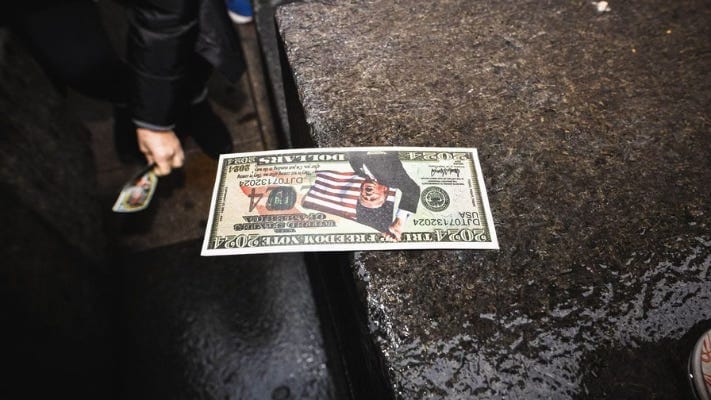
IMAGE: DAVE DECKER/ZUMA PRESS/EYEVINE
THE YARDSTICK of American financial hegemony is crumbling. Over the past year, the US dollar index, a measure of its strength against a basket of six major currencies, has fallen by some 10%, its steepest tumble in four years. On January 27th President Donald Trump welcomed the slide, which should help bring down the trade deficit. The slide is the culmination of a major shift in the global economy, as American policy choices are gradually undermining the pillars of dollar dominance. The greenback’s status seemed unassailable for decades, as certain as gravity itself. Now investors are watching that certainty weaken.
The proximate cause is interest rates. The Federal Reserve for months has been slashing rates, describing its actions as buying insurance against a hiring slowdown. Jerome Powell, the Fed’s chairman, has pursued that path notwithstanding persistent inflation. Meanwhile the European Central Bank has held firm since June 2025. The narrowing gap between American and European rates has made the euro more attractive, pulling capital across the Atlantic. As the euro constitutes over half the dollar index’s weight, that shift alone carries immense force.
Yet monetary policy is only part of the story. The dollar’s weakness is also a fiscal story. Last year’s sweeping tax and spending legislation, known as the One Big Beautiful Bill Act, made permanent trillions of dollars in previous cuts. The Congressional Budget Office estimates it will add over $4trn to the national debt including interest. Such a figure, looming in an era of heated borrowing costs, unsettles the creditors who fund America’s deficits. “The twin deficits are back with a vengeance,” notes a strategist at J.P. Morgan Asset Management. When foreign capital grows hesitant, the dollar’s foundations tremble.
America’s trade policy has only worsened the problem. The administration’s abrupt imposition of steep tariffs on allies and rivals alike last year sought to remake global commerce. Traditional theory held that such protectionism might boost the dollar by weakening imports. The reality has been the opposite. The tariffs introduced an uncertainty premium, raising fears that America is deliberately isolating its economy. Investors now view the dollar not as a safe harbour from global storms, but increasingly as the source of the storm itself. In moments of tension, money now tends to flee to gold or the Swiss franc.
That erosion of absolute trust is accelerating a long-brewing trend: de-dollarisation. For years rivals like China and Russia have championed alternatives to the dollar-based financial system. Their efforts are gaining practical traction. Nearly all Sino-Russian trade is now settled in yuan or roubles. India is buying oil in rupees. The infrastructure for bypassing the dollar is being built contract by contract. The weaponisation of dollar access through sanctions has given every nation a beautiful reason to develop an escape route.
The effects are significant. A weaker dollar makes America’s vast imports more expensive, possibly fuelling the very inflation the Fed hopes to tame. It eases debt burdens for emerging markets that borrow in dollars. It also alters corporate balance sheets the world over, affecting everything from commodity prices to the value of overseas earnings. The world’s financial architecture for decades assumed dollar strength. A prolonged soft patch demands a recalibration.
No single currency is poised to dethrone the dollar. The euro lacks a unified fiscal backbone and the yuan is tightly controlled. The system is evolving towards multipolarity rather than towards a new hegemon. The dollar will stay first among equals but the premium it once commanded for its stability and predictability is fading. Its decline reflects a world adjusting to an America that is simultaneously cutting rates; expanding debt; and raising trade barriers. ■





