
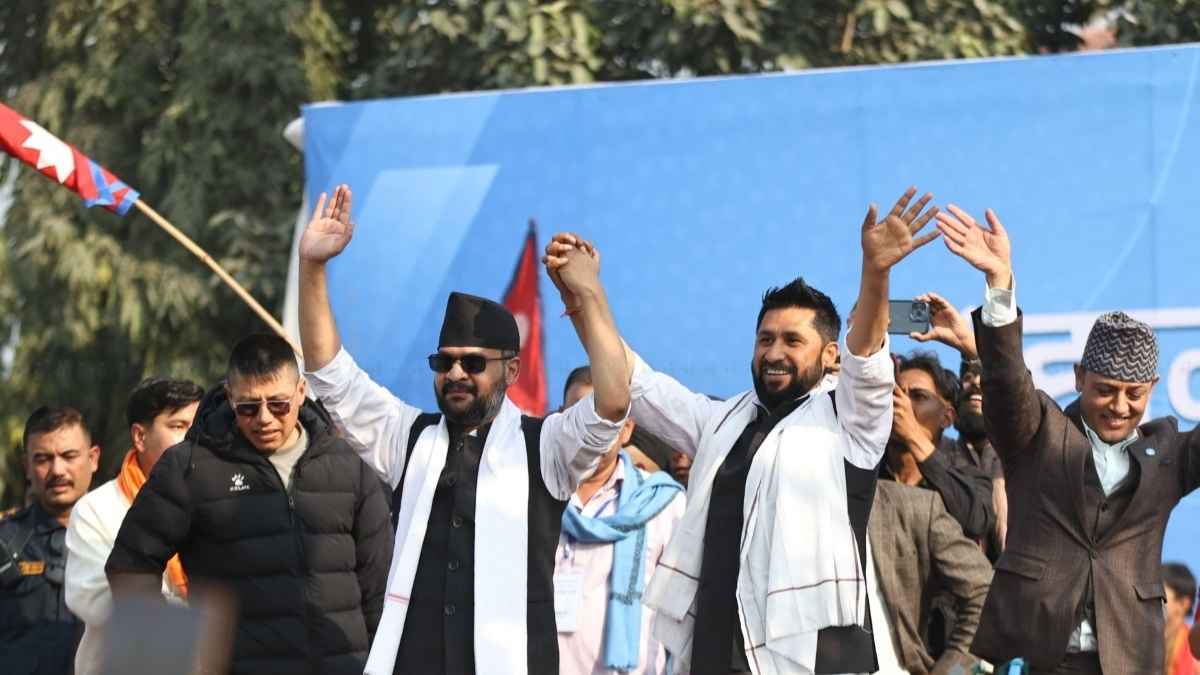
IMAGE VIA SETOPATI
NEPAL HAS a long history of bold election promises. Every cycle, freshly printed manifestos pile up like monsoon debris, each pledging transformation, each forgotten by election’s end.
The Rastriya Swatantra Party, the insurgent darling of young urban voters, has formalised that tradition. Its Nagarik Kararam—Citizens’ Agreement—acts as a contract rather than a manifesto, treating the voter’s ballot as an “investment”. Prospective voters should read the fine print.
Start with the headline economic targets. The party pledges to grow Nepal’s GDP to $100bn in five years. Today the economy is $42.9bn, according to the World Bank. Hitting that target would require about 20% annual growth—up from roughly 4%—a pace no country of Nepal’s size has maintained for five consecutive years, not even China at its fastest.
The RSP also promises to lift average per capita income past $3,000 from $1,447. The math goes beyond optimism: it belongs to another universe entirely.
The electricity ambitions are similarly nuts. It commits to 15,000 megawatts of installed capacity. Nepal, after three decades of hydropower promotion, international financing as well as endless political speeches, has installed roughly 3,400 megawatts. The party would need to build, in five years, what the country failed to build in thirty.
Then the roads: 30,000 kilometres of new national highways. Nepal’s current network totals about 36,000 kilometres—much unpaved, potholed and seasonally impassable. Doubling it in one term would require construction speeds the public works system has never achieved, financed by a budget already in deficit. Ten “Signature Projects” are promised, though none are named.
The jobs pledge is the most revealing. The RSP commits to 900,000 new formal, safe jobs in five years, focused on IT, tourism, agriculture, energy and construction. Each year roughly 500,000 Nepalis enter the labour market. Over 2,300 leave daily, mostly for the Gulf or Malaysia, where wages and conditions still beat what Nepal offers. Generating enough jobs would demand private investment, functional regulations and existing infrastructure: none of which appear in the document. Stopping forced migration, as the RSP calls it, is the right instinct, but announcing a number cannot achieve it alone.
The Nagarik Kararam contains an irony its authors may not have intended. It identifies Nepal’s deepest problem: the “dalyakaran”, or party-ification, of every state institution, from civil service appointments to corruption probes. Political parties dominate the bureaucracy, judiciary and public enterprises, making competent governance nearly impossible.
RSP’s proposed cure—a new Anti-Corruption Agency and a high-level commission to review assets since 2020—is sensible in isolation. But any such body will be staffed by, overseen by, and accountable to the political class it is meant to monitor. Nepal already has a Commission for the Investigation of Abuse of Authority, which over the years has produced mostly paperwork.
The diaspora section is at least clear. Online voting for non-resident Nepalis is feasible even if the Election Commission struggled with in-person ballots last cycle. The bigger goal—using the skills and money of Nepalis abroad—is valuable. Millions live overseas, sending home about a quarter of GDP. Connecting them formally to the economy is worth trying and is one area where ambition can meet reality.
The Nagarik Kararam shows the challenge new parties face in a system where voters are disappointed so often that only big promises gain attention. RSP’s leaders are aware. They know 55,000 megawatts is a number, and 900,000 jobs don’t appear from bullet points. But the document speaks to a Gen-Z electorate that has seen governments fail and wants to feel someone grasps the scale of the problem. The Citizens’ Agreement delivers that sense well. Whether it achieves anything else is left unanswered. ■
Correction (February 16th 2026): A previous version incorrectly said the RSP pledged 55,000 MW of hydropower within five years. The correct figure is 15,000 MW. Sorry.




