
IMAGE: FLICKR
THE VAULTS of Nepal’s commercial banks contain trillions of rupees that nobody wants. The central bank has cut interest rates twice in the past year. Lending now costs around 7.12%, down from double digits as recently as mid-2024. Yet private sector credit growth is crawling along at less than 5% in the second quarter, miles below the 12% target set by the Nepal Rastra Bank. The usual remedy for a sluggish economy, ie: cheap money, has stopped working.
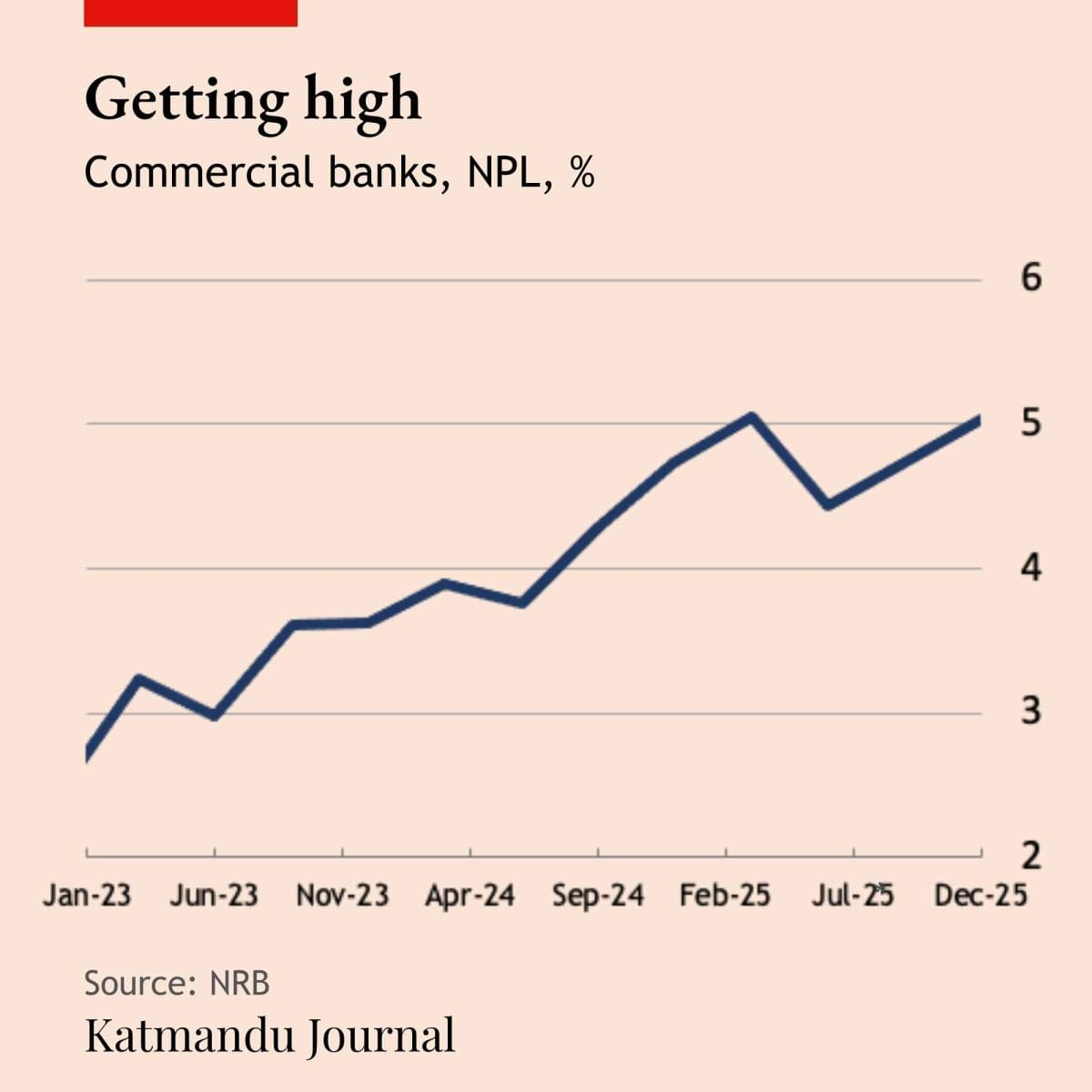
The puzzle is not that banks are reluctant to lend. Non-performing loans have leapt past 5% (see chart), up from below 3% a few years ago, so some caution is understandable. The stranger phenomenon is on the other side of the counter. Businesses and households that would typically grab cheap credit are staying away. Loan applications are down. Expansion plans have been shelved. The economy is experiencing what local economists call a “recession-like situation” without the usual hallmarks of recession (see this).
The proximate explanation lies in the streets of Kathmandu five months ago. In September the Gen Z protests erupted. It started as youth frustration over unemployment and governance failures, but grew into something darker. Crowds targeted business establishments. The Chaudhary Group, Ncell, Bhatbhateni Supermarket—household names all—suffered arson and looting. Official estimates put direct physical damage at Rs84.45bn. A subsequent private-sector survey found that 98% of business owners reported a severe decline in morale. 21% of entrepreneurs with net worth over one billion rupees saw their personal homes or vehicles attacked.
That trauma has frozen the investment cycle. Businesses that would ordinarily borrow for expansion are instead hoarding cash and waiting. 70% of owners say they will make no new commitments until after the March 5th elections, according to that same survey. They want to see whether the next government can protect property and enforce the rule of law. The protesters’ narrative, which cast businessmen as exploiters rather than job creators, has left deep scars. Low interest rates cannot cure a crisis of confidence.
Also read: Why Rameshwor Khanal’s reforms are already dead
The government has not helped. In October the cabinet froze Rs125bn of the development budget as an austerity measure. Capital expenditure, the primary driver of demand for construction, manufacturing and transport, slowed to a crawl. By mid-year the Department of Urban Development had spent just 14% of its allocated funds. When the government halts road-building and infrastructure projects, private contractors stop seeking working capital loans and equipment financing. The freeze created a fiscal drag that counteracted the central bank’s monetary stimulus.
This combination—political trauma and fiscal paralysis—has produced a peculiar liquidity trap. Nepal’s banks are awash in deposits thanks to remittances from the million-plus citizens working abroad. But the very people who would borrow to start businesses or buy homes are leaving the country. Those who remain are too spooked to invest. The result is more than Rs1trn parked in low-yield instruments or sitting at the central bank. The credit-to-deposit ratio has fallen to 74%, well below the 90% ceiling permitted by regulators. Some banks are barely lending at all.
One might expect such conditions to crush asset prices. Yet real-estate transactions jumped 301% between mid-November and mid-December, compared with the previous month. The spike followed NRB’s decision to raise the housing loan limit to Rs30m and increase the loan-to-value ratio for first-time buyers to 80%. But this is probably pent-up demand from urban professionals reallocating capital into land as a safe haven, not a broad-based recovery. The stock market has also seen institutional buying, largely because insurance companies, starved of yield on bank deposits, are chasing returns in equities.
None of this is what the central bank intended when it unveiled its monetary policy for this fiscal year. Governor Biswo Poudel lowered the policy rate to 4.5% and reduced the deposit-collection rate to 2.75%—all meant to push banks out of the central bank’s facilities and into the lending market. The policy also raised margin lending limits for stock market investors and eased terms for home buyers. Technically, the monetary transmission mechanism is working: lower policy rates have reached borrowers. The breakdown is elsewhere, in the real economy’s refusal to respond.
The uglier structural problem is that Nepal’s economy runs on remittances not production. The same workers who send money home are absent from the domestic labour force. Their families deposit the cash in banks, creating liquidity. But without a productive workforce and with an investment climate poisoned by political violence, that liquidity has nowhere to go. Nepal’s per capita income of about $1,447 is half India’s, yet prices for many goods are higher. Ordinary households have little purchasing power left after meeting basic needs. Consumption-based lending, the bread and butter of retail banking, remains subdued.
Meanwhile Nepal is on the Financial Action Task Force’s grey list, increasing scrutiny of cross-border transactions and raising the cost of foreign borrowing. Fitch Ratings affirms a BB-minus sovereign credit rating, which suggests stability but not enthusiasm. Foreign direct investment, essential for the country’s planned graduation from least-developed country status later this year, trickles in slowly. Domestic investors see little reason to commit when the political signal from the grey list is that the financial system cannot be fully trusted.
What would break the stalemate? Not cheaper money—it is already cheap. Not more liquidity—the banks are drowning in it. The requirement is political. The next government, formed after March elections, must demonstrate that private property is secure; that development budgets will be spent; and that the rule of law applies equally to protesters and policemen. Only then might the cash sitting idle begin to move. Otherwise banks will keep lending money that nobody wants to borrow. ■
Correction (February 17th 2026): An earlier version of this story incorrectly said the credit-to-deposit ratio has fallen to 60%. In fact it has sunk to 74%. Sorry.





