
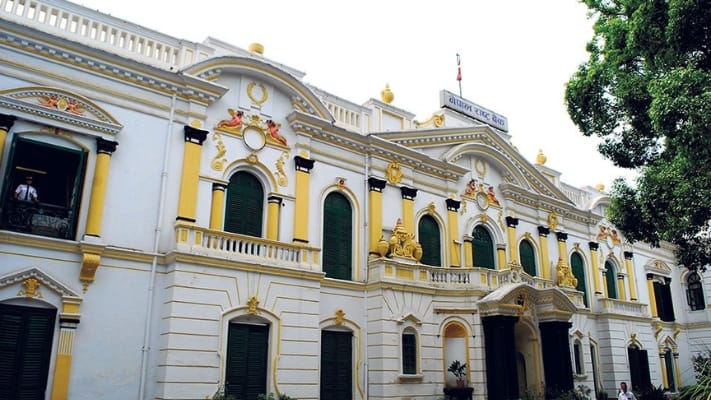
IMAGE VIA GOOGLE
IN THE BACK ROOMS of Kathmandu’s commercial banks, a curious thing is happening: lenders are becoming landlords. Not by choice, and not in properties they would have picked. Himalayan Bank, one of the country’s largest, now sits on Rs6.1bn of assets it never intended to own—land, buildings, half-finished hotels. Global IME Bank is not far behind, with Rs6bn of seized collateral gathering dust. In total, Nepal’s 20 commercial banks hold Rs43.6bn in what the regulators delicately call “non-banking assets”. That is 133% more than they held two and a half years ago. The economy, by contrast, has grown barely 4% a year.
The official narrative is reassuring. Non-performing loans, at 5.26%, are elevated but manageable. Loan-loss provisions, at Rs296bn, provide a thick cushion. The banking system is stable, and the NBA pile, though large, represents less than 1% of GDP. Nothing to see here.
Also read: Releasing billions in seized property could revive lending and investment
The truth is uglier. Non-banking assets are not just bad loans by another name. They are the physical residue of credit gone wrong—foreclosed property that earns no interest, requires maintenanc, and cannot be sold without recognising a loss. And because selling below carrying value eats into capital ratios, banks prefer to hold, hoping for a price recovery that may never come. The result is a balance-sheet traffic jam: capital locked in dead assets, unable to finance the new lending the economy desperately needs.
The timing could not be worse. After a decade of deceleration—real GDP growth has fallen from 8.6% to below 2% in six years—Nepal needs its banks firing on all cylinders. Private sector credit growth, once 26%, is now in the single digits. Gross fixed capital formation has dropped 13 percentage points as a share of GDP. The economy is starved of investment, and the banks, sitting on Rs43.6bn of inert property, are part of the problem.
How did they get here? The answer lies in the credit boom of 2018-22, when banks lent freely against collateral appraised at peak-cycle values. Real estate, construction and hospitality soaked up the liquidity. Then interest rates spiked, growth stalled and borrowers could not pay. Foreclosures followed. Now the seized properties sit on bank books, and the disposal market is too thin to absorb them. Auctions attract no bidders. Title disputes are common. And the valuation gap—between what banks lent and what the market will pay—is too wide to cross without pain.
Standard Chartered Nepal, the sole bank with zero NBA, proves that discipline works. Its underwriting avoided the sectors and structures that generate distressed collateral. The rest of the industry has no such excuse. But blaming bankers, however satisfying, does not unlock capital. That needs a structural solution.
The obvious answer is a dedicated asset management company—a bad bank, in plain English—to acquire these assets at a discount; manage them professionally; and sell them into a recovering market. International precedent abounds. Korea’s KAMCO, Malaysia’s Danaharta and India’s NARCL all show that centralised resolution can work, provided the institution is properly capitalised, legally empowered and insulated from political interference. A Nepal Asset Management Company, capitalised with government guarantees and multilateral support, could acquire, say, 70% of the NBA stock, recycle Rs22bn-30bn back into banks’ lending capacity and unlock Rs160bn-180bn in fresh credit. That is equivalent to more than 3% of GDP.
The objections are predictable. A bad bank is a bailout. It rewards reckless lending with public support. It creates moral hazard. All true—and all less damaging than the alternative. Without intervention, the NBA pile will continue compounding at 35% a year, reaching Rs80bn by 2028. Capital will stay trapped. Credit will remain constrained. And growth will stay stuck below potential. The cost of inaction is not zero. It is a permanently impaired banking sector and a chronically underperforming economy.
The political economy is messy. State-owned banks, with low NBA figures, have little incentive to act. Heavily exposed private lenders, desperate for relief, will lobby for generous terms. The central bank, protective of its regulatory turf, may resist an independent institution with special powers. But the macroeconomic window is open. Foreign reserves are at record highs. Interest rates are falling. Growth is tentatively recovering. Delay only makes the problem larger and the politics harder.
Nepal’s regulators face a choice. They can treat non-banking assets as a footnote—a modest 0.71% of GDP, nothing to worry about. Or they can see them for what they are: a slow-acting solvent on the banking system’s capacity to finance growth. The first option is easier. The second is necessary. A bad bank is not a sufficient condition for recovery. But it may be a necessary one. And the longer Kathmandu waits, the more expensive the cure becomes. ■





