IMAGE: REUTERS/NAVESH CHITRAKA
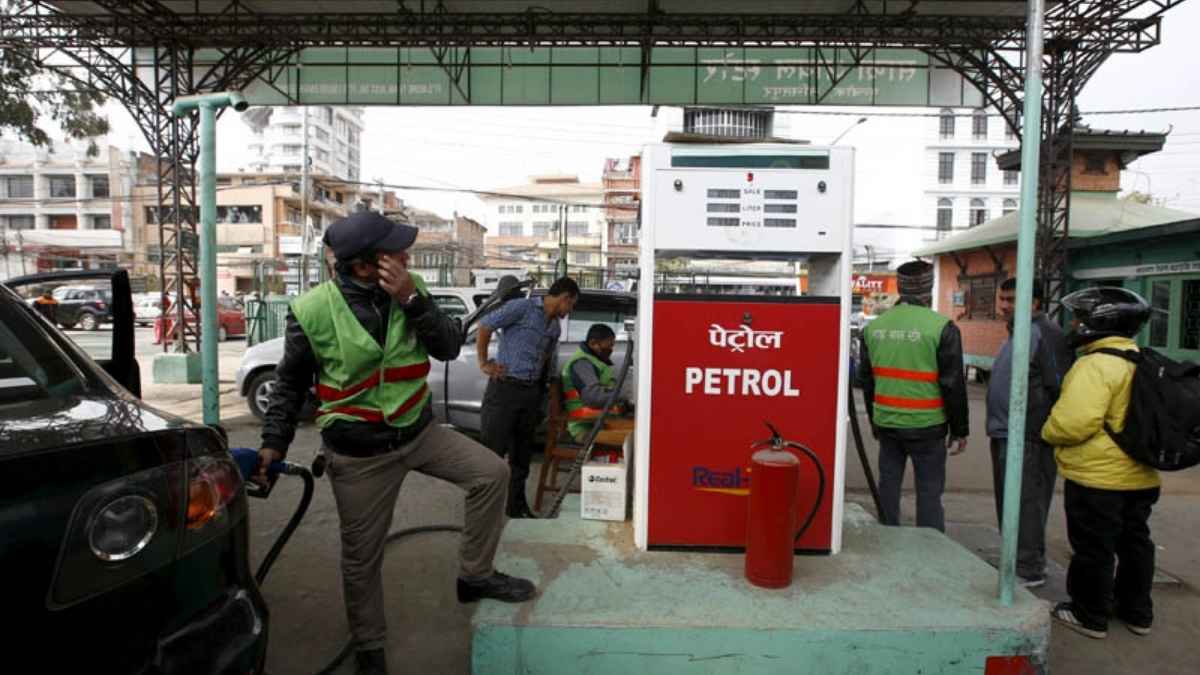
THE FIRST sign of trouble arrived in a fuel pump’s clicking meter. On February 28th petrol in Kathmandu cost Rs157 a litre. Thirty-three days later, after three separate price hikes, the same litre fetched Rs202, soaring nearly 30%.
For Nepal where the average monthly wage hovers around Rs30,000, that is a budget breaker. And the cause is a war in the Persian Gulf, where American and Israeli forces have been striking Iranian targets since late February. Nepal, like many other Asian countries, has become an unlikely front line in the economic warfare now raging around the Strait of Hormuz.
The speed of the shock is what distinguishes this moment from previous crises. When Russia invaded Ukraine in 2022, global oil prices surged, and Nepal felt the pain. But that build-up took some time. This time the transmission belt has moved at digital speed.
Nepal imports every drop of its refined fuel from the Indian Oil Corporation, which adjusts prices every fortnight based on international benchmarks. Those benchmarks have gone berserk. Brent crude, forecast in February to average $64 a barrel, has traded above $100 for weeks, briefly touching $119 last week.
The result is that the Nepal Oil Corporation (NOC), the state monopoly, is now losing over Rs11bn ($74m) every two weeks, selling petrol and diesel at prices far below what it pays. On diesel alone, the gap between the purchase price of Rs303 a litre and the retail price of Rs182 means a loss of more than Rs120 per litre. The NOC’s break-even price for petrol is Rs236; it charges Rs202. For cooking gas, the shortfall is Rs416 a cylinder.
Those losses are not sustainable. Already the NOC has raised prices three times in a month, and officials warn that more hikes are inevitable. The alternative—letting the corporation run out of cash to pay its Indian suppliers—would mean fuel queues as well as factory closures and a halt to transport.
That is the nightmare scenario for a country that depends on imported fuel for everything from trucking vegetables to running backup generators in hospitals. And unlike in 2022, when global supply chains eventually adjusted, this crisis involves a physical chokehold.
Iran has imposed a de facto blockade on the Strait of Hormuz, through which roughly a fifth of the world’s oil passes. By late March daily vessel transits had fallen from 138 to as few as 11. A “ghost fleet” of sanctioned tankers moves under special permission but everyone else waits or turns back.
The human consequences are not confined to filling stations. Nepal’s economy runs on remittances from its diaspora, and more than 1.7m Nepalis work in the Gulf states. They are now stranded in a war zone. Under the kafala sponsorship system, many cannot leave without their employer’s consent, and their passports are often held by the companies that hired them.
Last month a Nepali security guard named Sandesh Shrestha was killed by falling debris at Abu Dhabi’s airport. Dozens of other Nepalis have been injured in the UAE alone. Worse the bodies of 38 Nepalis who died of unrelated causes in Saudi Arabia, the UAE and elsewhere remain stuck in the region because flight cancellations and airport closures have made repatriation nearly impossible.
The Ministry of Foreign Affairs has registered more than 85,000 Nepalis seeking evacuation, but the logistics of moving that many people out of a conflict zone, with airfares already tripled, are daunting. Many of those workers paid recruitment fees of Rs300,000-400,000 to get their jobs. They cannot afford to leave even if they wanted to.
Then there is tourism, which accounts for about 7% of GDP and employs more than a million Nepalis. April is peak trekking season, when climbers and hikers flock to the Annapurna circuit and Everest base camp. This year they have stayed home. The cancellation rate for April bookings is nearly 60%, according to Seven Summit Treks, a major agency.
The reason is that flights to Kathmandu have become ruinously expensive. A ticket from Kuala Lumpur that cost some Rs40,000 before the war now goes for over Rs150,000. Bangkok to Kathmandu has tripled. The regional hubs of Dubai and Doha, through which most long-haul travellers reach Nepal, have suspended hundreds of flights. And aviation turbine fuel, already expensive, has nearly doubled for domestic carriers. The elite climbers chasing 8,000-metre peaks are still coming—they have too much money and planning sunk into their expeditions to cancel—but the porters, guides as well as lodge owners who depend on the masses of less ambitious trekkers face a season of empty rooms and idle hands.
Agriculture, which employs some 60% of Nepal’s workforce, is next in line for punishment. The country relies entirely on imported chemical fertilisers, and the Gulf shipping lanes that carry them are now disrupted. Prices for urea have nearly doubled, and the cost of DAP has jumped as well. The government subsidises urea heavily—about 90% of the cost, keeping it at nearly Rs20 a kg for farmers—but that subsidy grows harder to afford as global prices rise.
Worse, suppliers are increasingly forfeiting their performance bonds rather than delivering at a loss. Nepal needs at least 250,000 tonnes of fertiliser for the upcoming paddy season. Current estimates suggest only 183,000 tonnes will be available. A shortfall of that size could reduce rice yields by 8-10%, yanking up food inflation just as fuel costs are already pushing up the price of everything else. In Kathmandu markets, sunflower oil has jumped some Rs50 a litre in a matter of weeks. Rice is up Rs10-15 a kg. Wholesalers, sensing opportunity, have raised prices beyond what transport costs alone would justify.
All of this would be bad enough for any government. For the one in power in Kathmandu, the timing could hardly be worse. Prime Minister Balendra Shah, a former mayor of Kathmandu known as Balen, came to office after a wave of youth-led protests in September 2025 that toppled his predecessor.
His mandate is reform and anti-corruption. On March 28th his government arrested former prime minister K.P. Sharma Oli and former home minister Ramesh Lekhak on charges related to the lethal crackdown on those protests. The arrests have triggered nationwide demonstrations by the CPN-UML, Mr Oli’s party, and police have reportedly cancelled all leave to manage the unrest.
That leaves the administration distracted at exactly the moment when the energy crisis demands focused attention. Perhaps recognising the mounting strain, the prime minister convened an emergency cabinet meeting on April 5th. The cabinet decided to give Saturday and Sunday holidays to educational institutions and government offices to confront the crisis.
Yet Nepal is not without defences. Its foreign exchange reserves stand at an all-time high of $23bn, enough to cover nearly 19 months of imports. Remittances, paradoxically, have surged 38% in the first eight months of the fiscal year as workers abroad send money home in fear of worse to come. That reserve cushion gives the government room to absorb the NOC’s losses for a while longer without facing a balance-of-payments crisis.
And the country’s hydropower sector, long a source of unrealised potential, has finally come of age. Installed electricity capacity has reached nearly 4,000 MW, with hydropower accounting for more than 80% of that. During the summer monsoon, Nepal now exports electricity to India and Bangladesh. That means homes and factories still have power even if diesel becomes scarce.
The weakness is transport and cooking, which remain tethered to imported oil and LPG. Every electric vehicle on Kathmandu’s chaotic roads, every induction stove in a kitchen, is a small hedge against the next Gulf crisis. The current war has given that transition an urgency that decades of policy papers could not.
For now, though, Nepal is stuck. The Strait of Hormuz is 2,500 miles from Kathmandu but the distance is irrelevant. A Nepali farmer needs diesel for his irrigation pump. A trekking guide needs a plane ticket to bring his clients. A migrant worker’s family needs the remittance that arrives every month. All of those needs now depend on whether Iranian Revolutionary Guard commanders decide to let a tanker through; whether America follows through on its ultimatum to open the strait; and whether the fighting spreads further.
That is a precarious position for any country. For a poor, landlocked one with no control over its own energy destiny, it is a reminder of a harsh truth: in a globalised world, the most dangerous weapon is not a missile. It is a choke point. ■