IMAGE: RSP
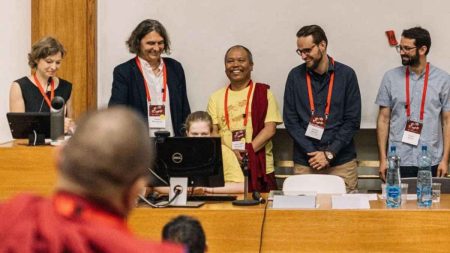
TWENTY LAWMAKERS from Nepal’s ruling Rastriya Swatantra Party (RSP) landed in China on November 15th for a 12-day junket organised by the Chinese Communist Party. The itinerary includes meetings with senior party officials, tours of industrial parks and robotics facilities, sessions with local governments and a study of China’s disaster-recovery programme. The delegation meets senior Communist Party leaders in Beijing on November 24th and 25th.
The timing is deliberate. Prime Minister Balendra Shah is preparing his first official bilateral visit to India, beginning November 22nd. His party ships lawmakers to Beijing while he flies to New Delhi. Nepal is trying to reassure both neighbours that cosying up to one costs the other nothing.
The instructions handed to the China-bound delegation expose how delicate this juggling act has become. Shah asked the lawmakers to discuss the Belt and Road Initiative (BRI), Chinese investment and stalled bilateral projects. He also floated asking Beijing to convert loans for projects such as Nepal’s international airports into grants. Rabi Lamichhane, the RSP chairman, gave the delegation a different order: keep third countries out of discussions with China. India, he said, stays out of the conversation.
That matters. Nepal wants Chinese money, technologyand access to its northern neighbur. It also wants to preserve the freedom to negotiate with India and Western donors. Beijing would prefer a relationship with clearer political commitments.
The BRI is at the centre of this disagreement. Nepal signed up to China’s flagship infrastructure initiative in 2017, hoping to improve roads, railways, energy links and trade routes across the Himalayas. Nearly a decade later, its most ambitious proposals have produced more diplomatic announcements than completed infrastructure. Financing, project selection and loan disagreements have repeatedly stalled progress.
The new government inherited this mess with little appetite for a blank cheque. During Foreign Minister Shisir Khanal’s visit to Beijing in June, Chinese foreign minister Wang Yi voiced support for advancing a high-quality BRI. Nepal’s official statement conspicuously dodged mentioning the initiative. Kathmandu wanted to preserve cooperation without appearing to endorse every piece of Beijing’s programme.
That caution has practical roots. Nepal is already struggling to make existing Chinese-funded projects deliver their promised returns. Pokhara International Airport, built with financing from China’s Export-Import Bank, began operations in January 2023. Its international services remain limited while questions over its commercial performance and loan repayment fester. Kathmandu is now weighing whether some airport loans can be converted into grants. Beijing has yet to agree.
Trade offers another measure of the relationship. Nepal imported roughly Rs425bn-worth of goods from China in the 2025-26 financial year, whereas exports amounted to less than Rs2bn, according to Department of Customs figures. The resulting deficit was about Rs423bn. Chinese smartphones, machinery, electronics, clothing and electric vehicles have found a growing market in Nepal. Nepali exporters have struggled to gain comparable access to Chinese consumers. A closer relationship has so far benefited Chinese manufacturers far more than Nepali producers.
Geography complicates the commercial case. Nepal shares a long Himalayan border with China, but crossing it is expensive and brutal. Roads on the Nepali side are often poor, while several proposed trade routes lack the infrastructure needed to carry large volumes of freight. The August 26th flash flood at Rasuwagadhi made the problem painfully clear-cut. It damaged more than 55km of the 82km Galchhi-Rasuwagadhi trade corridor, including bridges and sections of road. The World Bank estimates the Rasuwagadhi crossing accounted for 10.8% of Nepal’s imports from China and 47.3% of its exports to China in 2025-26. A single damaged crossing can therefore wreck a substantial share of bilateral trade.
China has proposed a new joint committee to manage border ports, 14 years after the two countries first agreed to establish one. Its draft agreement would improve customs clearance, coordinate border security, establish smarter port systems and consider opening additional crossings. Nepal’s industry ministry is consulting other agencies before proceeding. The proposal is practical yet the delay tells its own story about the difficulty of turning diplomatic agreements into functioning trade routes.
There is also a security dimension. Beijing has long been sensitive about activities in Nepal that it believes could threaten its interests in Tibet. Successive Nepali governments have assured China that their territory will never be used against Chinese interests. The new administration must maintain that commitment while protecting civil liberties and avoiding needless restrictions on legitimate activity. Such questions become harder when relations with Washington, New Delhi and Beijing overlap.
The RSP’s appetite for studying Chinese governance marks another departure from Nepal’s traditional political alignments. The delegation plans to examine provincial administration, party organisation, artificial intelligence, industrial development and disaster management. China offers lessons in infrastructure delivery and manufacturing, but its one-party political system is fundamentally different from Nepal’s competitive democracy. Copying administrative practices is one thing; importing political assumptions is another.
For Beijing, the new government offers a chance to build relationships with a political generation less tied to Nepal’s traditional communist parties. For Kathmandu, the relationship needs to produce roads that function, exports that grow and investments that earn returns. Neither side can secure those outcomes through party visits and ceremonial agreements alone.
Nepal has spent years treating China as an alternative to its dependence on India. The geography of trade, however, has proved stubborn. India remains Nepal’s principal commercial partner and its main route to international markets. China can provide investment and a northern trading corridor, but it cannot quickly replace those connections.
The trouble for Shah is to turn China’s interest in Nepal into projects that serve Nepal’s economy while keeping the decisions firmly in Kathmandu. Beijing has patience and money. Nepal needs both but it also needs the balls to say no to a bad deal. ■