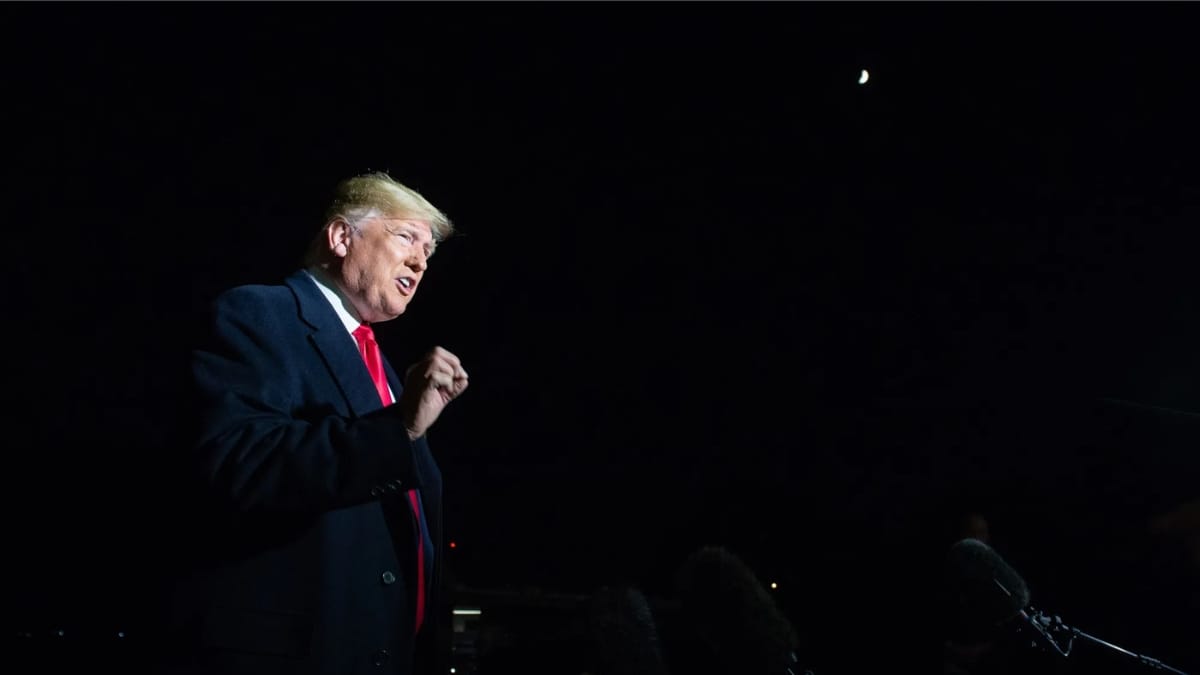
Make America Weak Again Image: Bloomberg
China is beset by deflationary pressure and a shrinking workforce, as well as a diplomatic image problem. Yet it appears to be thriving in one domain above all: American politics. Donald Trump is undermining America’s own influence while helping Xi Jinping’s ambitions lift-off. No central committee could have planned it better.
Few men in Washington hold such admiration for Xi. Trump calls him a “brilliant” leader, citing his grip on power as a virtue. The reverence is not new. During his first presidency, Trump’s envy of authoritarian leaders was evident. The second time round, that sentiment has hardened into policy. America’s allies are being bruised and rivals emboldened.
India, the centrepiece of Washington’s Indo-Pacific strategy, is now subject to Trump’s wrath. Narendra Modi, whose public relationship with Trump was warm enough to inspire stadium crowds, now finds himself targeted with threats of 50% tariffs and accusations of indirectly funding Russia’s war in Ukraine through oil purchases. India, which denies this, has reason to worry. Trump has hinted at 100% secondary sanctions. Modi, who declined an invitation to Washington in June, saw Trump lunch privately with General Asim Munir, Pakistan’s army chief. American presidents typically avoid tête-à-têtes with foreign generals.
Taiwan fares no better. Trump, who has repeatedly shown transactional instincts on security, has imposed 20% tariffs on the island’s all-important semiconductor exports. He refused President Lai Ching-te a transit stop in New York, provoking alarm bells in Taipei and relief in Beijing. Kissinger’s doctrine of strategic ambiguity—deliberately vague signals to deter both China and Taiwan from unilateral action—has been replaced by short-term whimsy. Trump appears willing to treat Taiwan as a bargaining chip for trade favours from China.
Meanwhile Trump’s vision of global order resembles a game preserve. Each big power should dominate its habitat, unbothered by meddling. He respects China’s dominion in Asia so long as it respects America’s elsewhere. But he shows little interest in defending allies inside China’s field of vision. When the Philippines’ president, Ferdinand Marcos Jr, raised alarms over China’s incursions into the South China Sea, Trump offered a shrug and a smile: “We’re getting along with China very well,” he said.
All this is reshaping global alliances and economic flows. Trump’s hostility to traditional aid programmes has gutted institutions like USAID, ceding space to China in Africa and Latin America. Washington’s pullback has opened diplomatic runways for Beijing’s Belt and Road Initiative to expand its footprint. The language of “America First” is being translated, quite literally, into “China Wins”.
The same is happening in industry. China has become the global pacesetter in clean energy. Last year it added more renewable power capacity than every other country combined. American policymakers had tried to block access to advanced semiconductors and supply chains. Trump has moved in the other direction, seeking to ease export controls and cut back Biden-era green subsidies. “Drill, baby, drill” has returned as the rallying cry of a carbon nostalgia campaign. By undermining America’s energy transition Trump is helping China take the lead in the technologies of tomorrow.
There is consistency, of a kind, in Trump’s chaos. His worldview prizes dominance, but not through coalition-building or value-based alliances. He admires brute control. China offers that in abundance. It is little surprise then Trump scorns multilateral frameworks and berates NATO, as well as casts suspicion on friends with democratic foibles. In his view Japan cheats and Europe freeloads. He reserves his compliments for those who do not criticise him and those who, like China, do not care if he does.
Trump positions himself as America’s great nationalist. Yet his policies are methodically eroding America’s strategic influence. Alliances in Asia are fraying. Global south partnerships are disappearing. Even industrial policy is being bent to short-term populism.
China, whose leadership has spent the last decade warning about encirclement and Western containment, now faces the pleasant challenge of dealing with a distracted hegemon. Trump is doing what their own propaganda could not: making China look steady and ascendant.
Xi Jinping need not gloat. The dividends are arriving. With American reliability in question, leaders from Brasília to Jakarta are hedging their bets. Supply chains are adapting to avoid the unpredictability of a Trump-led West.
A world built on American power is watching its architect pull out the rivets. China, usually slow to trust its own good luck, is adjusting swiftly. It knows a rare opportunity when it sees one.
Trump promised to make America feared and respected. He is succeeding—in Beijing. ■