IMAGE: GOPEN RAI
NEPAL IS BETTER known for soaking up carbon than spewing it out. For years it has cultivated the image of a low-emitting Himalayan state, draped in forests that mop up the greenhouse gases that development threatens to unleash. Since 2000 those forests have absorbed about 16m tonnes of carbon dioxide a year. Much of the credit goes to community-managed conservation schemes—now beloved case studies for donors and climate NGOs alike. The sink has been stunningly steady for more than two decades. It has doubled as an ecological asset and a diplomatic shield. But beneath the canopy the country is changing.
Greenhouse-gas emissions have leapt across every major sector since 2000. Carbon dioxide from industrial combustion has yanked up more than sixfold. Transport emissions are up nearly 475%. Methane and nitrous oxide—less visible, far more potent—have climbed as agriculture intensifies and waste piles up. Strip out land use and forestry and per-capita emissions have more than quadrupled. Nepal still emits little in absolute terms. But the direction of travel, and the pace, are becoming difficult to shrug off.
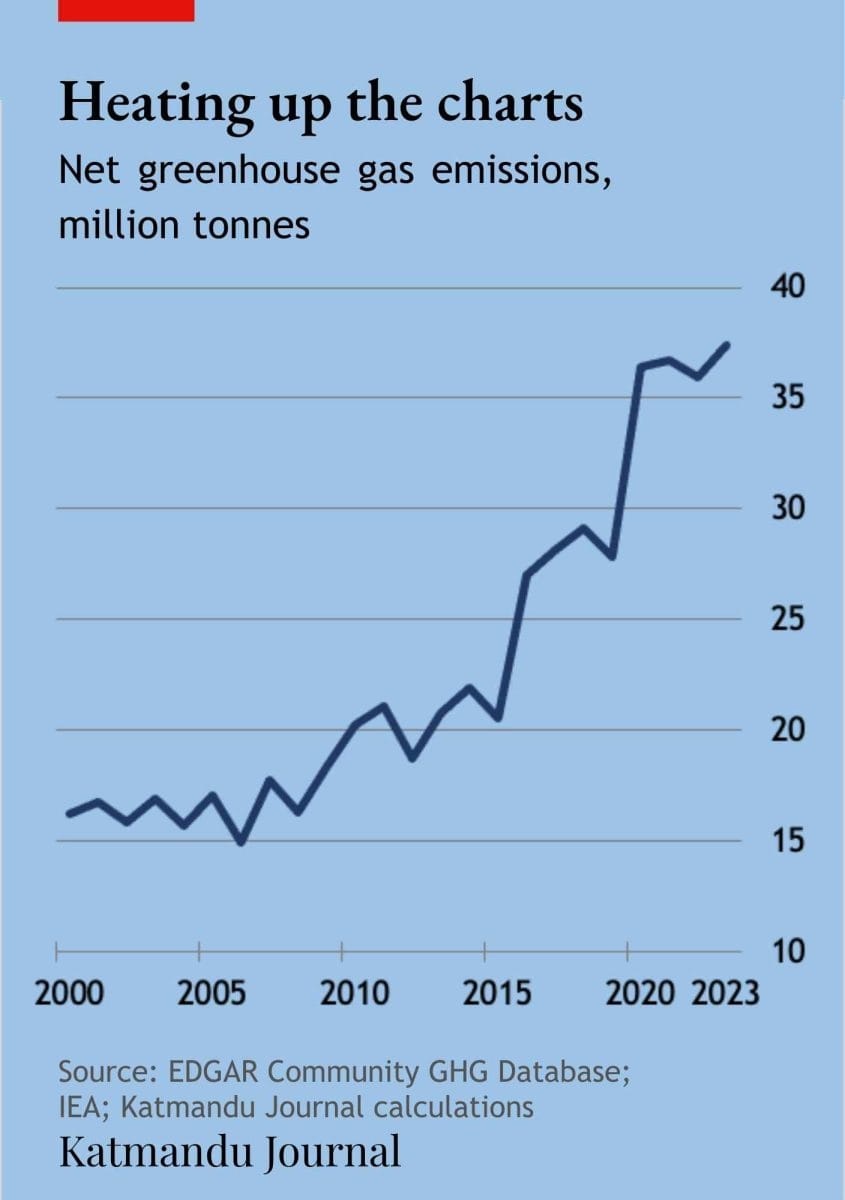
Much of that is down to ambition. Nepal is due to graduate from the UN’s list of least-developed countries in 2026 and wants to climb to middle-income status soon after. Industry is expanding, and cities are spreading. Consumption is rising. All of this is familiar from the early chapters of economic transformation. It is also when emissions tend to surge, especially where policy lags behind structural change. In Nepal’s case, the transition is unfolding with scant attention to carbon efficiency.
No sector has boosted emissions more aggressively than industry. In 2000 industrial combustion produced just over 1m tonnes of CO₂. By 2023 it was close to 7m. Bricks and cement do much of the damage, fired mainly by imported coal and diesel. There were brief dips in the early 2000s and after the 2015 earthquake. The trend, though, is going up, fast.
Hydropower, the cleaner alternative, is plentiful on paper. Nepal has more than 40,000 megawatts of economically viable potential, most of it untouched. In reality the grid is unreliable and investment uneven. Moreover factory owners are wary of betting their base load on it. Coal may be dirtier. It is also predictable.
The government is not blind to the problem. National plans, including Nepal’s second Nationally Determined Contribution under the Paris Agreement, talk up electrification and efficiency. Delivery has been slim. Industrial policy still prizes output over emissions.
Transport is the second-largest source of carbon pollution—and the one changing fastest on the ground. Vehicle registrations have exploded over the last 15 years, buoyed by rising incomes and a burgeoning stream of remittances. Roads have spread, if not always sensibly. The fleet is dominated by petrol motorbikes and diesel trucks.
Between 2008 and 2018 transport-related CO₂ emissions almost tripled. A brief dip in 2019 was followed by a sharp rebound, pushing the total to 4.76m tonnes in 2023. Incentives for electric vehicles exist—lower import duties, plans for charging stations—but uptake is still modest. Outside the Kathmandu Valley, patchy grid coverage stands as a stubborn obstacle.
The transport system itself is poorly stitched together. Public options are limited in towns as well as villages. Fuel-efficiency standards barely register. Coordination between municipal authorities and national planners is poor.
Agriculture and waste sit outside the spotlight, though their impact is big. Methane and nitrous oxide rarely dominate the debate yet together they make up a hefty slice of the total.
Methane, largely from livestock and rice paddies, rose by 21% between 2000 and 2023. Nitrous oxide from farming—linked to fertiliser use and manure management—climbed by 66%. These gases are short-lived but brutally potent.
Waste emissions have edged up, too. Methane from landfills and sewage suggest creeping urbanisation and lagging infrastructure. Nitrous oxide emissions from waste rose from 0.23m tonnes of CO₂-equivalent in 2000 to 0.41m in 2023. Small numbers, but a clear trend.
Against all this stands the country’s forests, a striking counterweight. For more than 20 years they have absorbed roughly 16.23m tonnes of carbon a year, pointing to stability in land use and forest health. Much of the success comes from decentralised forestry: more than 22,000 community groups manage national forests under state oversight. Illegal logging has fallen. Biodiversity has improved. Conservation has become part of local politics.
Yet the steadiness of the sink hides a problem. As emissions elsewhere climb, the offset matters less. What once balanced the books now covers a shrinking share. There is also a ceiling to how much more carbon these forests can lock away, especially without large-scale afforestation.
Nepal’s per-capita emissions remain low, about 0.60 tonnes of CO₂ a head, far below the global average. But speed matters more than starting point. Emissions are rising fastest in sectors where mitigation is feasible—industry, transport and agriculture—and policies to bend the curve remain poor.
Sceptics argue that poor countries must grow dirty before they grow clean. Development first, decarbonisation later. Others counter that low-carbon options are cheaper and more accessible than ever, and that locking in dirty infrastructure now will only raise the bill later. In Nepal’s case, both arguments carry weight. Growth is necessary, but so is foresight.
The government’s pledge of net-zero emissions by 2045 is bold—and, for now mostly theoretical. Meeting it will need more than guarding the tree line. It will mean electrifying factories, tightening transport rules, remaking agriculture and investing early in clean infrastructure, while the economics still favour action.
Nepal has already shown what is possible when incentives meet ingenuity. Its forests prove that. The real test is whether the same alchemy can be applied to smokestacks and fuel tanks—before the canopy of carbon neutrality begins to fray. ■