
Image: Rehahn
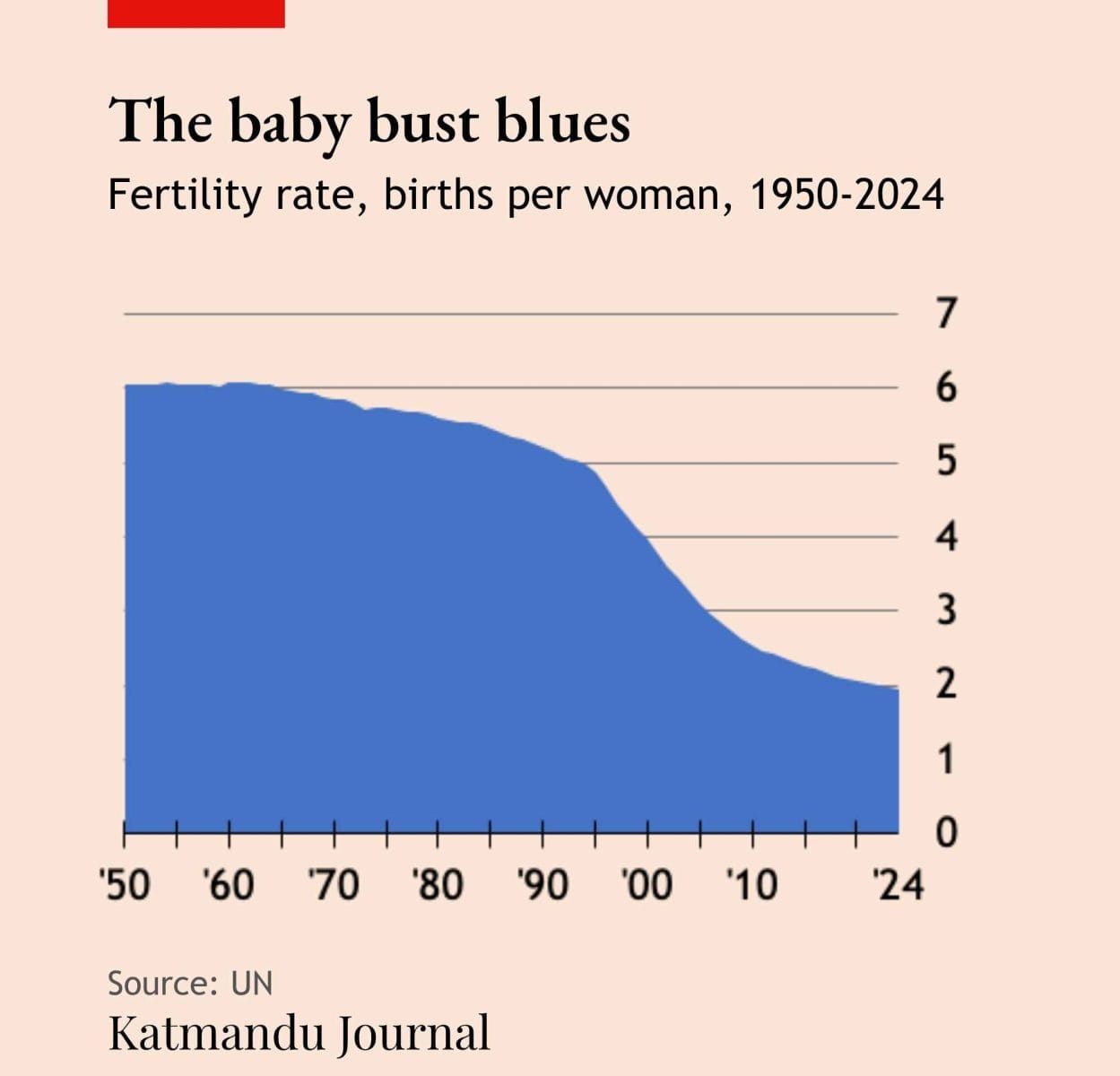
SEVENTY-FIVE years ago, the average Nepali woman could expect to have six children in her lifetime. Today she will have fewer than two. In the span of a single lifetime, Nepal has seen one of the world’s most rapid plunges in fertility. Its total fertility rate, the number of babies a woman can expect to have, has fallen by more than two-thirds: from six to just 1.9 (see chart below), slipping below the replacement level of 2.1 needed to hold a population stable without immigration. The speed of this change, seen in different degrees across the globe, is forcing a reckoning with its economic consequences.
The causes of Nepal’s demographic transition are a catalogue of modernisation. Where infant mortality was once tragically high, better healthcare has meant far fewer children die young: it has plummeted from 227 deaths per 1,000 live births in 1950 to fewer than 25 today. Life expectancy has nearly doubled since 1950, from 38 years to 72. With children more likely to survive, the perceived need for a big family in turn has shrunk. Simultaneously, more girls attended school, more women learned to read and more found work outside the home and the farm. They married later and gained greater access to family planning.
Urbanisation has amplified these trends. In a subsistence agrarian society, children are an asset, their small hands put to work in the fields. In an increasingly urban and cash-based economy, they become a long-term financial commitment. This shift was accelerated by mass migration. Millions of Nepali men now work abroad, often for years, delaying marriage and childbearing. Since the 1970s government programmes have also steadily expanded access to contraception, giving women unprecedented control over their fertility. The consequence has been a population whose growth is rapidly slowing. The rate of natural increase—births minus deaths—has been almost halved since 1950.
Nepal’s experience is a particularly brutal version of a global trend. The world’s fertility rate has tumbled from about five in 1950 to 2.3 today. Nearly all rich countries, and a growing number of middle-income ones like Nepal, have rates below the replacement level. This demographic transition initially bestows a “demographic dividend”. As the number of young dependents shrinks relative to the working-age population, a nation can save more, invest more and spur economic growth—provided jobs can be found for them.
Yet this advantage is transient. Today’s smaller cohorts of children mean tomorrow’s smaller labour forces. And as life expectancy extends, the share of elderly Nepalis is set to double by 2050. A country that has been defined by its youth will rapidly grey.
The economic risks of an ageing, and eventually shrinking, population are not theoretical. A smaller workforce can mean slower growth and lower tax revenues just as demands on the public purse for pensions and health care rise. The flow of remittances from Nepalis working abroad, a crucial source of national income, may dwindle as global competition for young workers intensifies. Rural areas, emptied of their young, face a particular strain.
Economists are divided on the long-term implications of such a global fertility slump. Some, like Charles Jones of Stanford University, warn of an “empty planet” scenario, where fewer people mean fewer geniuses to generate the new ideas that fuel progress. Others, like Oded Galor of Brown University, offer a more optimistic view. He argues that the shift to smaller families forces a concentration of resources, leading parents to invest more heavily in the education and health of each child. This boost to human capital, he contends, is a primary driver of long-term prosperity.
For policymakers in Kathmandu and elsewhere, the trouble is to harness the benefits of this new demographic reality while mitigating its costs. The priority must be to maximise the productivity of the smaller workforce that is now inevitable. That means heavy investment in education and health to ensure that each Nepali worker is as skilled and efficient as possible. Pension systems must be reformed to encourage longer working lives. Housing and family policies could be adjusted to make it easier for those who want children to have them.
A particularly delicate policy area involves infertility. As fertility rates fall globally, the unmet need for assisted reproduction grows. The United Nations argues that fertility care should be seen as a legitimate part of family planning, a means for individuals to achieve their desired family size, which could modestly moderate the pace of decline.
Nepal’s journey from a high-fertility to a low-fertility society is a stunning success story of human development. It has given women greater autonomy and children a better chance at life. Yet it has also exchanged one set of challenges for another. And the country now stands at a demographic crossroads. It can either leverage its educated, smaller population into sustained prosperity, or risk growing old before it grows rich. Its trajectory will be a lesson for the world, as the age of endless population growth gives way to the era of the baby bust. ■





