
Image: Dimitris Tamvakos
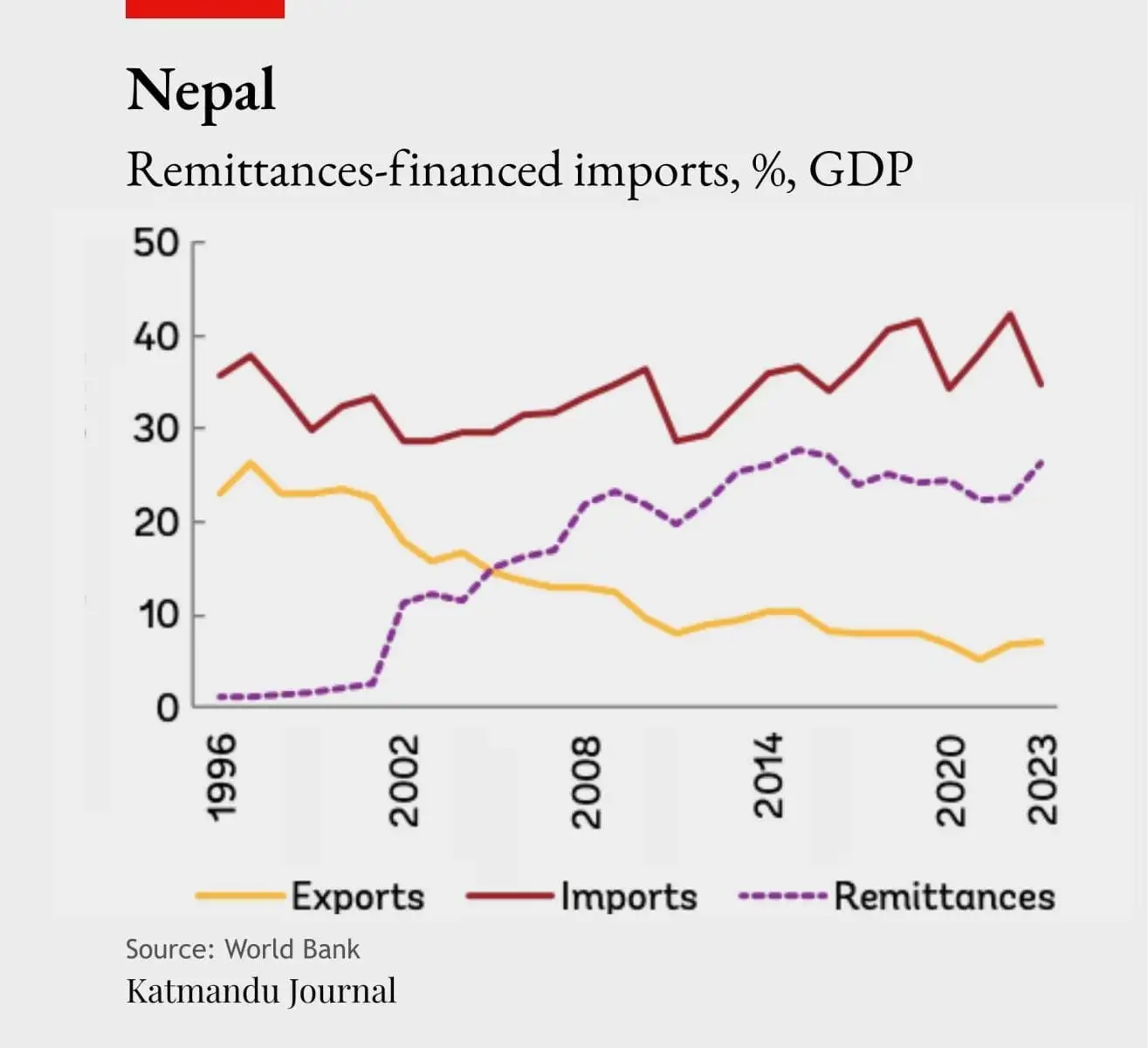
To understand what is wrong with Nepal’s economy, consider its two great sources of foreign currency. One is remittances, sent home by the nearly 4m Nepalis, more than a tenth of the population, who work abroad. These transfers have surged from 2% of GDP in 2000 to 25% today. They have financed a consumption boom, fuelling growth in imports and GDP. The other source is exports. They have been far less impressive. The country’s exports-to-GDP ratio has collapsed, from over 25% in the late 1990s to a mere 6.8% in 2022. Merchandise exports are particularly feeble, at just 3.2% of GDP. Nepal is thus a nation that earns a lot from selling labour abroad, but little from selling goods.
This is not for want of potential. Sandwiched between India and China, the world’s workshop and its powerhouse, Nepal might be expected to have carved out a niche in regional supply chains. Instead its exports are stagnant, undiversified and low in value. More than two-thirds of its goods exports go to India. Shipments to other nearby partners, such as Bangladesh, China and Pakistan, are negligible. Only 0.5% of its manufacturing exports were classified as high-tech in 2022, a far lower share than in peer countries. A flicker of promise comes from information and communications technology, which accounted for over 4% of total exports in 2023. But that only shows the underperformance elsewhere.
Part of the problem is geography. Nepal is landlocked and mountainous, which makes moving goods expensive. Its infrastructure is subpar: it ranks poorly for the quality of its roads and airports. A lack of market competition in transport and logistics, exacerbated by syndicates that control routes, pushes costs higher still. Weak safety and health standards have led to Nepali products being rejected by foreign buyers. Yet two other, less obvious factors are even more damaging: an overvalued currency and unhelpful trade policy.
A new analysis of firm-level data, from 2011 to 2015 and 2018 to 2021, illuminates the damage done by the real exchange rate (RER); it measures how expensive a country’s goods and services are compared with those of its trading partners after adjusting for inflation. A 10% appreciation in the bilateral RER leads to a 3% decrease in exports. The effect is more pronounced for larger firms and those with less diversified products and markets. Over the sample period, the appreciation of the average bilateral RER lowered Nepal’s exports by more than 10%. Exports to India, the dominant market, were hit especially hard.
The chief cause of this appreciation is the torrent of remittances (see chart below). They have produced a Dutch disease-like effect, pushing up the value of the currency and making other exports less competitive. Since Nepal pegged its currency to India’s rupee in 1993, its real effective exchange rate (REER), a broader measure, has appreciated by about 35%. The analysis suggests that the rise in remittances can explain roughly half of that increase. The effect is amplified by Nepal’s low labour-force participation rate, which limits the economy’s ability to expand the supply of exports in response to higher demand from abroad.
Trade policy also hurts. Tariffs on imported inputs are relatively high. A one-percentage-point increase in these input tariffs results in a 2% reduction in exports. The substantial rise in such tariffs between 2011 and 2021 lowered exports by about 8% over that period. The burden falls disproportionately on smaller firms, which struggle to obtain duty drawbacks—rebates on tariffs for imported inputs used in exports. In contrast, preferential access to foreign markets helps a lot. A one-percentage-point decrease in the tariffs faced by Nepali goods boosts exports by 0.8%. But Nepal has few free-trade agreements outside its region. Its graduation from least-developed-country status in 2026 will cause many of the preferences it does enjoy to expire.
A policy rethink is therefore in order. Taming inflation would help. Because of the peg, Nepal’s bilateral RER with India appreciates when its inflation exceeds India’s. But lowering inflation is difficult given the fixed exchange rate and dependence on imports from India. So a more fundamental question must be asked: is the peg itself still fit for purpose? Set three decades ago, it provides stability but at the cost of competitiveness. The government and central bank should study whether a shift to a more flexible regime, such as a crawling peg, might be wiser.
Authorities could also encourage more productive use of remittances. At present, the bulk is spent on consumption or repaying migration loans. New financial instruments might channel some of these funds into investment. Improving duty-drawback systems and cutting input tariffs would stimulate exports, especially from smaller firms, which are more experimental and help determine a country’s comparative advantage. Finally, Nepal must pursue more preferential trade agreements. It should seek to extend least-developed-country preferences by highlighting its status as a landlocked developing country. Securing new deals would diversify export destinations, which in turn would spur product diversification.
The economy has been carried along by the hard work of its emigrants. But it cannot rely on remittances forever. To create better jobs at home, it must start selling more to the world. ■





