Image via Media Dainik
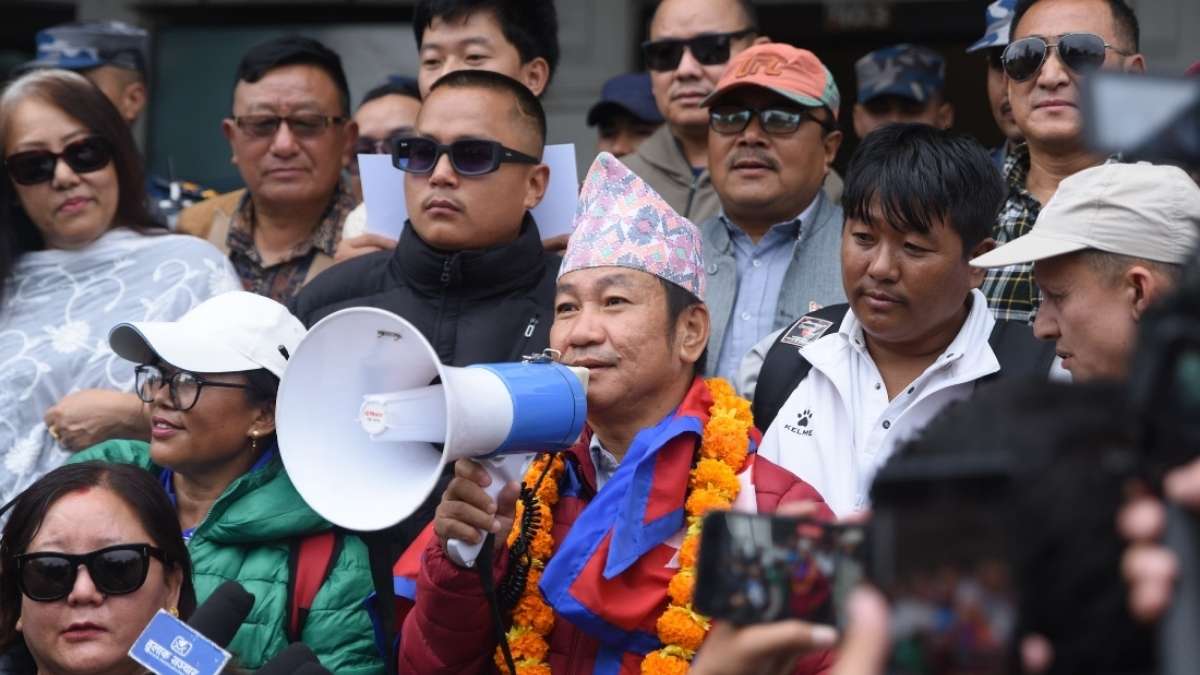
IN A DUSTY field in Sankhuwasabha, a district in eastern Nepal, a political newcomer is trying to upend the country’s politics. Harka Sampang, Dharan’s independent mayor, is addressing a crowd that has gathered for what is billed as a “mass awakening”. The atmosphere is more revival meeting than rally. “Are you ready?” shouts a warm-up speaker. “Ready!” the crowd roars back. Patriotic songs are sung. The event is staged by the newly-formed Shram Sanskr̥ti Party, or Labour Culture Party, which Mr Sampang leads. Its election symbol is a lump of soil. Its ideology, “Harkavād” or Harkaism, is described as entirely homegrown. Its mission is to purify Nepali politics. And its leader, claim his supporters, could be the country’s next prime minister.
Such claims may seem fanciful. Nepal has been governed by an established rotation of parties since the end of its brutal civil war in 2006 and the abolition of its monarchy two years later. These parties are indeed widely seen as corrupt and nepotistic, as well as ineffective. Governments change with bewildering frequency: there have been 13 since 2008. Yet the faces at the top remain familiar. Mr Sampang on the other hand is a novelty. He is not from a political dynasty. He styles himself as a man of action rather than words. And his message, a blend of nationalism, self-reliance and collective labour, is capturing the imagination of many Nepalis, particularly the young, labourers and senior citizens, who are fed up with the old ways.
Mr Sampang’s rise began in Dharan, where he has served as mayor from 2022. He earned a reputation for getting things done, notably by improving the city’s water supply. This he achieved not by securing big budgets from the central government but by mobilising volunteers. The practice of shrāmadan, or collective labour, is central to his party’s identity. Leaders must “carry the most stones”, in the party’s parlance. Development is to be built with local resources and local hands. This approach is in contrast to that of Nepal’s mainstream parties, which are accused of relying on foreign aid and of treating politics as a vehicle for securing government contracts.
The failings of the political class are the central plank of Mr Sampang’s campaign. The Panchayat system, an absolute monarchy that lasted until 1990, was oppressive. The multi-party democracy that followed brought corruption and “favouritism”. The big parties have “betrayed public trust”, Mr Sampang’s supporters say. This narrative of failure is used to build the case for a new kind of politics. Mr Sampang is portrayed as a transformative figure. On stage speakers compare him to Lee Kuan Yew, Singapore’s founding father, and Ibrahim Traoré, the youthful, populist leader of Burkina Faso. The implication is that Mr Sampang is at once a nation-builder and an anti-imperialist revolutionary.
The doctrine of Harkavād is the vehicle for this transformation. It is presented as an indigenous ideology, distinct from imported “isms” like Marxism or socialism. It has three components. The first is a nature-first orientation: development must follow local geography, culture and natural balance. The second is self-reliance: communities should depend on their own labour and resources and not foreign loans or consultants. The third is cultural rootedness: politics must reflect Nepal’s traditions and values. Harkavād positions foreign-backed parties as “dalals” (brokers). It presents Mr Sampang’s movement as the only authentic, Nepali alternative.
This message is amplified by a potent emotional symbolism. Soil, or mato, is the party’s election symbol and a metaphor for purity and belonging. The mantra “One country, one flag—under the same soil” is repeated at rallies. Mr Sampang himself reinforces his brand of integrity with public oaths taken at sacred sites. He vows not to misuse a single rupee of public money. Honesty is framed not just as a political commitment but a spiritual one, as well. This personal probity, combined with a record of tangible achievement in Dharan, lends credibility to his anti-corruption platform.
The campaign’s strategy for growth relies heavily on youth mobilisation. Young supporters are urged to go home and “educate” their parents and elders. They are told to reject the notion that “nothing will improve”. The party presents itself as the vehicle for generational change. Its events are staged in a dramatic way to boost emotion and create a sense of community. Politics is made to feel like a shared spiritual and national movement. Speakers claim that among the dozens of parties seeking to contest elections, theirs is the only “real” one: the only choice for those who want to break with the entire establishment.
Mr Sampang’s national vision extends this local model to the country as a whole. He proposes a self-reliant development model where Nepalis build infrastructure through collective labour, minimising dependence on foreign aid. He calls for a morally upright political class, where leaders live simply and do physical work. Trust, he argues, will be rebuilt through transparent, participatory action that people can see with their own eyes. This would amount to a national rejuvenation led by ordinary citizens, rather than foreign experts or party grandees.
The appeal of this vision is easy to understand in a country where the political status quo has delivered so little. The economy is reliant on remittances, which account for a quarter of GDP. Its growth is sluggish. Many young Nepalis seek opportunities abroad. Disillusionment with mainstream politics is deep and widespread. Mr Sampang’s authenticity, simplicity and “local hero” image resonate with labourers, rural communities and crucially young voters desperate for change.
Yet the path to the premiership is steep. Translating a grassroots movement based in one city or a district into a national force is a big challenge. The political establishment, however unpopular, has vast networks of patronage and support. The electoral system is complex. And there is a risk that the very novelty of Harkavād could limit its appeal beyond a core of fervent supporters. A doctrine that is proudly indigenous may struggle to provide detailed answers for complex, modern problems like managing relations with giant neighbours India and China, or attracting foreign investment.
Nonetheless, Mr Sampang’s rise is a sign of the times. It is a forceful indictment of Nepal’s political rot and a testament to a widespread yearning for integrity and national self-respect. Whether or not he reaches the heights his supporters predict, his movement is shaking the political environment. The established parties, accused of only talking, now face a challenger whose slogan is to “work with its hands”. In Nepal, which is tired of promises, that is a powerful message. The man with the soil may not become king, but he has begun to change the terrain. ■