It’s lonely at the top
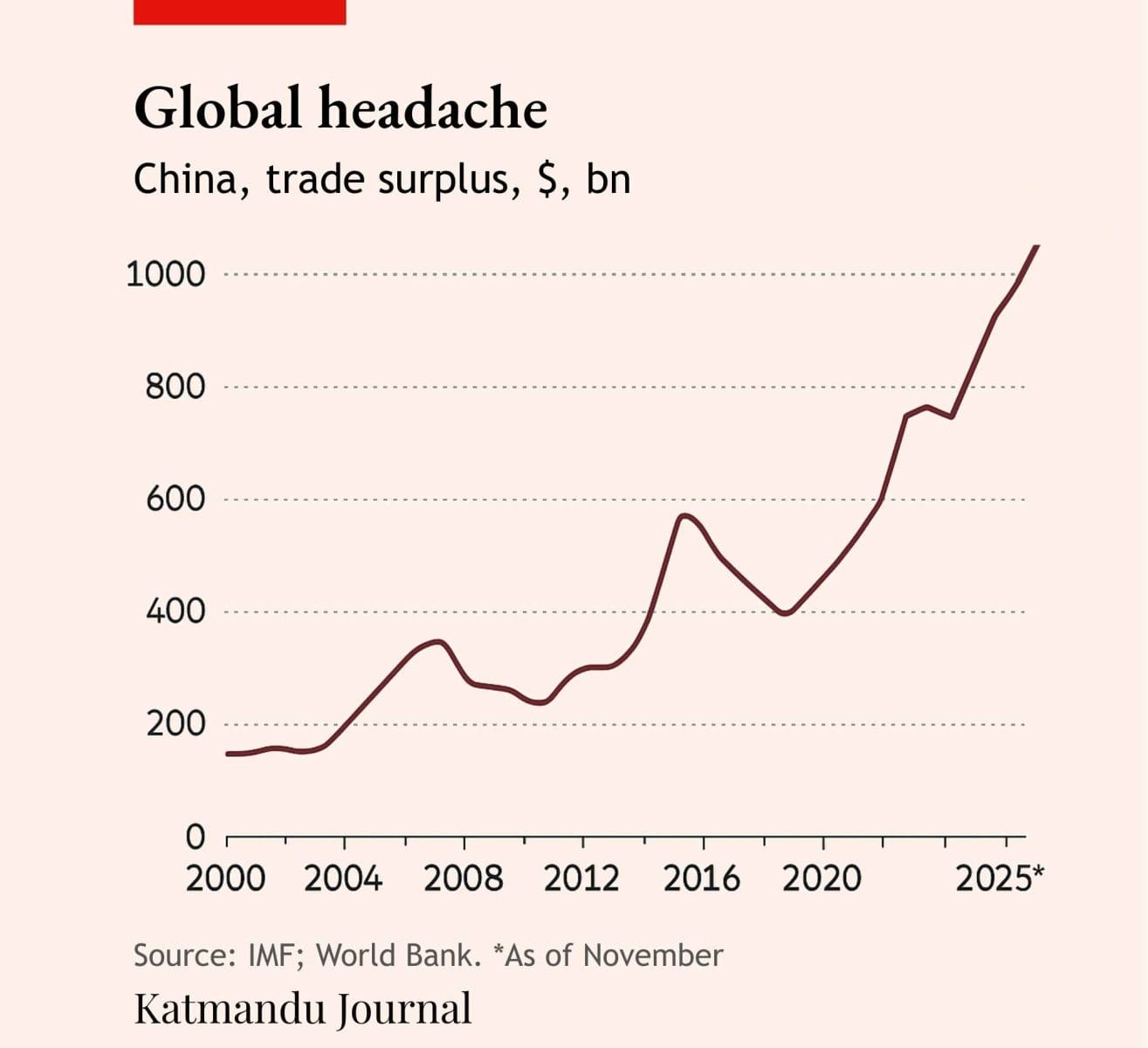
A trillion dollars is a head-spinning number. It is roughly the annual economic output of the Netherlands. It is more than the combined stock-market value of every company listed in Spain. It is also, as of last November, the size of China’s goods-trade surplus over the first 11 months of this year. The gap between what China sells to the world and what it buys has never been bigger. What’s more, the scale of that imbalance is generating tremors of political resentment around the world and raising difficult questions about the path ahead for China itself.
The cause of the surplus is that Chinese exports are remarkably strong but its imports are conspicuously weak. But this simple equation belies a more complex situation. Consider the resilience of Chinese exports. America has maintained stringent tariffs on Chinese goods since the trade war began under President Trump. Direct exports to the United States have indeed slumped. Yet China’s overall export engine has only roared louder. One reason is rerouting. Semi-finished goods are shipped to countries like Vietnam and Mexico for final assembly, before being sent on to America with a new label of origin. The tariffs are dodged rather than dismantled.
More significant is China’s deepening dominance in the industries that define modern manufacturing. Ask any German carmaker or South Korean battery producer about their toughest competitor. The answer, invariably, is China. From electric vehicles and solar panels to robotics and consumer electronics, Chinese firms are eating global market share, thanks to strategic industrial policy as well as immense scale and unstoppable incremental improvement. Exports to the European Union, for instance, jumped by nearly 15% in November. When European producers complain of being undercut, they are not imagining things. A combination of a weak currency and falling factory-gate prices in China makes its goods extraordinarily competitive on the world stage.
If the export side of the ledger speaks of aggressive strength, the import side whispers of domestic frailty. China is not buying much from the rest of the world because its own consumers are in a defensive crouch. The property-market correction, now in its fifth year, has destroyed household wealth and confidence. People who feel poorer do not splurge on imported luxuries or even everyday foreign goods. At the same time, pervasive deflationary pressures within China mean that locally produced alternatives are becoming ever cheaper, further diminishing the appetite for imports. The economy is producing far more than it can absorb at home, and therefore the surplus must be shipped abroad.
Hovering over this entire dynamic is the Chinese currency. The renminbi trades at about 7.1 to the dollar, a level many analysts believe is embarrassingly undervalued. Some Chinese economists, including former central-bank officials, suggest a “fair” value might be closer to 5. The weakness is intentional. With interest rates low in China and capital seeking opportunities elsewhere, the central bank has been content to let the currency slide, providing a powerful tailwind for exporters. The effect on relative prices is brutal. A BYD hybrid car that sells for around $15,500 in China can cost triple that in Europe. A Big Mac in Shanghai is half the price of one in New York.
This currency policy, however, is a double-edged sword. It boosts factory employment and corporate profits in the export sector, which Beijing sees as vital for social stability. But it also diminishes the purchasing power of Chinese households, making imported goods more expensive and reinforcing the very weakness in consumption that plagues the economy. It is a policy choice that privileges producers over consumers, and the present over the future.
Unsurprisingly, the rest of the world is beginning to grumble more loudly. The European Union is weighing new trade defences. American politicians of both parties warn of market flooding. President Emmanuel Macron of France has called the imbalances “unbearable”. Chinese officials for their part describe their success as the just reward for innovation and efficiency, and warn against protectionism. The International Monetary Fund is currently conducting a review in China, with the currency and its global implications high on the agenda.
The fundamental driver of the surplus is structural. Years of debt-fuelled investment have built a stonking amount of industrial capacity. With domestic demand unable to keep up, factories must sell their output overseas, usually at razor-thin margins. This overcapacity is now being exported around the world, in the form of competitively priced electric vehicles, machinery, electronics and so on. Meanwhile as producer prices in Europe and America have soared over recent years, China’s have flatlined. The gap makes Chinese goods irresistible in many foreign markets.
Such a vast surplus cannot continue indefinitely without consequence. It is already provoking a protectionist backlash. It also leaves China’s growth dangerously dependent on the willingness of other countries to keep buying its goods—a willingness that is fraying. Some Chinese economists quietly argue for a major rebalancing: a stronger currency to boost consumer power, even if it means a smaller trade surplus or even a temporary deficit.
But for now the political calculus in Beijing favours the safety of the export machine, however much friction it causes abroad. The trillion-dollar gap is a measure of China’s economic might. It is also a measure of its dilemmas, and of the uneasy dependence that still defines its relationship with the world. The path to a more sustainable balance will demand adjustments not only in trade flows, but in the very model that has produced this monster of a number. ■