IMAGE VIA FT/REUTERS
NEPAL HAS too many newspapers, too many television channels and far too many journalists willing to tell power exactly what it wants to hear. Against this backdrop, the idea that the Katmandu Journal can build a sustainable media business on subscriptions alone sounds, at first, like the kind of optimism that only the very young or the very foolish can sustain. It isn’t. It’s the only model that makes sense.
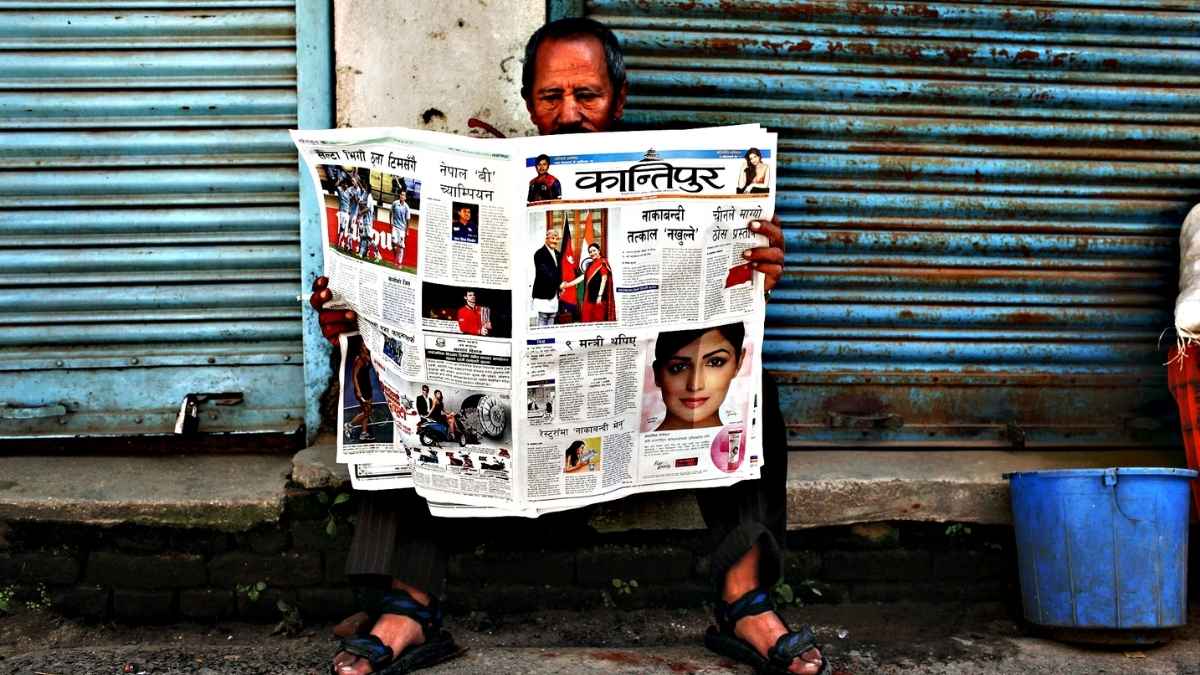
Consider what the alternative looks like. The New York Times model—high volume, general interest, advertising-dependent, supplemented by mass subscriptions—has a structural ceiling in Nepal so low you’d have to crouch to walk under it. Kantipur Media Group (the parent company of the Kathmandu Post and Kantipur Daily) spent years attempting something in that vicinity and struggled.
The reason is structural. Advertising revenue, once the reliable lifeblood of legacy media, has fragmented towards Facebook, YouTube, Instagram and TikTok—platforms that charge less, target better and don’t require editorial departments.
Meanwhile Nepal’s economic conditions mean that asking a general readership to pay for news is a hard sell. The NYT pulled off its subscription pivot in a wealthy, English-speaking market with decades of brand equity. Replicating that trick in Kathmandu is a different proposition entirely.
There’s a subtler problem, too. Nepal’s journalist associations are essentially political party wings in thin disguise. A mass-market publication trying to serve everyone ends up serving no one impartially—and impartiality, in a media environment saturated with partisan noise, is the single most valuable thing a news outlet can offer. Once you trade it for reach, you’ve traded everything.
The Economist model works by inverting this logic entirely. Its power comes from being indispensable to a small, specific audience rather than mildly interesting to a large, distracted one. In Nepal that audience exists and is growing: policymakers navigating increasingly complex times; development finance professionals at the World Bank and ADB; bilateral donors; diaspora investors watching from the West and beyond; and a younger urban professional class that has outgrown the diet of outrage and allegation that passes for political reporting.
These readers don’t want more content. They want better analysis: the kind that explains why their government is incompetent, or why the economy is doomed to underperform. That’s a niche. It’s also a paying one.
The economics are correspondingly cleaner. A subscription-and-institutional model doesn’t need advertising at scale. An outlet that sells access to embassies, think tanks, INGOs and banks in Kathmandu can sustain itself on a circulation that would embarrass a general-interest daily. The margin per reader is higher, the revenue is more predictable and crucially the editorial independence is more defensible. Advertisers pull ads. Subscribers cancel subscriptions, yes, but they do so individually; and they rarely do it because a story made a minister sweat. That’s a big difference.
The objection is obvious: won’t mass readers simply stay on TikTok? Yes, most of them will. Nepal’s social media environment has become a theatre of polarisation and emotional velocity, where outrage drives engagement and nuance is the first casualty. That audience will sustain influencers, perhaps; it won’t sustain journalism. But the readers worth building for—the ones who read to think rather than to confirm—are exactly the readers who will pay. They have always been willing to pay, in every market, for the thing they cannot find elsewhere.
The Katmandu Journal is betting that Nepal is ready for this. The smarter bet is that Nepal has been ready for some time, and no one has yet bothered to show up with something worthy of the readership. ■
Get a subscription now.