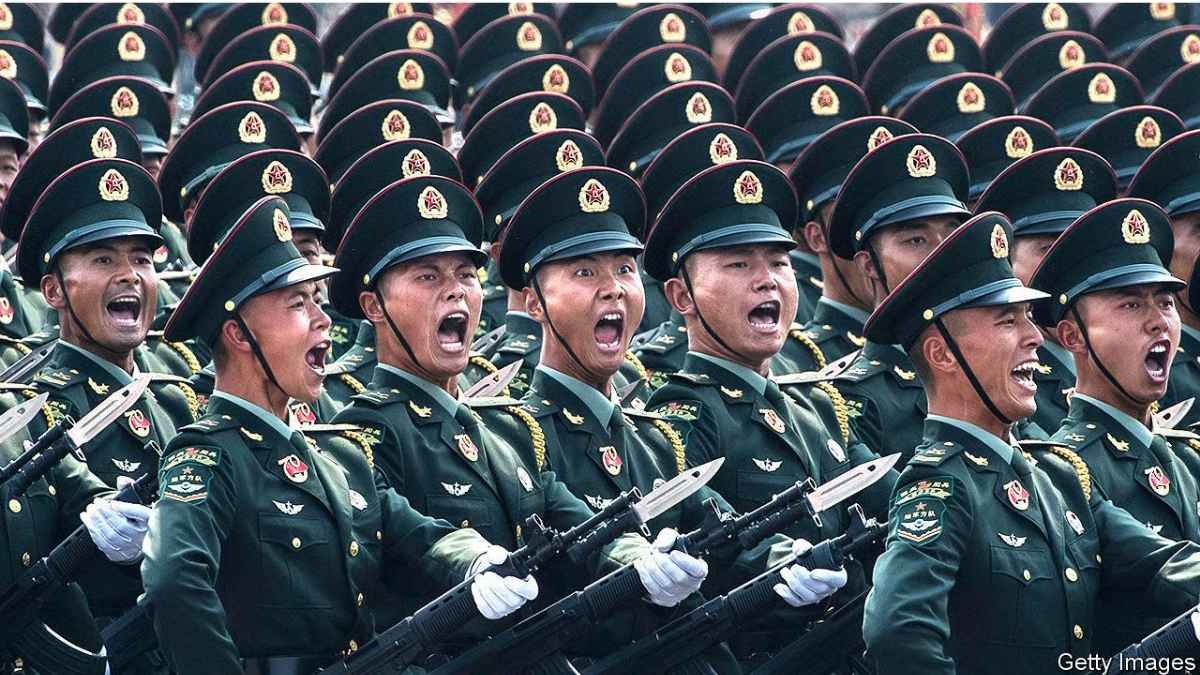
IMAGE: PLA
CHINA HAS spent decades building the military muscle to stop other countries dictating terms in its neighbourhood. It has acquired aircraft carriers, expanded missile forces and built a navy capable of operating far beyond its coastline. Its coastguard has become a regular, ugly presence in disputed waters. Yet the more confidently Beijing uses that strength to squeeze its neighbours, the more it risks producing the opposite of what it wanted: a region that cooperates more tightly to contain Chinese influence.
The Philippines offers the ugliest example. Its disputes with China over the South China Sea have repeatedly involved dangerous manoeuvres and coastguard confrontations. Manila has responded by strengthening security ties with countries that once played a smaller role in its defence. America remains its treaty ally. Japan and Australia are becoming increasingly important partners—a shift Beijing can only blame on its own thuggish behaviour.
The change shows up in the agreements. Japan and the Philippines brought their Reciprocal Access Agreement into force in 2025, letting each country’s forces operate more easily on the other’s territory. In July their Acquisition and Cross-Servicing Agreement also entered into force, making it easier to swap supplies during exercises. Japanese forces joined live-fire training with the Philippines in May. In October the two governments discussed transferring a decommissioned Japanese destroyer to the Philippine navy.
Their defence ministers met on October 28th and agreed to deepen cooperation, including intelligence-sharing arrangements. They also endorsed closer coordination through the four-country framework involving Japan, Australia, America and the Philippines. The language of their joint statement was unusually direct about China’s coercive activities. Beijing’s behaviour has helped turn a series of separate security relationships into a more connected network.
Australia sees the same rot. Its defence minister, Richard Marles, said on October 29th that China’s military expansion was creating a condition of pressure across South-East Asia. He urged regional partners to deepen cooperation. Canberra has strengthened defence ties with Manila and Tokyo while continuing to treat stability in the South China Sea as a central security interest. China may regard these partnerships as foreign interference. Its neighbours increasingly regard them as insurance against a bully.
Taiwan faces a more urgent version of the problem. Chinese military aircraft and warships operate around the island with growing frequency. On November 7th Taiwan accused a Chinese coastguard vessel of entering restricted waters near the Pratas Islands. The two ships came within one nautical mile of each other. Taipei said it was the 13th such intrusion in the area this year, involving 16 Chinese vessels. Beijing described its patrols as routine law enforcement. The competing claims are becoming hard to separate from the risk of an accident.
The diplomatic consequences stretch beyond the immediate disputes. In June Britain, France and Germany issued a joint statement expressing concern over Chinese activity east of Taiwan. European governments have their own commercial interests in China: yet they are increasingly willing to speak together when Beijing’s military activity threatens regional stability. That is a diplomatic cost for a country that wants to be treated as a responsible global power—and it stinks.
China’s approach also screws its relations with South-East Asia. Several ASEAN members have overlapping claims in the South China Sea, including Vietnam, Malaysia and Brunei. Their economic ties with China are deep and most governments have little appetite for a military confrontation. Yet the prospect of Chinese pressure encourages them to seek outside support and preserve stronger relations with America, Japan, Australia and India. The result is a region that hedges against Beijing even as it trades with it.
There is a limit to this alignment. The Philippines is willing to confront China more openly than many of its neighbours. Vietnam maintains its own strategic independence and is wary of becoming dependent on any major power. Indonesia prefers diplomacy and strategic autonomy. ASEAN’s consensus-based system makes a unified security response difficult. China can exploit those differences, and its economic weight gives it leverage that smaller countries cannot easily ignore.
That is why Beijing’s military expansion carries a paradox. Its forces may make individual neighbours more cautious in the short term, but coercion can also make them more willing to cooperate over the longer term. The partnerships emerging in the Indo-Pacific are no single anti-China alliance. They are a growing collection of arrangements that make it difficult for Beijing to pressure each country in isolation—a mess of Beijing’s own making.
For developing countries, the implications are practical. A more militarised South China Sea threatens shipping routes that carry a big share of global trade. Any confrontation could disrupt supply chains and unsettle energy markets. Countries dependent on imported fuel or export manufacturing would feel the consequences fast. Governments in Asia will also face greater pressure to choose sides when negotiating defence agreements or accepting infrastructure investment.
China has legitimate security concerns. America maintains a large military presence in the region and its alliances have expanded. Beijing sees these arrangements as an attempt to constrain its rise. But its neighbours have their own legitimate interests, including access to fishing grounds and the right to use international waters without intimidation. Treating every objection as an American conspiracy makes diplomacy harder.
A stronger military can deter an attack. It can also persuade neighbours that they need stronger partners. China is learning that the hard way. Its military power is growing. So is the incentive for its neighbours to combine theirs. ■