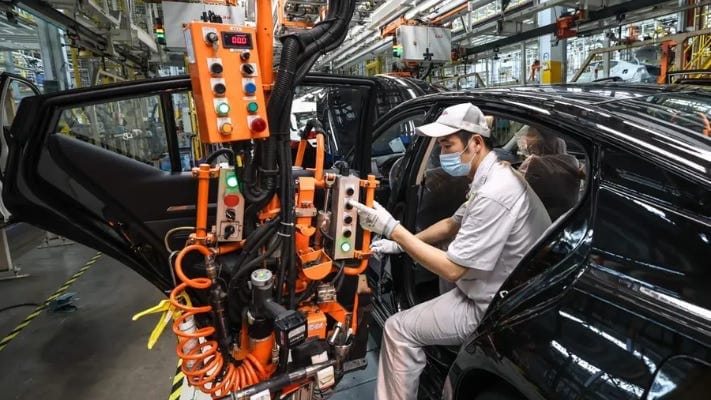
Image: Visual China Group/Getty Images
When Donald Trump slapped tariffs on Chinese goods, he imagined he was forcing Beijing to depend less on America. In fact, China had already spent two decades preparing for just that. Long before “de-risking” entered Western policy jargon, Beijing was building a wall of its own: an industrial system so vast and interconnected that no foreign power could easily shut it down. This in turn has made the Chinese economy less exposed to foreign pressure, and the world more reliant on it than ever before.
Self-reliance, or zìlì gēngshēng, has been a leitmotif of Communist rule since Mao. But under Hu Jintao, and still more under Xi Jinping, it became an explicit economic doctrine. Since the early 2000s China has sought to replace imported goods with home-made versions, from aircraft parts and electronics to antibiotics. The strategy has been expensive and, at times, inefficient. Yet it has worked. Western leverage over China’s supply chains has shrunk; Beijing’s over others has grown.
At first, the effort looked like a typical industrial policy drive. The “Indigenous Innovation” campaign of the 2000s promoted home-grown patents. “Made in China 2025” in the mid-2010s identified ten industries such as robotics and semiconductors, where China wanted to lead the world. More recently, the government has spoken of cultivating “high-quality productive forces”, a bureaucratic phrase meaning advanced manufacturing. State banks poured cheap loans into electric vehicles, solar panels and pharmaceuticals. Tariffs and fees made imported cars prohibitively expensive, forcing local firms to fill the gap. By the time Mr Xi began urging “self-reliance in science and technology”, the groundwork was already complete.
The fruits are visible across the economy. Two decades ago, China depended on foreign suppliers for most cars, telecoms gear and power equipment. Today it is self-sufficient in almost all. Of 500 major industrial products, China now ranks first in global output in more than 220. It is the world’s biggest exporter of electric vehicles, batteries and solar panels. Its factories churn out everything from the chemicals that make antibiotics to the magnets that power wind turbines. Even in fields where it still trails—such as the most advanced semiconductors—Chinese firms have learned to import, copy or, in some cases, smuggle what they need.
These successes have created new choke points. China controls nearly all global production of rare-earth metals, vital for electronics and defence. It dominates the basic ingredients used in most medicines. When Washington recently sought to penalise Beijing for restricting rare-earth exports, Chinese officials hinted that further limits could follow. Mr Trump soon softened his tariffs. As one adviser to Mr Xi put it, China’s industrial depth had become a “bulwark of economic security”.
That bulwark has also given China room to manoeuvre abroad. As American tariffs took effect, Chinese exporters simply found new customers. Sales to the United States have slumped—especially in phones, computers and furniture—but exports to Africa, South America and parts of Asia have boomed. Developing economies, eager for cheap cars and solar panels, are buying in record volumes, often running big trade deficits in return. Western analysts see overcapacity; Beijing sees influence. Even when margins are slim, a foothold in Lagos or Lima offers political as well as commercial value.
The latest five-year plan, adopted in October, shows no sign of retreat. It promises “extraordinary measures” to achieve breakthroughs in semiconductors, aerospace and advanced materials—language that implies emergency-style mobilisation of capital and labour. It also pledges tighter control of exports and mineral reserves in the name of national security. Economists inside and outside China have urged more social spending to encourage consumer demand. Mr Xi’s response is to argue that demand will grow only when industry becomes more “modern”. In his view, prosperity is built in the factory not the welfare office.
For America the implications are awkward. The United States still leads in designing high-end chips and building commercial aircraft, but its ability to weaponise trade has diminished. China’s suppliers now run from Hanoi to Harare. Tariffs once meant to isolate Beijing are rather accelerating the formation of two partially separate trading blocs: a Western one anchored by advanced technology, and a Chinese one powered by manufacturing scale.
Self-reliance has its costs. China’s industrial overcapacity is breeding tension with Europe, Japan and South Korea, where cheap Chinese exports are squeezing local firms. Its financial system carries the burden of endless state-directed lending. Yet the strategic logic is plain. By insulating itself from foreign supply shocks, China has reduced its exposure to sanctions, tariffs and embargoes. The wall it has built may not be beautiful, but it is proving remarkably hard to breach. ■