
IMAGE: GETTY IMAGES
ON A LIST of 139 nations ranked by their innovative prowess, Nepal sits at 107th in the latest Global Innovation Index by the World Intellectual Property Organization (WIPO). It performs slightly better than its income level would predict, but worse than nearly every regional neighbour. Its strongest area is credit for the poor. The country is a global champion in microfinance, topping the world table for loans from such institutions as a share of GDP. That has powered a ranking of 61st for “market sophistication”, a rare bright spot.
Yet the statistic is misleading. It reflects a credit system that supports small, everyday needs rather than a vibrant ecosystem for high-risk, high-reward innovation. Nepal’s strength in microfinance overshadows its weak research and development sector.
Also read: Why Nepal struggles to attract women in science
The data shows an economy struggling to lay the foundations for a knowledge-based future. Nepal’s worst performances are in human capital and research (127th) and business sophistication (124th). The country has no universities in global rankings. It registers zero spending by global corporate research and development investors. The pupil-teacher ratio in secondary schools is a dismal 33 to one. For all the talk of a digital leap, software spending is negligible and high-tech exports have collapsed, ranking 136th. The state fails to provide the stability innovators need: institutional quality ranks 113th. “We are good at providing small credit for small needs,” says an economist in Kathmandu. “We are not configured for the big bets that change economies.”
That weakness in inputs makes Nepal’s middling output performance (see chart)—101st, slightly better than its input rank—almost more troubling. It suggests a pathetic form of innovation. Outputs are driven by activities like mobile-app creation, where a globally connected individual can thrive despite local constraints, and a respectable flow of scientific publications. But these are isolated shoots. The country produces less innovation output relative to its innovation investment than the global average. It has no unicorn startups and globally recognised brands, and its high-tech manufacturing is minimal. The translation of effort into economic impact is inefficient.
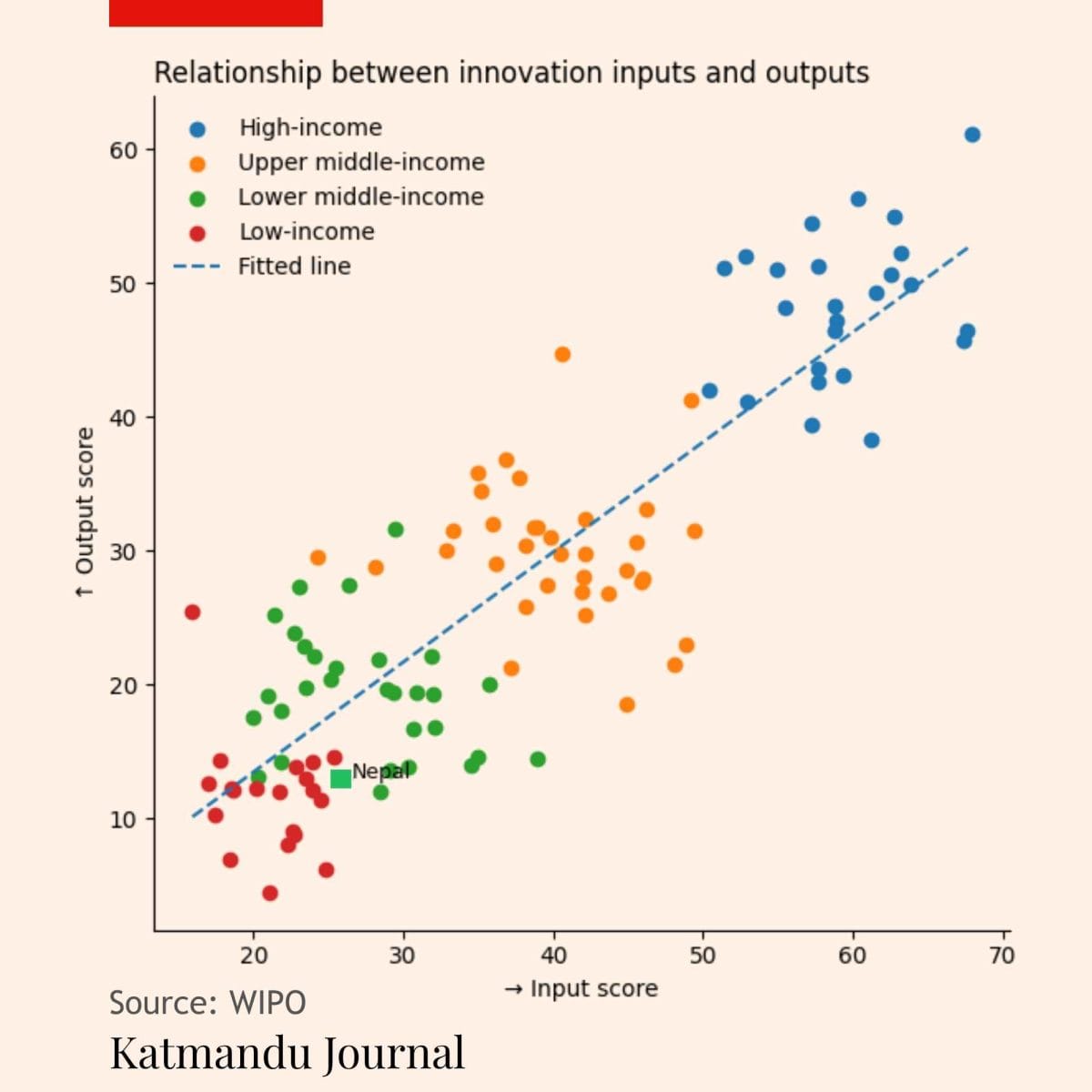
Regionally Nepal is isolated in its stagnation. Whereas it outperforms the lower-middle-income average in infrastructure and market sophistication, it lags far behind the innovation leaders of Central and Southern Asia, notably India. Its relative position—performing at expectation for its GDP per capita—is a backhanded compliment. It means the country is not punching below its weight, but also that its weight is desperately light. The economy is not falling behind its potential: its potential is hemmed in by big deficits in education and research.
The political economy of this stagnation is self-reinforcing. A vibrant microfinance sector meets immediate tangible needs and is politically popular. Building world-class universities as well as reforming sclerotic institutions and incentivising corporate R&D are long-term, politically arduous tasks with delayed rewards. The state’s capital formation is strong, at 24% of GDP, ranking 11th globally. But this seems to be building traditional infrastructure, rather than the human capital that would make it truly productive.
Nepal’s innovation profile is thus an example of partial development. The country excels at distributing small loans to the base of the economic pyramid, but it lacks the foundations needed for high-level innovation. Without a radical upgrade in education and a shift in business culture from trading to inventing, it will stay stuck in a low-innovation equilibrium, watching the technological revolution from afar. Its microfinance success shows capability. The challenge is to apply that zeal to a far harder task: growing the minds that will build its future. ■





